
A quantum week with two different scoreboards
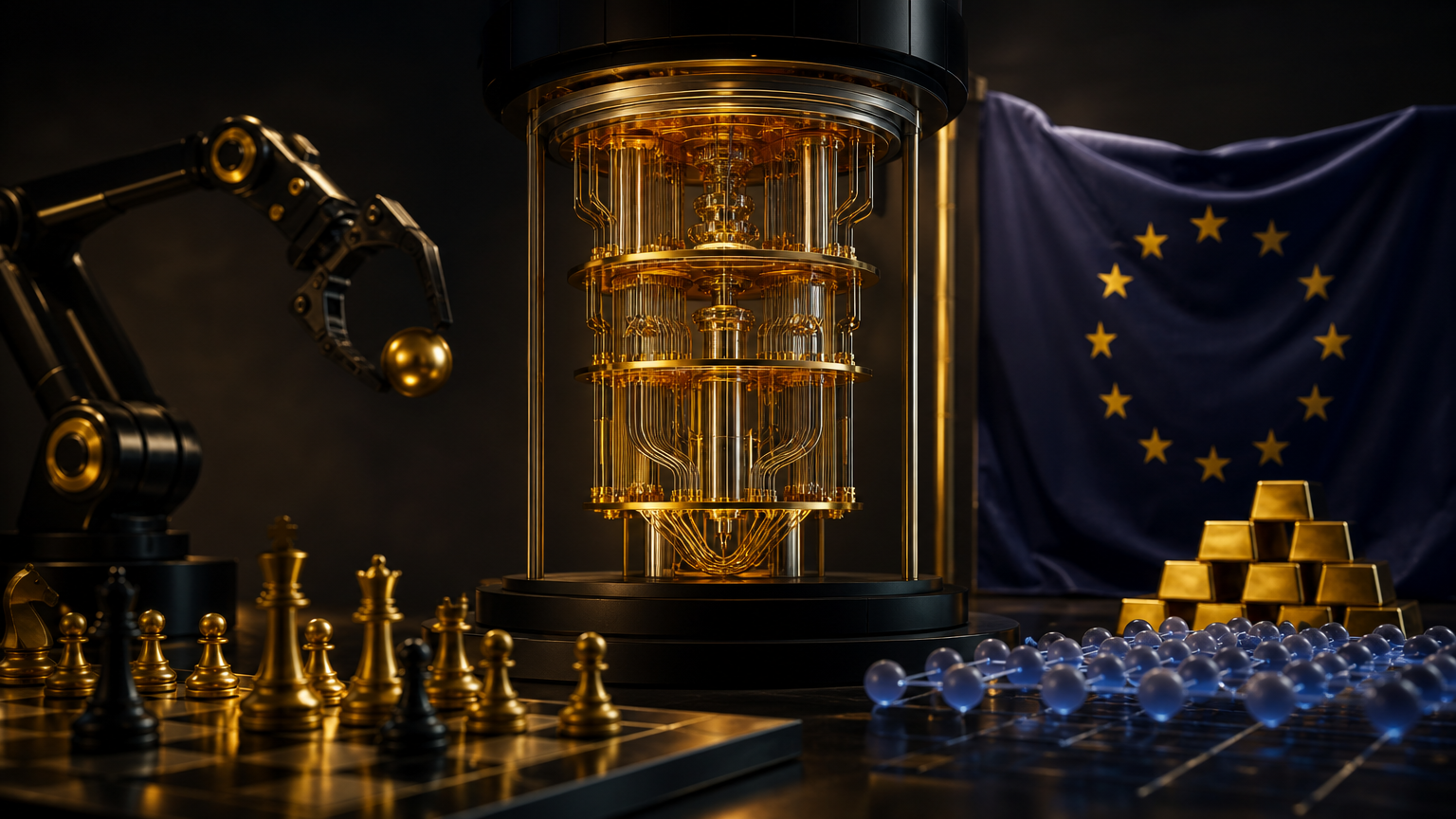
Google quantum lead meets €8.6B because two contests are now unfolding at once: one inside the lab, where researchers are trying to prove that quantum hardware can do something classical strategies cannot match, and one inside governments, where quantum capacity is being treated as strategic industrial infrastructure. Google Quantum AI said new work published in Science demonstrated contextuality at scale on its quantum processor, with qubits winning a coordination game 98.3% of the time against an 88.9% classical limit and with tasks spanning as many as 105 qubits . ForkLog, summarizing the same result, described Google’s Willow processor as outperforming classical strategies across specialized experimental tasks, while noting that this does not mean arbitrary quantum computation has arrived .
The timing matters. In the same 72-hour window, the European Union’s quantum strategy became more explicitly industrial: Brussels is preparing a Quantum Act that would favor EU-controlled suppliers, or companies from partner countries, in public quantum technology procurement . Dealroom reported that the EU has announced about €8.6 billion in public quantum funding, compared with €5.3 billion in the United States and €13.5 billion in China, while private funding still runs heavily in America’s favor . Meanwhile, Chinese institutions took the 2026 ACM Gordon Bell Prize for exascale work on a problem long used to motivate quantum advantage in chemistry .
The result is a sharper picture of the field. Quantum progress is no longer measured only by who has the most physical qubits. The more important questions are whether those qubits can sustain useful quantum behavior, whether logical qubits can be managed at scale, whether classical supercomputers can keep closing the gap, and whether governments can help domestic firms survive long enough to commercialize.
Google’s result: advantage, but in a carefully bounded sense
Google’s announcement is not a claim that a universal, fault-tolerant quantum computer is ready for customers. It is more precise than that. The company said it tested contextuality, a property of quantum systems in which measurement outcomes cannot be reduced to pre-existing values independent of the measurement context . In practical terms, contextuality is important because theorists have linked it to the resources that allow quantum algorithms to exceed classical limits .
The headline figure is easy to remember: in the Mermin–Peres magic square game, Google reported a 98.3% win rate, above the 88.9% limit for the best classical strategy . ForkLog added that the experiment used four qubits representing two entangled pairs and ran over more than 900,000 rounds . The point of the game is not that it solves a commercial problem, but that it creates a clean boundary between what classical coordination can do and what quantum correlations can do.
Google also expanded the tests. Its research post said the team ran hidden-linear-function instances on grids of up to 105 qubits, using a shallow-circuit structure whose success probability stayed above the conjectured classical bound even as noise reduced performance at the largest sizes . ForkLog reported that, at the 105-qubit scale, the probability of a correct answer fell to about 60%, illustrating both the quantum signal and the continuing drag from accumulated hardware errors .
That duality is the point. Google is strengthening its quantum-advantage case on specialized tasks, but the result also functions as a diagnostic. The company argues that contextuality experiments expose coherent errors that random-circuit benchmarks can average away, making them a more sensitive “ruler” for structured quantum algorithms . In other words, the benchmark is not just a trophy; it is a way to see where the machine still fails.
Infleqtion and the logical-qubit pivot
The second technical thread comes from Infleqtion, whose Sqale neutral-atom platform entangled 30 logical qubits using 80 physical qubits . In a November 20 blog post, Infleqtion’s Pranav Gokhale said the company arranged 80 atoms into ten blocks of eight, with each block encoding three logical qubits, then entangled all 30 logical qubits in one quantum state . The company also said its next commitment is 100 logical qubits by 2028 .
That result matters because it shifts attention from raw physical-qubit numbers to error-managed structures. A physical qubit is a fragile component; a logical qubit encodes information across multiple physical qubits so errors can be checked or suppressed . In neutral-atom systems, each qubit is an atom held and moved with laser light, which gives the architecture a different scaling logic from superconducting chips that require fabricated circuits for each qubit .
Infleqtion’s framing is explicitly competitive. The company said its approach benefits from atom uniformity, movable qubits and the ability to choose which pairs interact as arrays grow . It also said an AI-assisted search reduced a key cross-block operation from eight physical two-qubit gates to four, lowering the number of error opportunities in the 30-logical-qubit experiment .
This does not prove that neutral atoms have won the hardware race. It does show why the hardware debate is changing. The question is less “how many qubits can a company display?” and more “how many protected, programmable, connected logical qubits can it operate through meaningful circuit depth?” Google’s contextuality tests and Infleqtion’s logical-qubit milestone are different achievements, but they converge on the same theme: the next credible claims will need to connect quantum behavior, error control and useful computation.
Europe turns procurement into strategy
The EU’s €8.6 billion quantum push is the political counterpart to that technical shift. Dealroom reported that the Commission plans to present a Quantum Act that would require public authorities to buy quantum technology from EU-controlled companies or from companies in partner countries . The same report says the Act would create a European quantum platform for shared access to infrastructure and a network of innovation hubs to help start-ups test and commercialize products .
The policy logic is familiar but urgent. Europe has strong quantum research and a large share of the world’s quantum companies, but it has struggled to turn scientific depth into dominant technology companies . Dealroom reported Commission estimates that about a third of global quantum companies are based in the EU, compared with roughly a quarter in the United States and 5% in China, while the United States and China hold more quantum patents . The private-capital gap is especially stark: U.S. quantum start-ups drew roughly €7 billion, compared with €1.1 billion in the EU .
A procurement preference would make the state an anchor customer. That could matter in quantum because early systems will be expensive, specialized and tightly linked to national-security, scientific and industrial users. If governments buy from domestic suppliers, they can help companies move from prototypes to repeatable products. But the risk is that public preference alone cannot compensate for fragmented capital markets, slow contracting or weak commercialization discipline.
China’s Gordon Bell win complicates the quantum narrative
China’s Gordon Bell Prize adds a useful caution. The Quantum Insider reported that a 10-member team from Chinese institutions won the 2026 ACM Gordon Bell Prize for “Closing the FeMo-Cofactor ‘Quantum-Advantage’ Gap with Exascale Supercomputers” . The team modeled the iron-molybdenum cofactor involved in nitrogen fixation and achieved sustained performance of 1.456 exaflops in double precision across 20,480 LineShine nodes, according to the report .
That is not a quantum-computer victory; it is a classical supercomputing victory. But it directly affects the quantum story because quantum advantage is always measured against the best known classical strategy. If exascale classical teams keep improving algorithms, software and hardware utilization, the bar for useful quantum advantage rises. Google’s latest result is impressive precisely because it is framed against known classical limits, but the Gordon Bell result shows that those limits are not static across all problem classes .
The real race: useful logical qubits
Taken together, the week’s news points to a more mature phase. Google is testing whether quantum resources survive at larger scale and can beat classical limits in well-defined settings . Infleqtion is arguing that neutral atoms can deliver logical-qubit density and a path toward 100 logical qubits . Europe is trying to use public money and procurement to keep domestic suppliers in the game . Chinese researchers are showing that classical exascale computing remains a formidable moving target .
The hype version says quantum computing is arriving. The sober version is better: quantum computing is becoming a systems race. Hardware, error correction, software compilation, public capital, procurement rules, talent pipelines and classical supercomputing all now interact. No single result means general-purpose quantum machines are here. But the center of gravity has moved. The field is no longer impressed by physical-qubit totals alone. It wants logical qubits that can be controlled, benchmarked and eventually made useful.
Comments
Be the first to comment.