
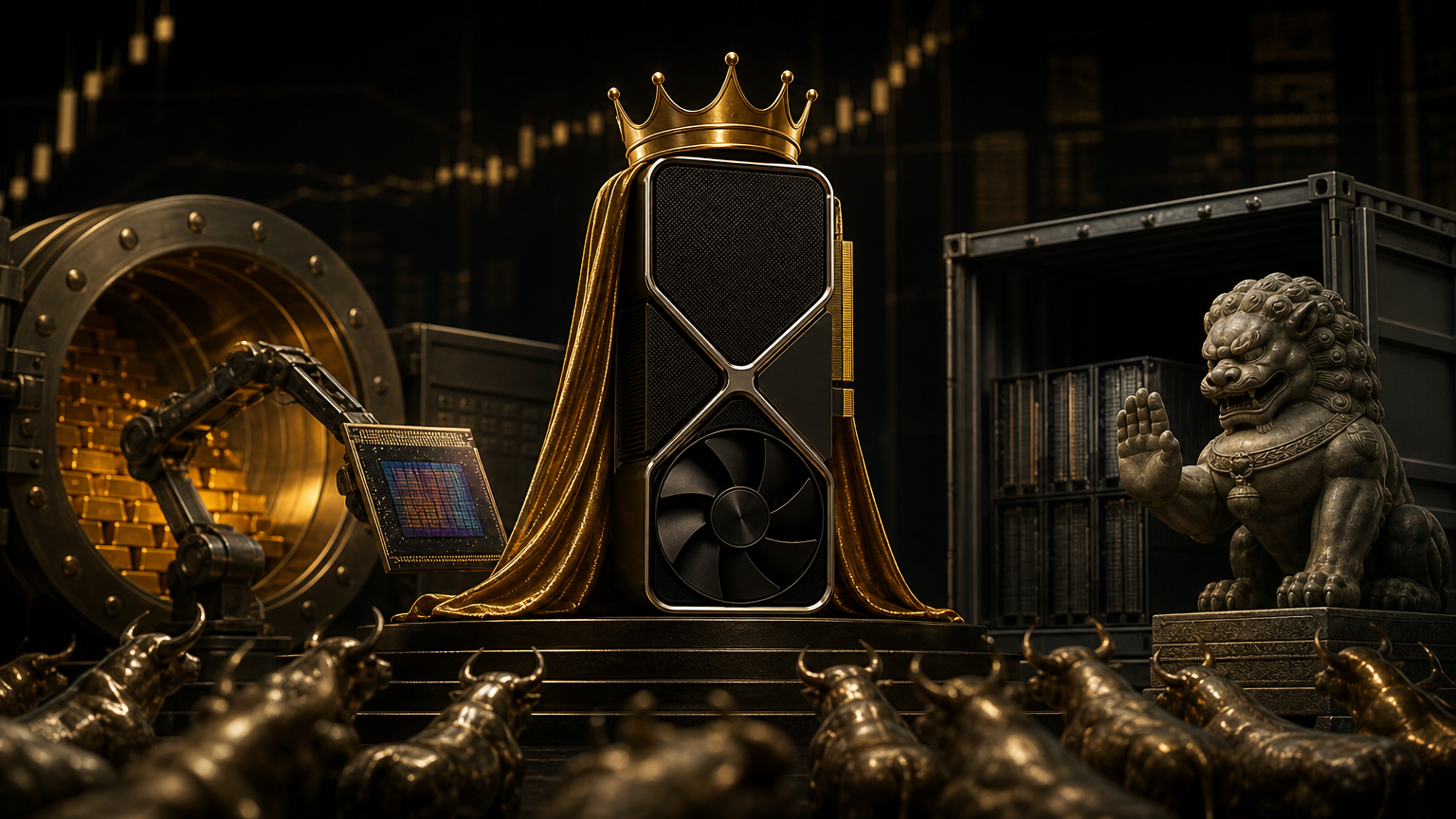
The scoreboard finally arrived
Nvidia’s latest quarter gives the AI infrastructure boom a hard number: $115.8 billion in fiscal third-quarter revenue, up 103% year over year, with data center revenue alone reaching $107.6 billion . For a market that has spent two years arguing about whether hyperscaler capital expenditure would become useful computing capacity or financial overreach, this is the clearest scoreboard yet. The quarter says that at least one part of the AI chain has already converted promises into cash: the supplier of the accelerators, networking, systems and software that make the buildout possible.
The quality of that revenue matters as much as the size. Nvidia’s data center business is now the company’s center of gravity, and the quarter was strong enough that analysts framed it as proof that demand remains broad even under pressure from leadership turmoil, export questions and market anxiety about circular financing . In other words, the AI trade is no longer being judged only by narratives about future intelligence or productivity. It is being judged by utilization, customer commitments, gross margins, and whether the enormous physical buildout can keep turning into operating results.
That is why the “above $100 billion” milestone is more than a headline. It shifts the debate from “will AI companies spend?” to “who captures the spend, and for how long?” Nvidia is capturing it now. But the week’s other developments show that the walls around advanced compute are rising at the same time the revenue curve is steepening.
China revenue becomes a smaller, riskier line item
The sharpest signal came from Nvidia’s own earnings materials. The company said third-quarter sales of licensed Hopper data center products to China were $2.4 billion, but also said its guidance includes no licensed Hopper data center products and that it is no longer shipping those products to China . That turns what looked like a negotiated export channel into a stranded, uncertain business line.
The Hopper family includes chips such as the H200, powerful enough to matter for frontier AI training and inference but positioned below Nvidia’s newest Blackwell and Rubin platforms. Washington had allowed some sales under license, but Nvidia’s latest statement effectively tells investors not to count on that route in the next quarter . For a company with $115.8 billion in quarterly revenue, $2.4 billion is not existential. Strategically, however, it is revealing: the company can still grow without near-term China data center shipments, but it must do so while absorbing heavier compliance, political and reputational risk.
That is exactly the point investors are now pricing. China demand has not disappeared; access to Nvidia-class compute is being redirected, denied or forced into harder-to-monitor channels. If the company’s record quarter proves demand is real, its China posture proves demand is no longer enough. Location, customer identity, ownership, routing and end use now matter almost as much as the chip itself.
The firewall now covers the cloud
The U.S. Bureau of Industry and Security moved to close another route: remote access. Its interim final rule, effective November 19, creates new restrictions on exports, reexports and in-country transfers to overseas data centers that remotely supply significant compute to companies headquartered in Country Group D:5 or Macau . The rule also adds license requirements for advanced semiconductors going to Indonesia, Malaysia, Singapore, Thailand and Brazil, while formally rescinding the Biden-era AI Diffusion Rule .
This is a major conceptual shift. Export controls used to focus mainly on boxes crossing borders: chips, servers, tools and components. The new framework treats compute delivered through a foreign data center as a controlled pathway when the beneficiary is in a country of concern . That means a Chinese AI lab does not necessarily need to import a restricted GPU to be affected; renting capacity abroad can now trigger the same strategic concern.
Chinese technology companies are already bracing for the impact. Alibaba said it was assessing how the new U.S. rules could affect some global data center expansion plans, while Tencent’s president said the remote-compute rule sets everyone in China back by reducing access to advanced compute . The Associated Press also reported that Nvidia is no longer shipping chips including the H200 to China, reflecting a tougher stance after Washington’s scrutiny intensified .
This is why Nvidia’s quarter is such a useful benchmark. The company is showing that global AI demand is still powerful enough to fill a massive order book. At the same time, regulators are narrowing who can use the most advanced compute, where it can be hosted and how access must be documented.
TSMC closes another manufacturing door
The same week, the controls pushed deeper into the foundry layer. TSMC is reportedly tightening restrictions on Chinese chip designers, suspending some previously permitted advanced manufacturing orders and limiting affected customers to older process technologies . According to the report, affected orders using 16-nanometer processes and below must be halted unless customers obtain U.S. export licenses, while many Chinese designers would be steered toward older 28-nanometer and 40-nanometer processes if their designs avoid high-bandwidth memory or advanced packaging .
That matters because the AI race is not only about finished GPUs. It is also about whether Chinese firms can design alternatives and have them manufactured at cutting-edge nodes. If TSMC cannot process certain advanced Chinese designs without U.S. license coverage, then the constraint moves upstream from Nvidia’s finished chips to the fabrication path itself . The result is a tighter choke point: China can lose access both to Nvidia accelerators and to the manufacturing services needed to build credible substitutes.
TSMC said it is aware of and will comply with applicable BIS regulations, while declining to comment on market rumors . Even that cautious response tells the story. The foundry is no longer just a neutral production partner in the AI boom; it is part of the enforcement perimeter.
Enforcement enters the corporate file
California’s attorney general added a domestic enforcement dimension by serving an investigative subpoena on Nvidia on November 19 . The California Department of Justice said it is asking whether Nvidia’s advanced chips or confidential information may have gone to China and whether Nvidia misled investors or the public . The subpoena does not establish wrongdoing, but it broadens the story from export licensing into securities disclosure and corporate governance.
That matters for shareholders because export risk is no longer merely a policy variable. It can become a disclosure risk, a board oversight risk and a legal risk. Treasury Secretary Scott Bessent said on November 20 that no further restrictions on older Nvidia chips to China were needed after the administration’s remote-access move, and Nvidia said the limited H200 program shipments it made were legal and authorized by BIS . But the same AP report noted that earlier in the week Nvidia said it was no longer shipping H200 chips to China, despite prior approvals .
The message is not that every rule has become a ban. It is that every path to advanced compute is now conditional. Licenses can exist, shipments can stop, remote access can be curtailed, and state investigators can still ask what investors were told.
Andhra Pradesh plays the subsidy game
While the U.S. and its allies tighten access, governments elsewhere are competing to host more of the supply chain. Andhra Pradesh has amended its Semiconductor and Display Fab Policy 4.0 to offer combined capital support of up to 80% of eligible project costs for silicon fabs, with 40% central support and a 40% state match . The state also plans a 5,000-acre semiconductor park in Tirupati and offers 70% support for compound, photonics, sensor and display fabs, as well as advanced packaging .
The timing is not accidental. As export controls fragment supply chains, jurisdictions that can offer land, power, water, talent and subsidies are trying to turn geopolitical anxiety into industrial policy. Andhra Pradesh’s package is unusually aggressive, but the hard part comes after the headline. Fabs need reliable utilities, supplier ecosystems, process engineers, logistics, environmental clearances and long customer qualification cycles. Subsidies can reduce capital cost; they cannot instantly create a semiconductor cluster.
A boom with borders
Nvidia’s record quarter and the expanding control regime are not contradictory. They are the same story. AI demand is strong enough to push one company above $100 billion in quarterly revenue, but the compute behind that demand has become a strategic asset that governments will not leave to ordinary market flows.
The result is a new operating reality for the AI infrastructure chain. Nvidia is the revenue benchmark. TSMC is a manufacturing gatekeeper. BIS is extending controls from chips to cloud-style access. California is testing whether export exposure was properly disclosed. Andhra Pradesh is betting that subsidies can attract a piece of a supply chain being rebuilt for political resilience.
The GPU gold rush has shipped its quarterly scoreboard. Now the scoreboard sits behind a firewall that checks both packets and pallets.
Comments
Be the first to comment.