
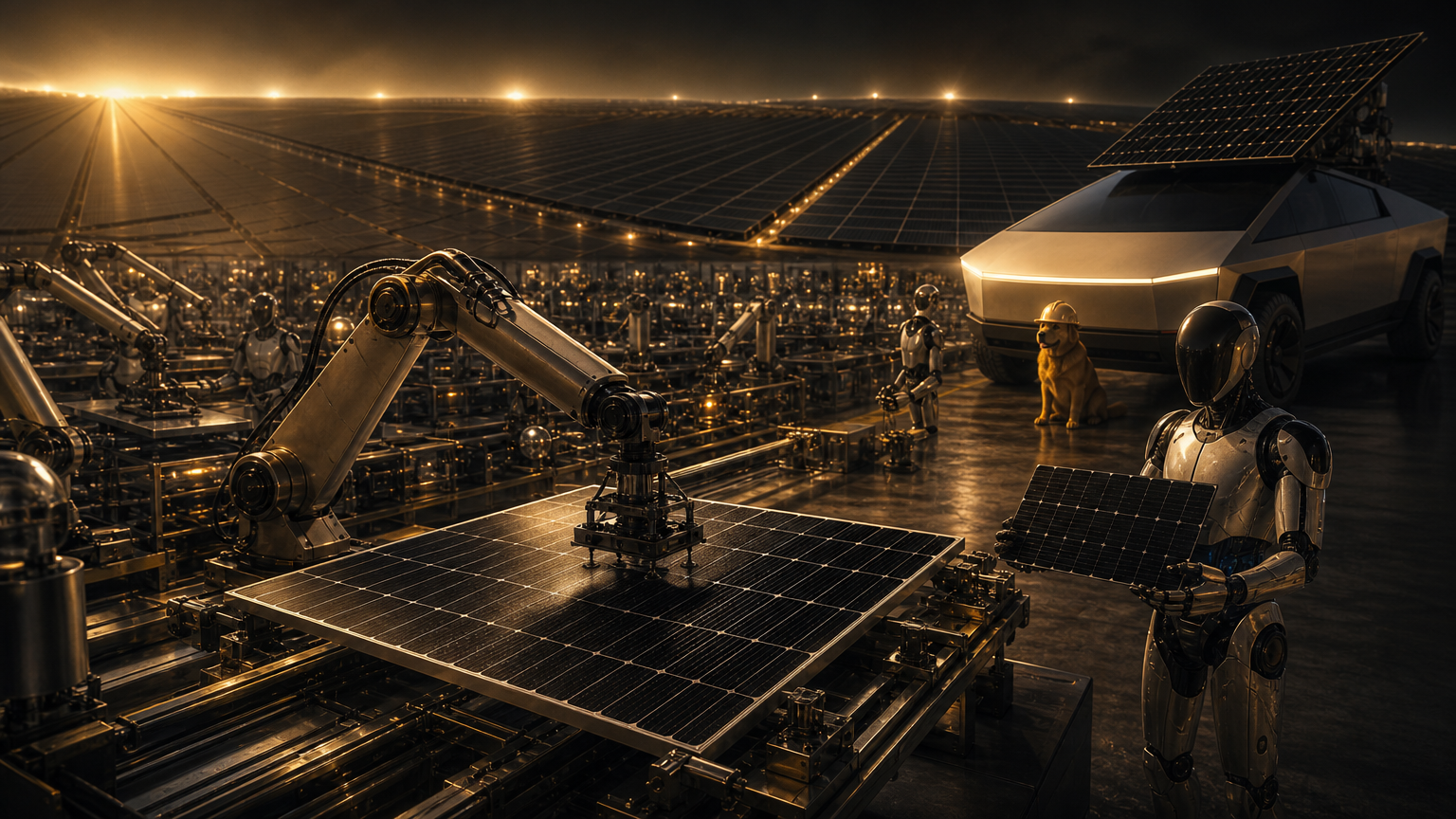
The headline still points to Fort Bend County
The working headline is the same story: Elon Musk's World's First 1000GW Solar Factory Shocked the Energy Industry. The project at the center is Tesla’s proposed Project Crystal Sun, the roughly $10.1 billion solar-cell and module manufacturing complex planned for Fort Bend County, near Houston. Fresh reporting in the 72-hour window did not add a new final investment decision for the Fort Bend site, but it did sharpen the picture around Tesla’s wider solar-manufacturing strategy: the company is now also seeking incentives for a $3.1 billion solar-grade polysilicon refinery near Robstown in Nueces County .
That matters because solar factories are not just buildings with panel lines. A serious domestic solar platform needs purified silicon, ingots, wafers, cells, modules, energy infrastructure, workforce planning and a tax structure that makes multi-billion-dollar manufacturing viable. In the latest filings described by local and industry media, Tesla frames the Robstown refinery as an upstream piece of a vertically integrated domestic solar manufacturing platform . In plain language, the newly reported refinery proposal is the feedstock side of the same story that made Project Crystal Sun so disruptive.
What changed in the last 72 hours
The new development is not that Tesla has announced a finished “1000GW” production line. It has not. The new development is that Tesla is seeking a Texas school-property-tax incentive for a proposed $3.1 billion polysilicon plant in the Tuloso-Midway Independent School District, with the material intended for solar manufacturing . KRIS 6 reported that the plant would make polysilicon, the main material used in solar cells, and that Tesla says it would employ 515 workers by 2032 .
The proposal is conditional. Tesla’s application says that without the tax break, the company “would not make the proposed investment in this state,” according to KRIS 6’s report on the filing . Tuloso-Midway ISD Superintendent Steve VanMatre also cautioned that the investment is “not a guarantee,” and the local school board had not approved a tax break at the time of the report . That caution is important for readers tracking Project Crystal Sun: Tesla’s Texas solar map is advancing through incentive applications, not through a single simple “factory is guaranteed” switch.
Why polysilicon is the key to Crystal Sun
Project Crystal Sun is described in recent reporting as Tesla’s separate $10.1 billion solar-cell and module factory in Fort Bend County, with prior application details listing 9,712 permanent jobs, a roughly 3,050-acre site near Richmond and commercial production targeted for the first quarter of 2029 . The newly reported Robstown plant would sit upstream from that. Hoodline summarized the relationship clearly: Crystal Sun would focus on cells and assembled panels, while the Nueces County refinery would produce the raw material that feeds that kind of manufacturing .
This is why the Robstown news belongs inside the Crystal Sun story rather than beside it. If Tesla wants to control the chain from purified silicon to finished solar modules, it cannot rely only on an assembly campus. It needs material independence. pv magazine reported that Tesla describes the Robstown plant as “under consideration for development” and as the “upstream component” of its vertically integrated domestic solar manufacturing platform . Manufacturing Dive similarly reported that the facility would serve as the upstream component of Tesla’s domestic solar manufacturing platform and would support production of high-efficiency N-type solar cells .
A factory story, but also a tax story
The Fort Bend project already made headlines because of its size: approximately $10.1 billion, thousands of acres and nearly 10,000 permanent jobs in the plan. But the current news shows that Tesla’s solar push is also a negotiation with Texas tax law. The Robstown proposal is being pursued under the state’s Jobs, Energy, Technology and Innovation program, commonly called JETI, which can limit school-district maintenance-and-operations taxable value for qualifying large projects .
Under Tesla’s Robstown proposal, KRIS 6 reported that the buildings and equipment would pay no day-to-day school operating tax from 2028 to 2030, pay on half their value from 2031 to 2040 and pay full taxes starting in 2041 . Even with that break, Tesla’s numbers show the district would collect about $222 million in taxes from the plant from 2028 through 2065 . For Texas officials, the pitch is jobs and long-term tax base. For Tesla, the argument is cost competitiveness against other jurisdictions and overseas supply chains.
Manufacturing Dive reported that Tesla plans construction from 2027 to 2030 for the Robstown refinery and expects 515 employees at an average salary of $130,000 once the facility is fully operational in 2032 . That timeline would place Robstown’s startup after the expected buildout window for Project Crystal Sun, but close enough to support a broader solar supply chain if both projects proceed.
The “1000GW” claim needs a careful reading
The title’s “1000GW” language captures the shock value surrounding Musk’s solar ambitions. However, the fresh sources reviewed in this 72-hour window do not show a newly verified nameplate output of 1000 gigawatts for Project Crystal Sun or for Robstown. In fact, Manufacturing Dive reported that Tesla did not disclose annual polysilicon output for the proposed Robstown facility . TeslAnt’s analysis of the same filing also noted that the refinery filing gives no output capacity in tonnes or gigawatts of cells .
That does not make the story small. It makes it more industrially serious. The real signal is not one headline number alone; it is the possible construction of a U.S.-based solar chain: polysilicon near Corpus Christi, solar-cell and module production near Houston, and a Texas manufacturing footprint that already includes Tesla’s battery, vehicle and energy businesses. Construction Review Online described the Robstown proposal as part of Tesla’s broader ambition to expand solar manufacturing in the United States and noted that Tesla has separately pursued the $10.1 billion solar manufacturing facility near Houston .
Why the energy industry is watching
The energy industry is watching for three reasons. First, Tesla is trying to move upstream at a time when solar supply chains remain strategically sensitive. KRIS 6 reported that Tesla says more than 90% of the world’s solar-grade polysilicon is made in China . A U.S. polysilicon plant would not by itself replace global supply, but it would give Tesla a domestic source for one of the most important materials in crystalline solar manufacturing.
Second, Project Crystal Sun would be far more than a panel-assembly warehouse if paired with upstream material supply. The Fort Bend facility has been reported as a solar-cell and module project; Robstown would add a raw-material base. That combination suggests Tesla is thinking less like a rooftop installer and more like a vertically integrated energy manufacturer.
Third, the timing overlaps with Tesla’s broader corporate identity shift. The company is still known to the public primarily as an EV maker, but solar and storage increasingly define its infrastructure story. If Crystal Sun proceeds, it would make Tesla’s energy division look less like a side business and more like a manufacturing pillar built for grid-scale demand.
What to watch next
The next milestones are procedural, not theatrical. For Robstown, the Texas Comptroller must review the application, and both the school board and the Governor’s Office must approve any deal . For Fort Bend County, the critical question remains whether Tesla converts the Project Crystal Sun incentive pathway into a final construction and production commitment. Recent coverage says Crystal Sun has advanced further than the Robstown refinery, including prior county incentive approvals, but still emphasizes that Tesla had not committed unconditionally to build .
So the most accurate current reading is this: Project Crystal Sun remains the core $10.1 billion solar-factory story, and the new 72-hour development is Tesla’s move to secure the upstream polysilicon supply that could make that factory more than a headline. The energy industry is shocked not because every number is final, but because Tesla appears to be sketching a domestic solar stack from raw material to finished panel.
Comments
Be the first to comment.