
A rollout that feels bigger than a point release
Before writing this piece, the working headline was checked against the subject: “How The FK? Tesla FSD v15 Is A Stunning Moment.”** That is the right frame, because the story is not simply that Tesla pushed another software build. It is that v15 appears to repackage the FSD experience around a new visual language, a new neural-network stack, and a new safety claim that is already being debated as aggressively as it is being shared.
Tesla began rolling out Full Self-Driving Supervised v15 to a first group of customers on November 21, 2026, with reports describing it as an early wave rather than a fleetwide release . TeslaNorth reported that Tesla AI software chief Ashok Elluswamy confirmed the first wave, while Tesla had not publicly detailed how many cars, which regions, or which owners were first in line . Teslarati similarly described the initial deployment as reaching Early Access Program members, after Elon Musk said a wider release was expected in December .
That distinction matters. The stunning part is real; the availability is still limited. Tesla is not saying that every eligible owner woke up with v15. It is saying the v15 era has started.
Reality View is the “how the f**k?” moment
The interface is what makes this release feel different at first glance. Tesla calls the new system Reality View, a live visualization designed to show what FSD is planning to do rather than merely rendering surrounding vehicles and lane markings . TeslaNorth describes it as an overhead-like driving view that shows the car’s surroundings and intended path, with options for full-screen visualization, map, split view, or a quieter layout .
This is not a small cosmetic update. According to the fresh reporting, Reality View replaces separate model signals with a single end-to-end visualization that Tesla says uses less compute . The driver sees upcoming turns and path intent in the driving view itself, and release-note coverage says even the turn-signal audio has been softened so that it fades after the first few clicks .
That matters because FSD’s weakest public problem has never been only whether the car can drive. It has also been whether the human supervisor understands what the system thinks it is about to do. A black-box assistant creates tension. A system that visibly previews its plan can reduce that tension, even if it does not eliminate the need to supervise.
The 25-fold claim is huge, but not self-proving
The second reason v15 is exploding online is Tesla’s safety claim. Tesla’s rollout material says v15 brings “25x better handling of safety critical cases,” and fresh reports tie that claim to an upgraded vision encoder shared across FSD, Robotaxi, and Optimus . TeslaNorth’s release-note coverage says that encoder was trained on millions of internet videos and that Tesla claims a 25-fold improvement in its rate of critical interventions .
CarSauce adds the crucial caveat: Tesla has disclosed the multiplier, not the underlying intervention rate or the full method behind the measurement . That means “25x better handling” should not be casually translated into “25 times fewer crashes” or “25 times safer than humans.” It is a company metric about critical intervention behavior, and the baseline is not fully visible from the public rollout material .
This is where the “nine times safer than human driving” conversation needs discipline. The broad social-media reaction has mixed Tesla’s new v15 claim with older or separate safety comparisons, but the fresh, documented v15 figure now on the table is the 25-fold handling claim for safety-critical cases . The more responsible conclusion is stronger and narrower: if Tesla’s measurement holds up in real-world owner use, v15 could represent a major step in reducing scary takeover moments. But Tesla has not published enough data in this rollout to let outsiders independently verify the full safety story .
A new brain for more than cars
The technical core of v15 is the upgraded vision encoder. Fresh release-note coverage says Tesla describes it as shared between FSD, Robotaxi, and Optimus, which is exactly why this update feels strategically bigger than one car feature . In Tesla’s worldview, the same visual intelligence that interprets a road scene for a Model Y could also help power robotaxis and humanoid robots.
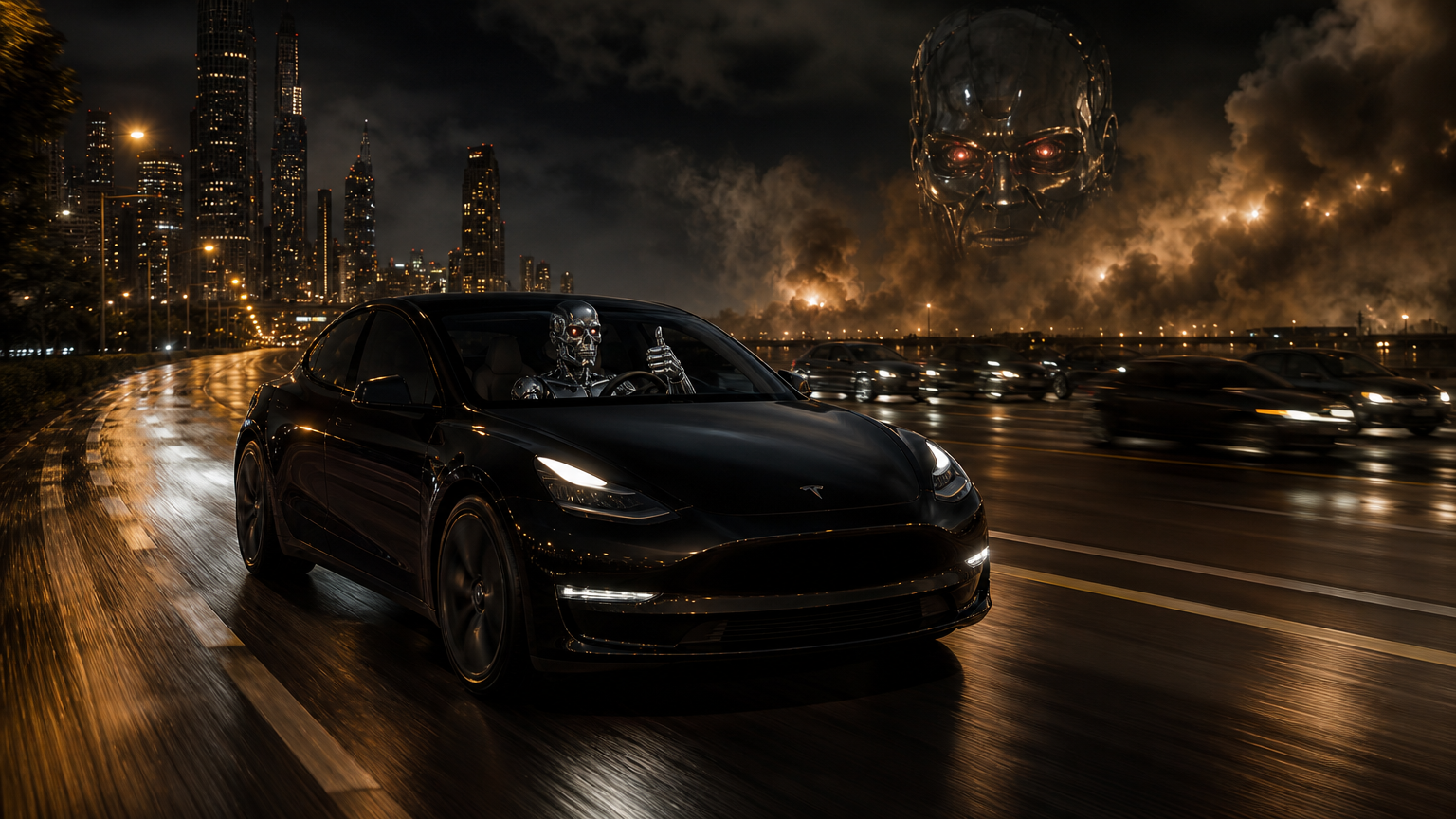
That is the Skynet-flavored joke hiding inside the headline, but the serious point is architecture. Tesla is trying to build one scalable perception-and-action stack, not a collection of isolated features. If the same encoder can generalize across customer cars, robotaxi operations, and Optimus environments, the company gets more leverage from every training improvement.
Still, leverage is not proof. The public will judge v15 by ordinary driving: unprotected lefts, awkward merges, school zones, construction debris, potholes, parked cars, impatient humans, and rain. Tesla says v15 improves detection of signs, small animals, debris, chains, potholes, and deep standing water . It also says speed choices should better account for driver profile, posted limits, school zones, and bad weather . Those are exactly the everyday situations where FSD users tend to form trust or lose it.
Navigation, parking, speed cameras, and bike racks
Beyond the headline interface and safety claim, v15 adds practical changes that show Tesla is attacking edge cases around the beginning and end of trips. TeslaNorth reports that navigation at the start and end of a trip now learns from fleet route preferences, with broader full-route learning planned for later v15 releases . Release-note coverage also says the car can use parking history at destinations and show multiple parking options on the map .
There are smaller but telling additions too. FSD can slow down when it detects a speed camera, and the driver can override that behavior by pressing the accelerator or selecting a higher speed profile . Bike Rack Mode allows FSD use with a bike rack or similar hitch accessory, but changes arrival behavior by pulling over near the destination without reversing and disabling Autopark and Summon .
These are not sci-fi features. They are the annoying real-world details that make autonomy hard. A self-driving system does not just need to steer through a lane. It needs to understand how people actually arrive, park, avoid hazards, and configure their vehicles.
Wide release is still a December promise
Elon Musk said on November 21 that FSD v15 would go to wide release “next month,” putting the target in December 2026 . TeslaNorth noted that Musk did not provide an exact date, region list, or hardware eligibility list for that wider rollout . CarSauce likewise reported that the first rollout began on November 21 U.S. time but that Tesla had not identified which vehicles or regions were receiving it first .
So the current state is clear: v15 has started, but the mass moment is still pending. If December brings a true wide release, then this weekend’s early builds will be remembered as the opening shot. If the rollout slows, fragments by hardware, or reveals regressions, the “stunning moment” will become another chapter in Tesla’s long cycle of big promises and uneven delivery.
The bottom line
FSD v15 is stunning because it changes the emotional interface between driver and machine. Reality View makes Tesla’s driving AI feel less invisible and more legible. The 25-fold critical-intervention claim, if borne out, would be a serious leap. The shared encoder hints at a larger Tesla AI strategy across cars, robotaxis, and Optimus.
But the “Supervised” label remains the guardrail. Drivers still must pay attention and be ready to take over . V15 may be a major milestone toward advanced autonomous driving, but it is not a public declaration that privately owned Teslas are now unsupervised robotaxis.
That is the honest read: a spectacular visual and technical upgrade, wrapped in a safety claim that demands real-world validation. Or, to put it in the spirit of the headline: yes, this looks like a “how the f**k?” moment. Now Tesla has to prove it at scale.
Comments
Be the first to comment.