
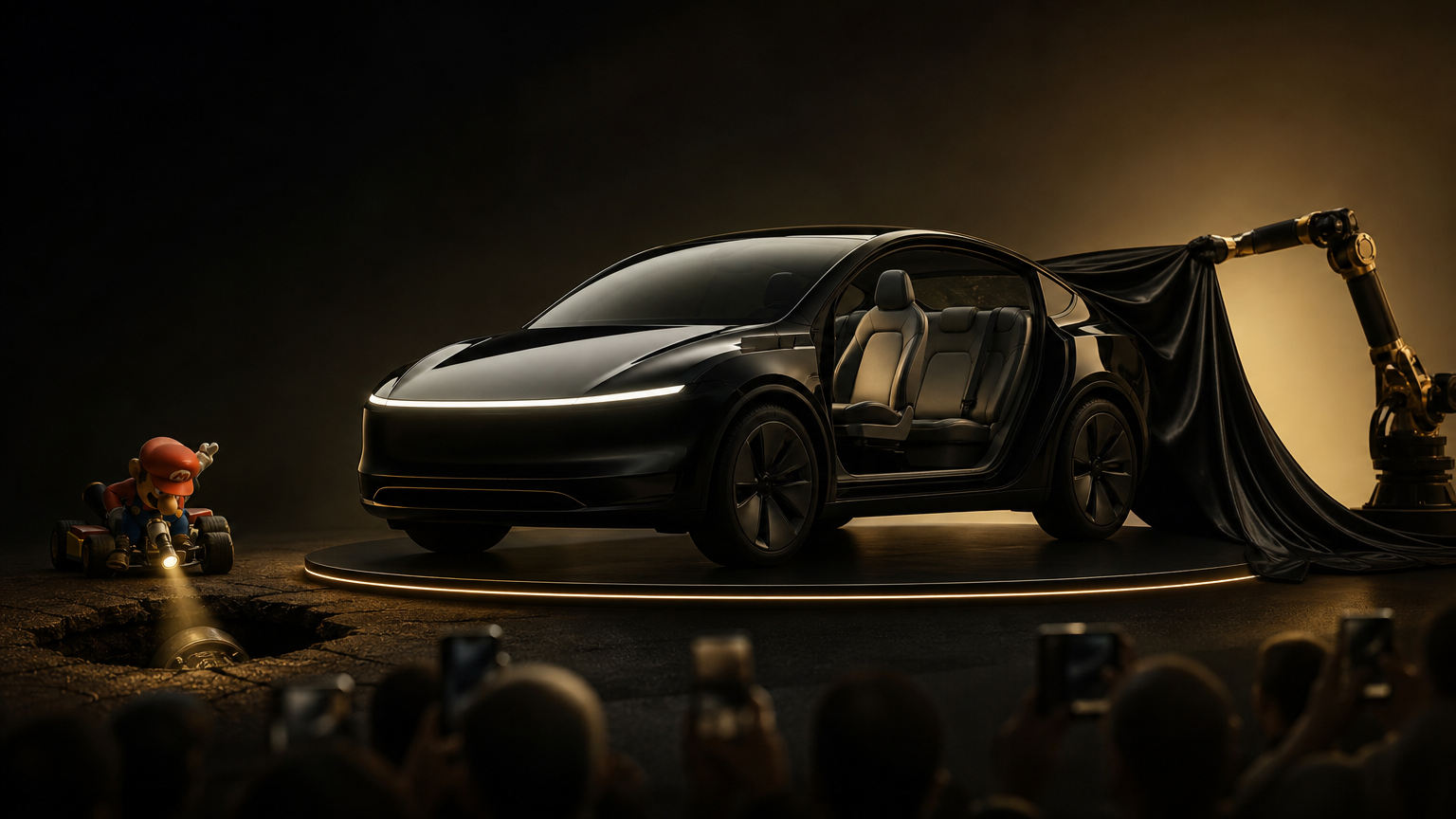
The headline is software, but the story is hardware
Tesla’s Full Self-Driving v15 began rolling out on November 21, with release notes aimed less at spectacle than at the awkward everyday cases that make or break autonomy: missed signs, potholes, standing water, school-zone speeds and the way the car explains its own intentions to the person supervising it . On paper, that makes v15 a reliability release. In context, it is something heavier: a software bridge toward a Model Y variant that Elon Musk says would not have steering wheels or pedals .
That pairing matters. A supervised driver-assistance update can be imperfect and still be useful, because a human remains the fallback. A vehicle with no steering wheel changes the contract. It asks regulators, insurers, passengers and Tesla itself to accept that the software, sensors, compute stack and remote support model are good enough when there is no ordinary driver intervention left.
What v15 is trying to fix
The v15 notes read like a checklist of Tesla FSD’s most visible weak spots. Tesla says the update improves detection of road signs, small animals, road debris, chains, potholes, road details and deep standing water . It also targets speed behavior in school zones, at posted limits, across driver profiles and in bad weather . These are not glamorous items, but they are the kinds of conditions that turn a demo into a transportation product.
Tesla also claims “25x better handling of safety critical cases,” tied to an upgraded vision encoder shared across FSD, Robotaxi and Optimus . That number is attention-grabbing, but the public record around it remains incomplete. Tesla has not published the baseline rate, the measurement method, the route mix or the definition of a safety-critical case, so the figure should be treated as Tesla’s internal claim rather than an independently validated safety result .
That distinction is essential. If the baseline is recent and the denominator is large, a 25-fold improvement could be a major engineering step. If the baseline is older, narrow or measured under favorable conditions, the practical improvement may be more modest. Either way, the focus on signs, potholes and school zones is the right one because these are precisely the “small” problems that accumulate into distrust.
Reality View is more than a pretty screen
The most visible new feature is Reality View, a live visualization that Tesla says lets the driver see and control what FSD is planning to do . Reports describe a real-time, virtual-camera view from above the car, with display modes that can show the planned path, upcoming turns and a quieter layout . Elon Musk’s description turned it into a pop-culture moment by comparing the effect to a video game-style view, but the interface has a practical purpose .
Autonomy systems do not only need to drive well; they need to communicate intent. When a car hesitates near a pothole, drifts toward a turn lane, slows in a school zone or chooses a parking spot, the human supervisor wants to know whether the behavior is intentional or a mistake. A clearer visualization can reduce unnecessary takeovers if it makes the system’s plan legible. It can also increase trust too quickly if the graphics look more certain than the underlying decision-making actually is.
That is the editorial caution around v15. Better visualization is useful, but it is not the same as better driving. Tesla’s release combines both claims, and owners will naturally judge them together. If the car still misreads a sign while drawing a beautiful overhead scene, the interface becomes theater. If the improved perception and the visualization reinforce each other, v15 could feel like a real maturity step.
The December bridge
Tesla’s first v15 push is an initial rollout, not yet the broad public moment. TeslaNorth reported that the early group is separate from the wider release Musk said to expect in December . That framing helps reconcile two timelines that otherwise looked contradictory: v15 can start now, while the broader Holiday Update release still lands next month.
A staged rollout is normal for a high-risk driving update. Tesla can watch telemetry, interventions, complaints and edge-case reports before widening availability. The narrow start also gives the company a chance to discover whether the same changes that improve one problem create another. FSD history has repeatedly shown that autonomy does not improve in a clean straight line; regressions can appear in areas that were previously stable .
For owners, the practical question is not whether v15 is impressive on launch day. It is whether the update reduces the number of moments when the driver’s hand hovers near the wheel. For Tesla’s future hardware plan, the question is sharper: can the same software family eventually support a vehicle where that wheel does not exist?
Musk’s wheel-free Model Y raises the stakes
At the New York Times DealBook Summit, Musk said Tesla plans an autonomous version of the Model Y without steering wheels or pedals, aimed at carrying groups of six or seven people . He framed it as the larger companion to the two-seat Cybercab: the small vehicle covers most passenger miles, while a bigger autonomous Model Y would handle families and larger groups .
The remark was not a full product launch. Musk gave no timeline, no price and no factory plan for the wheel-free Model Y . But the statement is still strategically important. It suggests Tesla does not see driverless operation as limited to a bespoke robotaxi pod. Instead, it wants a mass-market nameplate, the Model Y, to carry the driverless idea into a format people already recognize.
That is a powerful signal and a risky one. The Model Y is familiar precisely because it is a normal crossover that owners can drive themselves. Removing the wheel would convert it from a consumer EV into an autonomy appliance. It would also make every software failure more consequential. In a supervised Model Y, a pothole miss is annoying and sometimes dangerous. In a wheel-free Model Y, the same miss becomes a question of fallback design, liability and whether the passenger has any meaningful way to intervene.
The regulatory problem is not cosmetic
A steering wheel is not just a part; it is a legal and safety assumption built into decades of vehicle rules. Electrek noted that Tesla’s wheel-free ambitions face a regulatory mess, including questions around federal safety standards for service brakes and NHTSA scrutiny of the Cybercab path . A second no-controls vehicle would not magically bypass that problem.
This is where v15’s less flashy work becomes central. Regulators will not be persuaded by a slick render or a live visualization alone. They will care about how often the system fails, how it fails, how it detects degraded sensors, how it handles school zones, and what happens when roads are flooded, signs are ambiguous or a camera is dirty. Potholes and school-zone speeds are not side quests. They are the main quest.
Tesla also has a product-liability challenge. If the driver is removed, blame becomes harder to distribute. There is no ordinary steering input to analyze, no obvious claim that the user should have braked sooner, and no manual correction code hiding behind the dashboard. The vehicle either executed the trip safely or it did not.
The real test is edge-case boredom
The significance of FSD v15 is that Tesla appears to be spending engineering effort on boring, messy edge cases. That is exactly where autonomy must improve if it is to scale beyond enthusiastic early adopters. A car that handles 99 easy miles but fails at the one confusing school-zone sign, the one deep puddle or the one cratered lane is not ready to lose its wheel.
The wheel-free Model Y, meanwhile, turns Tesla’s autonomy narrative into a hardware promise. It says the company is preparing for a future in which a family vehicle might be designed around not being driven by its occupants. That future depends less on cinematic demos than on whether FSD can stop treating every pothole like a secret pipe from a Mario level.
For now, v15 should be judged as a supervised software rollout with ambitious claims, not as proof of full autonomy. But it is arriving at exactly the moment Tesla is talking about removing the human fallback from one of its most important vehicles. That is why this update matters: it is not just about what the screen shows. It is about whether Tesla can make the car reliable enough that the missing steering wheel feels inevitable rather than reckless.
Comments
Be the first to comment.