
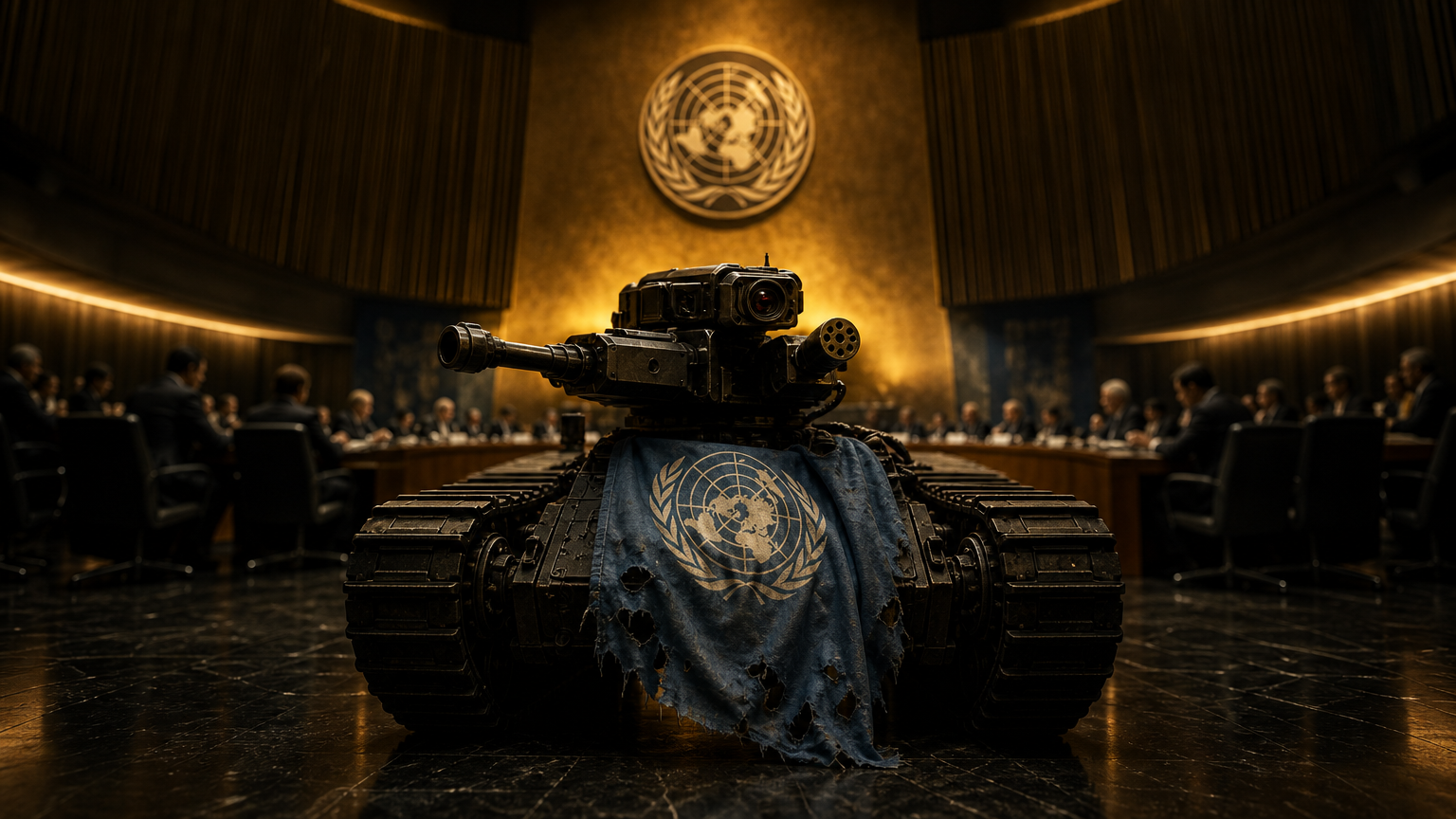
UN stalls on killer robots
The working headline is the story: UN stalls on killer robots. After a week of negotiations in Geneva, states did not launch the legally binding treaty process that many governments and humanitarian groups wanted for lethal autonomous weapons. Instead, they accepted a softer formula: keep talking, “elaborate” a possible instrument, and aim for rules by 2028 . In diplomatic terms, that keeps the file alive. In technology terms, it is a deferred update on a system already being deployed.
The talks took place under the Convention on Certain Conventional Weapons, a UN-backed framework whose 128 member states operate by consensus . That procedural design mattered as much as the ethics of artificial intelligence. Reuters reported that roughly 100 countries supported legally binding rules on weapons that can identify and engage targets with varying degrees of autonomy, but major arms-producing states including the United States, Russia and Israel opposed that stronger outcome . The result was not a ban, not a treaty mandate, and not even a clear commitment that the eventual instrument will be legally binding.
The Associated Press and NPR accounts described the compromise more bluntly: negotiators emerged after late-night talks with two years to suggest regulations that could be binding, but could also remain optional . That “maybe” is the center of the story. Diplomacy preserved a process; governance did not catch up with military AI.
What actually happened in Geneva
The Geneva review conference was billed as a chance to move from 13 years of discussion to a negotiating mandate. The strongest proposal would have pushed states toward a new protocol under the CCW, with prohibitions and restrictions for autonomous weapons systems. Instead, the final language asks states to keep elaborating an international instrument by consensus . The Guardian reported that week-long efforts to agree a mandate for a legally binding treaty collapsed just before 5 a.m. after all-night talks failed to overcome Russian objections .
The formal UN paper shows how deep the procedural trouble ran. The conference record says the High Contracting Parties were not able to adopt the agenda or rules of procedure because no consensus was reached, which left the conference unable to conduct a formal review of the convention’s scope and operation . The same document records that the final declaration was adopted and that follow-up work on lethal autonomous weapons systems was budgeted, but the process that survived is narrower than the treaty track many states sought .
This is why both descriptions are true. The talks “collapsed” if the benchmark was a binding negotiating mandate. They “succeeded” if the benchmark was avoiding a total breakdown of the CCW process. The compromise saved the room, not the rulebook.
Why “elaboration” is doing so much work
The choice of wording matters. “Negotiate” would have signaled a formal move toward an agreement with legal force. “Elaborate” leaves more exits. Aligned reporting from Geneva says some countries rejected the word “negotiate,” and the agreed language therefore leaves open whether the final instrument will be a treaty, a political declaration, voluntary guidelines or something in between .
That uncertainty is not academic. A binding treaty could define unacceptable systems, require meaningful human control, set limits on targeting humans, and clarify responsibility when an algorithm contributes to a strike. A nonbinding instrument could help build norms but would leave compliance largely to national policy, military doctrine and corporate restraint.
Stop Killer Robots, a coalition campaigning against autonomous weapons, called the outcome a “watered-down mandate” that fails to chart a clear route to a legally binding instrument . The coalition said more than 95 states expressed support for a treaty during the week, but a small number of states weakened the final mandate and introduced uncertainty about the legal status of the end product .
The technology is not waiting for 2028
The central mismatch is speed. States now have a two-year diplomatic workstream; militaries and manufacturers have live incentives to field systems faster. NPR reported that conflicts in Ukraine, Sudan and Gaza are already shaping fears about semi-autonomous drones and AI-assisted targeting, even if humans remain somewhere in the decision chain for many current systems . The concern is that the last step — selecting and attacking without meaningful human judgment — is moving from theoretical debate to operational design.
The Guardian’s follow-up reporting captured the warning from the International Committee of the Red Cross: it may soon be too late to put the “genie back in the bottle” if autonomous weapons become normalized before states set limits . The ICRC position is not a call to ban every automated military system. It is a call for red lines: no unpredictable autonomous weapons, no systems designed or used to target humans directly, and strict restrictions on others .
For defense contractors, that uncertainty cuts both ways. A weak international outcome may leave more room to develop AI-enabled targeting, drone autonomy, swarming behavior and decision-support systems. But it also leaves companies exposed to future legal reversals, export-control surprises and reputational risk. A product that is technically permissible in 2026 could become politically toxic, or legally restricted, by 2028.
For AI model builders, the problem is even more diffuse. General-purpose models can support logistics, intelligence analysis, object recognition, simulation, software development and mission planning. The Geneva outcome does not clarify where assistance ends and weapons functionality begins. It does not define when a model provider becomes part of a targeting chain. It does not settle whether fine-tuning, API access, data labeling or autonomous agent tooling should trigger arms-control obligations.
Accountability remains the missing patch
The ethical core is accountability. International humanitarian law already requires distinction, proportionality and precautions in attack. But autonomous systems complicate the practical question of who made the life-and-death decision. A commander may authorize a mission, an engineer may design a targeting model, a contractor may train perception software, and a drone may choose from a set of targets in a dynamic environment. If the strike is unlawful, the chain of responsibility can become technically and legally fragmented.
That is why the debate is not just about “killer robots” as a scary label. It is about whether the rules of war can still assign responsibility when more of the sensing, classification and engagement loop is automated. NPR quoted ICRC legal concerns that a machine cannot be held accountable for a violation of law; the commander remains responsible, but the commander’s ability to predict or control system behavior may weaken as autonomy increases .
The Geneva compromise does little to close that gap. It gives diplomats time to define terms, but it gives militaries time to define facts on the ground. Once systems are procured, integrated and battle-tested, states may become less willing to accept rules that make those systems unusable.
The politics behind the stall
The divide in Geneva was not simply democratic versus authoritarian, or humanitarian states versus military states. Russia was widely identified as a blocker, but the reluctance of other advanced military powers also mattered . The Guardian reported that the United States was reluctant to accept a binding treaty, while other defense-technology powers favored nonbinding approaches or resisted being bound too tightly .
That reflects a strategic calculation. States that expect AI-enabled weapons to provide battlefield advantage do not want to freeze the technology too early. They argue that existing humanitarian law already applies, that autonomy can improve precision, and that premature bans might block defensive systems as well as offensive ones. Treaty supporters counter that existing law is too general for systems that can select and engage targets without meaningful human control.
Consensus rules amplify the conservative side of that argument. In a body where every party can block strong language, the final text tends toward the lowest common denominator. That is why some campaigners and diplomats may now look outside the CCW process, as happened historically with landmines and cluster munitions when frustrated states built treaty processes beyond the consensus forum.
What to watch next
The next milestone is not a single signing ceremony. It is the shape of the 2027-2028 work program: whether states draft prohibitions and restrictions, whether the term “legally binding” re-enters the text, and whether treaty-supporting countries organize an alternative process if the CCW remains stuck. The UN process can still produce useful rules, but the mandate’s ambiguity means the burden shifts to political will.
For industry, the prudent move is not to read the Geneva outcome as a green light. The direction of travel remains toward more scrutiny of human control, auditability, target-selection autonomy, data provenance and export governance. Companies building models, sensors, drones or decision-support tools should assume that future buyers, regulators and courts will ask how a system preserves human judgment and who is accountable when it fails.
The short version: the UN did not unplug killer robots. It clicked “remind me later.” The problem is that autonomous weapons are unlikely to wait politely for the 2028 patch.
Comments
Be the first to comment.