
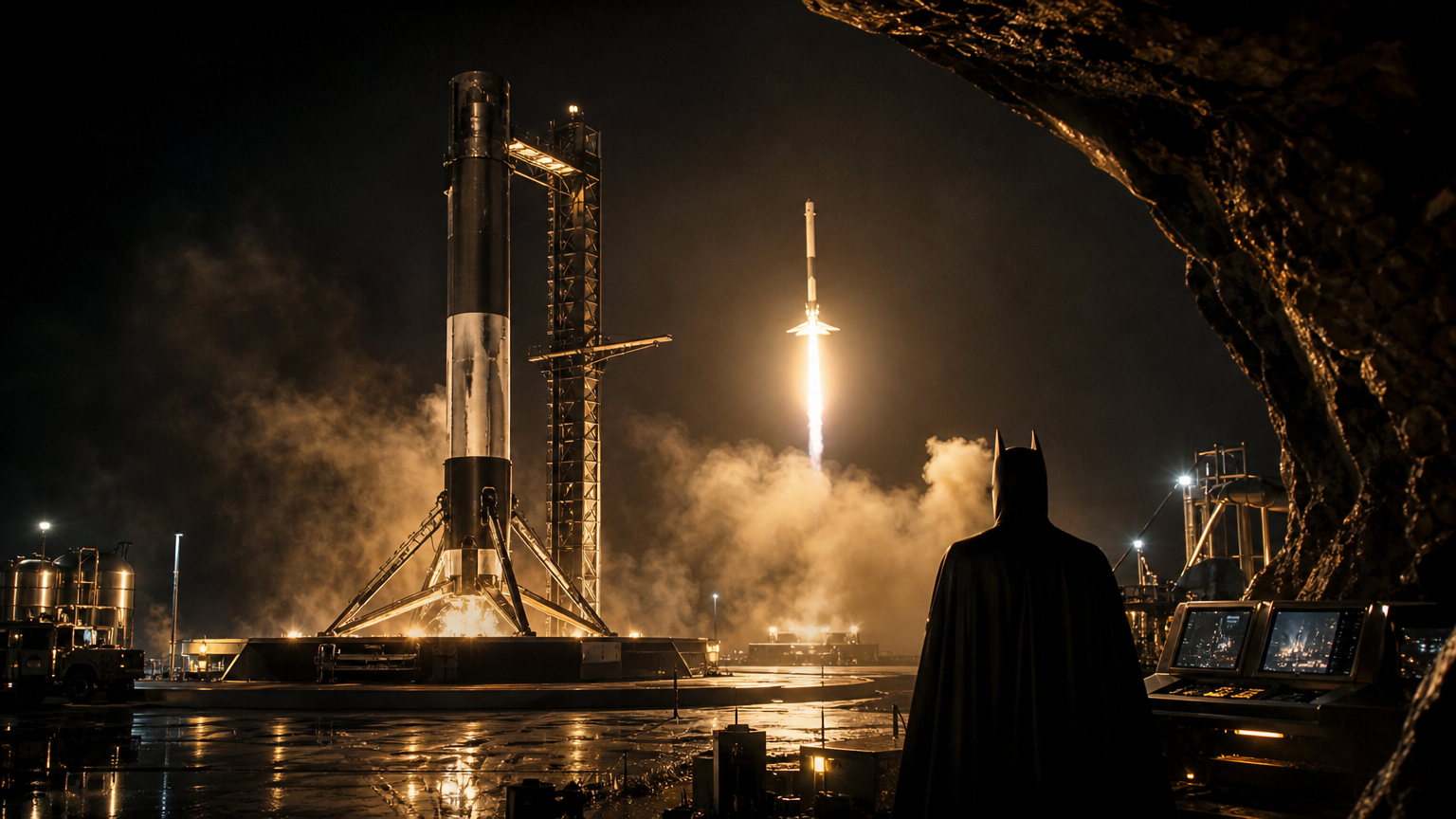
The stopwatch was the headline
SpaceX’s NROL-136 launch was classified, but the operational metric around it was not: a Falcon 9 lifted off from Vandenberg Space Force Base’s Space Launch Complex 4E on November 22 at 7:23 a.m. Eastern time, carrying a National Reconnaissance Office mission, only a little more than 32 hours after the same pad supported USSF-317 for the U.S. Space Force . Space.com reported the precise interval as 32 hours, 3 minutes and 21 seconds, citing SpaceX launch executive Kiko Dontchev’s post praising the West Coast team and noting that the mark beat the company’s previous same-pad turnaround record of about 45 hours at Cape Canaveral’s Pad 40 .
That distinction matters because this was not “rocket reuse” in the casual sense of the same booster flying twice in a weekend. It was launch-site reuse: the physical pad, ground systems, range coordination, fueling flow, safety checks and post-launch inspections were all cycled fast enough to support two sensitive government missions in barely a day and a half . The USSF-317 mission had lifted off at 11:20 p.m. Eastern on November 20, or 8:20 p.m. local time in California, and its Falcon 9 first stage landed on the droneship “Of Course I Still Love You” about 8.5 minutes later . NROL-136 then used Falcon 9 booster B1097, which returned to Vandenberg and landed at Landing Zone 4 roughly 7.5 minutes after launch .
For SpaceX, the new number is a manufacturing-style performance indicator applied to a launch pad. A faster pad cycle means the same concrete, plumbing, towers, transporter-erector hardware and support crews can generate more missions per year without waiting for a new launch complex to be built. That is why the 32-hour figure is more than a bragging right: it is capacity created by operations rather than by real estate. Yahoo Finance framed the milestone as a same-pad turnaround record with direct commercial and strategic implications, because shorter pad downtime can support both government launches and SpaceX’s own internal demand for Starlink flights .
Classified satellites, visible tempo
The payload side of NROL-136 remains opaque, as expected for an NRO mission. Space.com reported that the agency did not disclose the exact number of satellites aboard or their onboard technologies . What is visible is the programmatic direction: NROL-136 was described as another launch for the NRO’s “proliferated architecture,” a network built around numerous spacecraft intended to improve coverage, revisit rates and resilience for U.S. intelligence operations .
This is where the operational story meets the national-security story. U.S. intelligence customers want satellites on orbit when they are needed, not merely when a launch provider has a comfortable gap in its manifest. If a pad can be inspected, safed, refurbished, configured and cleared again in 32 hours, that pad becomes a more responsive national asset. The secret satellites stayed secret; the launch cadence did not.
The sequence also reinforces how deeply Falcon 9 has become embedded in the U.S. security launch pipeline. USSF-317 was itself a classified Space Force mission, with Space.com reporting that the payload and destination were not publicly known, although outside observers speculated it may have involved Starshield-related spacecraft . NROL-136 followed immediately with another classified customer, and Space.com noted that all six NRO launches so far in 2026 had been carried by Falcon 9 . The result is a very public demonstration of reliability around missions that reveal almost nothing about the hardware they carry.
The pad record and the Starship argument
The 32-hour reset also lands in the same news cycle as SpaceX’s latest Starship milestone, which gives the Vandenberg story a broader meaning. Falcon 9 is the mature, high-cadence workhorse; Starship is the architecture SpaceX wants to turn into an even faster, fully reusable transportation system. Current reporting on Flight 15 is important because it clarifies what happened: SpaceX did not complete a Super Heavy booster catch on that flight; instead, Super Heavy diverted to the Gulf of Mexico, while Ship 42, the Starship upper stage, returned from orbit and was caught by the tower’s “chopstick” arms at Starbase .
That correction does not weaken the larger point. In some ways, it sharpens it. SpaceX had already caught Super Heavy on previous Starship flights, but catching an orbital upper stage is a different kind of reuse problem because the vehicle has gone faster, farther and through a harsher reentry environment . According to Space.com, Musk said Ship 42 made it through Flight 15 in good enough condition that it could probably have been reflown after weeks of refurbishment, but the company plans to retire it for public display because of its historic role .
In other words, the Falcon 9 pad record shows operational discipline today, while the Ship 42 catch shows the direction SpaceX wants tomorrow’s launch economics to move. Falcon 9 still lands boosters; Starship aims to bring back both stages to a tower, remove the mass and complexity of traditional landing systems, and shorten the path from flight to inspection to flight again. The decisive test is not whether one spectacular catch can happen once. It is whether SpaceX can repeat the process under schedule pressure, with vehicles moving through production, refurbishment and launch operations at industrial scale.
Why 32 hours changes capacity math
Launch cadence is often discussed as a rocket problem, but this weekend showed that the bottleneck can be the pad. A booster can be available, a payload can be integrated and a customer can be ready, yet the launch complex still has to be reset. Reducing that reset from days to roughly 32 hours increases theoretical annual throughput without adding another coastal site, another environmental review, another range interface or another full ground crew.
That matters at Vandenberg in particular because California is crucial for polar and high-inclination missions, including many national-security flights. A faster SLC-4E gives SpaceX and its government customers more scheduling flexibility on the West Coast. It also provides insurance against congestion elsewhere in the system: if Florida pads are loaded with crew, cargo, Starlink, commercial and defense work, a more productive Vandenberg pad becomes a strategic pressure valve.
The Starship production story points in the same direction. A Space.com tour report from Starbase said SpaceX officials described production of roughly one Starship upper stage every two weeks and one Super Heavy booster every four weeks, with overlapping flows inside Starfactory . Those numbers do not mean Starship is already operating like an airline; they mean SpaceX is trying to align factories, pads and recovery systems so that rapid reuse becomes a complete loop rather than a single demonstration.
The Moon, the market and the next constraint
The Starship milestone also feeds directly into the lunar narrative. The Hill, republished by AOL, framed Flight Test 15 as a step toward the Moon because NASA’s Artemis ambitions depend on a version of Starship that can support lunar landing operations . The same article noted that Flight 15 reached orbit, deployed 26 advanced Starlink satellites, and then completed the upper-stage return sequence, while the booster catch was called off and the booster was destroyed after a Gulf splashdown .
That mixed outcome is exactly why the story should be read with both excitement and discipline. SpaceX achieved a major recovery milestone, but it also demonstrated that full-system reuse still has failure modes to close. The company’s strongest argument is not perfection; it is iteration at high speed. Falcon 9’s 32-hour pad reset at Vandenberg is what that philosophy looks like after years of operational learning. Starship’s tower catch is what the next version still has to prove repeatedly.
For investors, government customers and competitors, the message is the same. SpaceX is not merely launching more often; it is attacking the idle time between launches. On November 22, the payload stayed classified, the booster landed, and the pad record became the public result. Even Batman would respect a Batcave reset that fast.
Comments
Be the first to comment.