
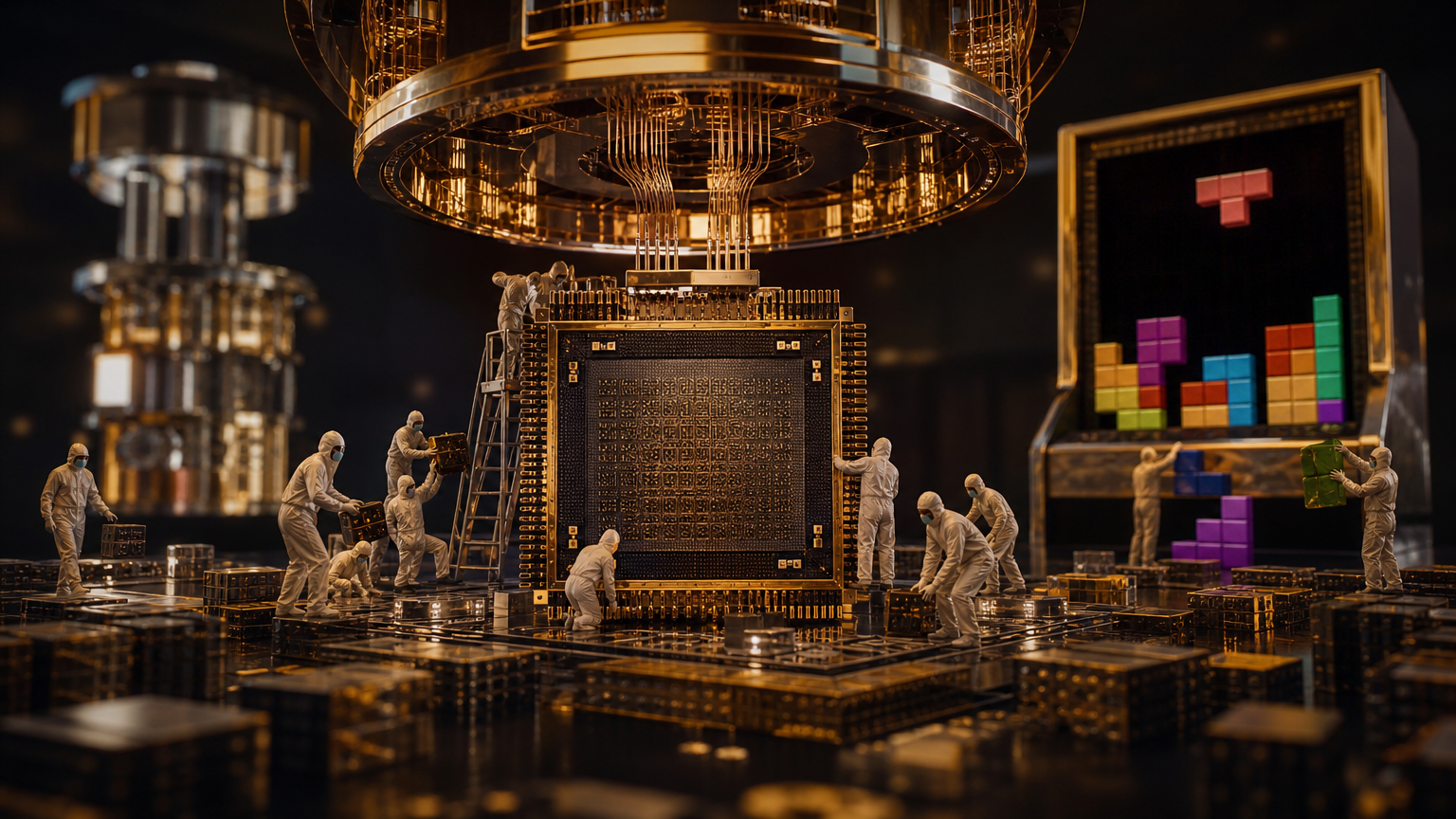
Two scaling stories, one engineering problem
Canada and IBM are pushing on different parts of the same quantum-computing bottleneck: how to make quantum machines large enough, reliable enough and checkable enough to matter outside the lab. In Canada, researchers at the National Research Council and the University of Warwick reported progress on a germanium-silicon chip approach aimed at scaling quantum computers from small numbers of qubits toward one million qubits on a single chip . IBM, meanwhile, said a quantum computer completed in about 15 minutes a computation beyond the practical reach of leading classical methods, while also providing a statistical basis for trusting the result .
These announcements should not be read as “a finished million-qubit computer” on one side and “a universal quantum computer” on the other. The Canadian work is about a material and device pathway for future dense integration, not a production-scale fault-tolerant machine already running applications . IBM’s result is a benchmark-style quantum advantage demonstration, not a direct industrial workload such as drug discovery, logistics or cryptography . Still, both stories matter because the field’s next phase is less about isolated hero experiments and more about credible routes to scale.
Canada’s million-qubit path runs through materials
The Canadian work focuses on engineered layers of germanium and silicon, a materials platform the researchers say could support future quantum chips based on quantum dots . Quantum dots are nanoscale semiconductor structures that can be used to form certain kinds of qubits, and NRC researchers have worked in this area for more than two decades . The reason this matters is straightforward: if quantum processors are ever to reach very large scales, their qubits must be manufactured, aligned, cooled and connected with semiconductor-like discipline .
The NRC describes the challenge as moving from a handful of qubits toward one million qubits on one chip . That target is important because fault-tolerant quantum computers generally require many physical qubits to encode and protect a smaller number of logical qubits. In practical terms, a future machine’s usefulness will depend not only on whether individual qubits are high quality, but also on whether the surrounding architecture can support error correction, routing, control and readout at scale.
The Canadian project highlights that “scaling” is not a single number. A million-qubit chip would need high-quality materials, precise manufacturing and accurate alignment of nanoscale devices, according to NRC principal investigator Sergei Studenikin . It would also need cryogenic operation: the NRC account describes laboratory testing with a cryostat capable of cooling fragile qubits to near absolute zero . That kind of infrastructure is part of the quantum computer, not merely its support equipment.
The collaboration also reflects a broader commercialization angle. The Quantum Insider reported that the NRC-University of Warwick effort received support from the NRC’s Internet of Things: Quantum Sensors Challenge program, and that the researchers are seeking academic and small-business partners for follow-on work . NRC’s own account frames the work as part of Canada’s quantum ecosystem, with program director Marina Gertsvolf emphasizing the importance of long-term collaboration between Canadian and international researchers .
IBM’s 15-minute result is about speed and trust
IBM’s announcement attacks a different scaling problem: not how to place one million qubits on a chip, but how to show that a quantum computation beyond practical classical simulation has actually produced a reliable answer. ScienceDaily, citing IBM, reported that IBM and University of Chicago researchers completed a complex calculation in about 15 minutes that leading classical computing methods would find impractical to reproduce . The same report says the team used a novel error-detection method to establish statistical confidence in the result .
That verification point is central. Random circuit sampling and related tests can become so hard for classical computers that checking the answer becomes nearly as difficult as generating it. The IBM-University of Chicago work addressed this by using a structured alternative to random circuit sampling that preserved computational hardness while allowing errors to be detected during computation . In other words, the claim is not merely “the quantum machine was faster,” but “the researchers had a way to bound how faithfully it ran.”
The experiment used 70 protected logical qubits, 2,415 logical two-qubit operations and 468 logical T gates, according to the ScienceDaily summary . It also reported effective logical error rates 10 times lower than the underlying physical error rates . Those details matter because quantum advantage claims can collapse if noise overwhelms the computation or if classical researchers later find a better simulation route. IBM’s result is therefore strongest where it connects runtime, error behavior and verification rather than relying on speed alone.
At the same time, the limitation is clear. ScienceDaily states that the experiment was designed to demonstrate quantum advantage rather than solve an immediate real-world problem . That distinction is not a footnote; it is the line between a benchmark and a business case. A 15-minute quantum computation becomes industrially meaningful only when the task is both valuable and independently checkable, and when the error profile remains manageable as circuits become deeper and more application-specific.
Why these two developments belong together
Taken together, the Canadian and IBM stories show why quantum computing is increasingly a systems-engineering discipline. Canada’s work is about the physical path to dense qubit integration: materials, fabrication, alignment and cryogenics . IBM’s work is about computational scale: logical qubits, error detection, circuit depth and confidence in answers . One asks whether enough qubits can be built into a coherent chip architecture; the other asks whether those qubits can run difficult circuits in a way scientists can trust.
That convergence is important because useful fault-tolerant machines will need both. A beautiful chip design without a convincing error-correction and verification strategy remains a laboratory platform. A compelling quantum-advantage demonstration without a credible hardware scaling path risks remaining an isolated benchmark. The industry needs the two tracks to meet: manufacturable qubit platforms and computations whose outputs can be trusted.
The Canadian project is especially notable because it leans toward semiconductor-style thinking. Germanium and silicon are familiar to the chip world, and the researchers’ emphasis on engineered layers points toward manufacturability rather than exotic one-off devices . If that approach continues to mature, it could make quantum processors look less like bespoke physics experiments and more like integrated systems, even though the operating conditions remain deeply non-classical .
IBM’s result, meanwhile, increases pressure on the software and verification stack. If quantum advantage is to become more than a marketing phrase, users will need ways to compare quantum runtimes, classical baselines and error models. The reported public release of circuits and experimental results through a Quantum Advantage Tracker is therefore important because it invites further benchmarking and challenge . In a field where claims often depend on assumptions about classical difficulty, openness is part of the engineering process.
The road from milestones to machines
The immediate takeaway is cautious optimism. Canada’s researchers have not delivered a one-million-qubit fault-tolerant computer, but they have advanced a materials route intended to make that scale more plausible . IBM has not shown a general-purpose quantum machine replacing classical supercomputers, but it has reported a 15-minute, beyond-practical-classical computation with an accompanying method for confidence in the result .
The deeper lesson is that quantum scaling is no longer only a question of “how many qubits?” It is a question of what kind of qubits, how they are fabricated, how they are cooled, how they are connected, how errors are detected, and how outsiders can verify performance. Canada’s chip work and IBM’s advantage claim sit on different layers of the stack, but they point in the same direction: the quantum race is becoming less about spectacular prototypes and more about complete, reliable systems.
If that direction holds, the next winners in quantum computing will not be the teams with the biggest headline number alone. They will be the ones that can turn materials science, device engineering, error correction and verification into an architecture that scales. Even in quantum computing, Tetris gets harder when every block needs error correction.
Comments
Be the first to comment.