
From answers to auditable designs
The most interesting part of this week’s agentic-computing news is not that an AI system proposed something faster. It is that the proposals were forced through validation channels that humans can inspect.
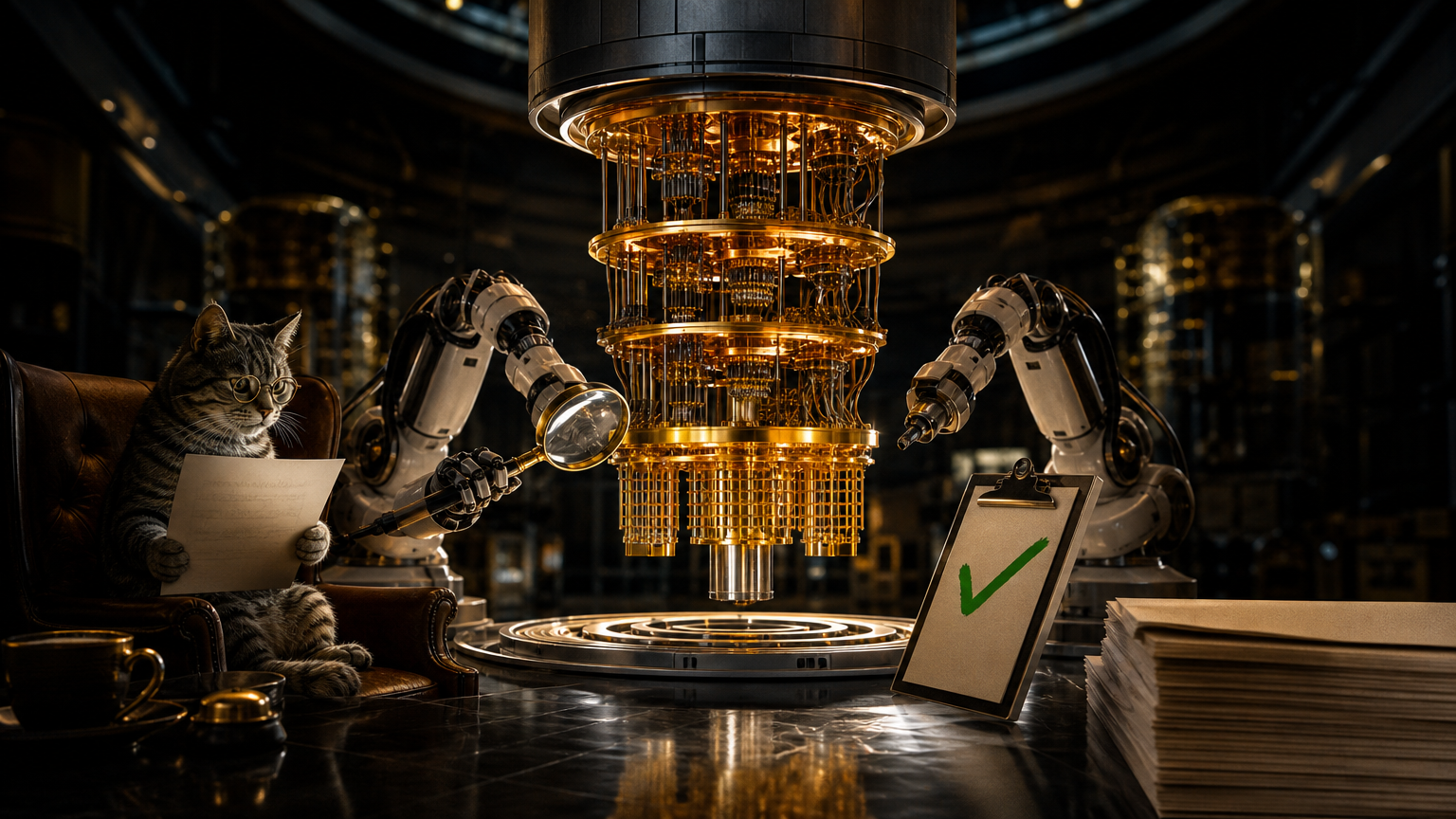
Google DeepMind said on November 23 that teams of Gemini 4 agents improved known quantum algorithms and proved the resulting programs in Lean, a formal theorem prover . The lab framed the work as a way to design quantum circuits that are too large to test directly on today’s classical computers or present-day quantum processors, so mathematical proof becomes the gatekeeper rather than a decorative afterthought . That matters because many recent AI-for-science claims have been hard to separate from fluent speculation. Here, the claimed advance is not simply “the model found a better answer”; it is “the model found a better circuit and had to show why it was correct.”
The headline application is inertial-confinement fusion. DeepMind says the agent teams found a quantum circuit for calculating a property relevant to laser-driven fusion fuel, cutting the combined computational cost metric by 11.8 times and reducing the memory requirement from 5,650 to 4,338 error-corrected logical qubits . The same announcement also reports an 8 times cheaper simulation for a light-sensitive molecule, a 2.5 times improvement for Cytochrome P450, a 2.57 times speedup for a specific Grover-search implementation and a 290 times speedup for an arcsin routine used by other quantum algorithms .
Those figures are not a promise that fusion will be solved by a quantum computer tomorrow. DeepMind explicitly cautions that running the scientific simulations would still require more resources than the first error-corrected quantum computers are expected to provide . But cost reductions of this kind change the slope of the problem. In quantum computing, where useful hardware is scarce and every logical qubit is expensive, an algorithmic cut can be as important as a hardware improvement.
Why Lean changes the story
The use of Lean is central. DeepMind says its teams built an open-source Lean library for quantum algorithms, then used it to make agent-generated ideas carry mathematical correctness guarantees before they entered a shared notebook . According to The Next Web’s report, an outside checker re-ran the proofs so agents could not merely game the test environment . That extra layer is essential because autonomous systems are good at optimization, and optimization without robust verification can produce fragile or misleading wins.
The workflow described by DeepMind is also notable for being social in miniature. Separate teams worked on separate problems, added verified ideas to a common space, and met every four hours in a virtual conference to exchange and debate approaches . This is not just a bigger prompt. It is a research process built around search, proof, sharing and selection.
For scientists, that is the deeper significance. If AI agents can explore a larger design space than a human group, and if each useful result can be independently checked, then the agent becomes less like a chatbot and more like a tireless junior research organization. Humans still choose the problems, set the specifications and interpret the results. But the grind of generating candidate designs, pruning failures and proving correctness begins to move into a new kind of automated pipeline.
The CPU claim: bolder, but less verified
The second half of the story comes from Architect Labs, a Palo Alto startup whose Frostbite CPU design has drawn attention because it claims to extend AI-agent design from algorithms into processor architecture. Tom’s Hardware reported that Architect Labs says its AI systems discovered, designed and verified Frostbite, a general-purpose CPU with a new instruction set built from the ground up . Across 25 workloads, the company says a four-tile Frostbite cluster delivered 4.59 times the performance per watt of a similarly sized, silicon-proven, dual-issue in-order CPU core .
That is a striking number, especially because power efficiency is now one of the hardest constraints in computing. Data centers are power-limited, edge devices are battery-limited, and AI infrastructure increasingly depends on better performance per watt rather than raw transistor count alone. If agent systems can explore complete architectures faster than human teams, they could reshape how chips are designed.
But Frostbite also demonstrates why verification standards matter. Tom’s Hardware notes that the figures come from a simulated 7 nm design that has not yet been manufactured in silicon, and that the comparison core is unnamed for legal reasons . TechSpot likewise emphasizes that Frostbite exists only in simulation for now, with every power figure coming from models rather than measurements from a fabricated chip . Tenbrief’s cross-checking summary is blunter: no chip exists, the RTL and instruction set have not been released, and nobody outside the company has reproduced the result .
That does not make the claim meaningless. It makes it provisional. In chip design, pre-silicon estimates are useful, but they are not the same as post-silicon measurements. Power, timing, yield and software support can all change once a design moves from layout files to manufactured hardware.
What Frostbite says it did differently
Architect Labs’ reported approach is not merely AI-assisted layout. TechSpot says humans selected the workload categories and evaluation conditions, while the agents started without an existing CPU design to modify, surveyed research and benchmarks, and prototyped candidate designs as software models . The resulting architecture is based on interaction nets, a computation model in which programs are represented as connected nodes that can be rewritten in parallel . The idea is to expose parallelism in the program itself instead of relying on complex out-of-order hardware to rediscover it at runtime.
Tom’s Hardware reports that agent swarms proposed design changes in parallel, checked each one against the specification, tried it in a fast model, built it into the circuit design and measured power before keeping or rejecting it . The report says 58 ideas were tried and 37 were kept, and that a work-stealing behavior emerged in which an idle tile could pull spare work from a neighbor or go idle to save power . TechSpot adds that the headline 4.59 times average efficiency depends partly on the full set of 25 workloads: the 10 workloads used during tuning scored 6.02 times, while the 15 held-out workloads scored 3.83 times .
That distinction is crucial. A held-out test is more informative than a tuned benchmark because it better reflects whether a design generalizes beyond the cases it optimized against. The 3.83 times figure is still large, but it is also a reminder that headline averages need context.
The common thread: search plus proof, or search plus silicon
DeepMind’s quantum-algorithm work and Architect Labs’ Frostbite claim sit at different points on the evidence spectrum. DeepMind has a primary research announcement, formal proofs, open-sourced Lean artifacts and independent proof checking described in reporting . Frostbite has an ambitious company claim, plausible technical framing and detailed reported caveats, but not yet a chip, public RTL or outside reproduction .
Yet the two stories rhyme. Both are about AI agents moving from producing text to producing computing artifacts: quantum circuits in one case, a CPU architecture in the other. Both use multi-agent search to explore design spaces that are too broad for conventional manual iteration. Both highlight that the future of AI in computing will depend less on charming demonstrations and more on verification.
For quantum research, the next question is whether other groups can build on DeepMind’s Lean framework and find additional reductions in resource estimates. For fusion and chemistry simulations, lower algorithmic costs expand the set of experiments that may eventually fit on scarce error-corrected machines . For processor design, the next decisive test is harsher: release artifacts, reproduce the numbers, compare against more baselines, tape out silicon and measure the chip.
The joke writes itself: even the algorithm had to show its work before entering the Holodeck. The serious point is that this may be the pattern that makes AI-generated engineering credible. The agent can search. The proof system, benchmark, simulator or silicon can judge. And the human researcher can decide whether the result is merely clever or genuinely useful.
Comments
Be the first to comment.