
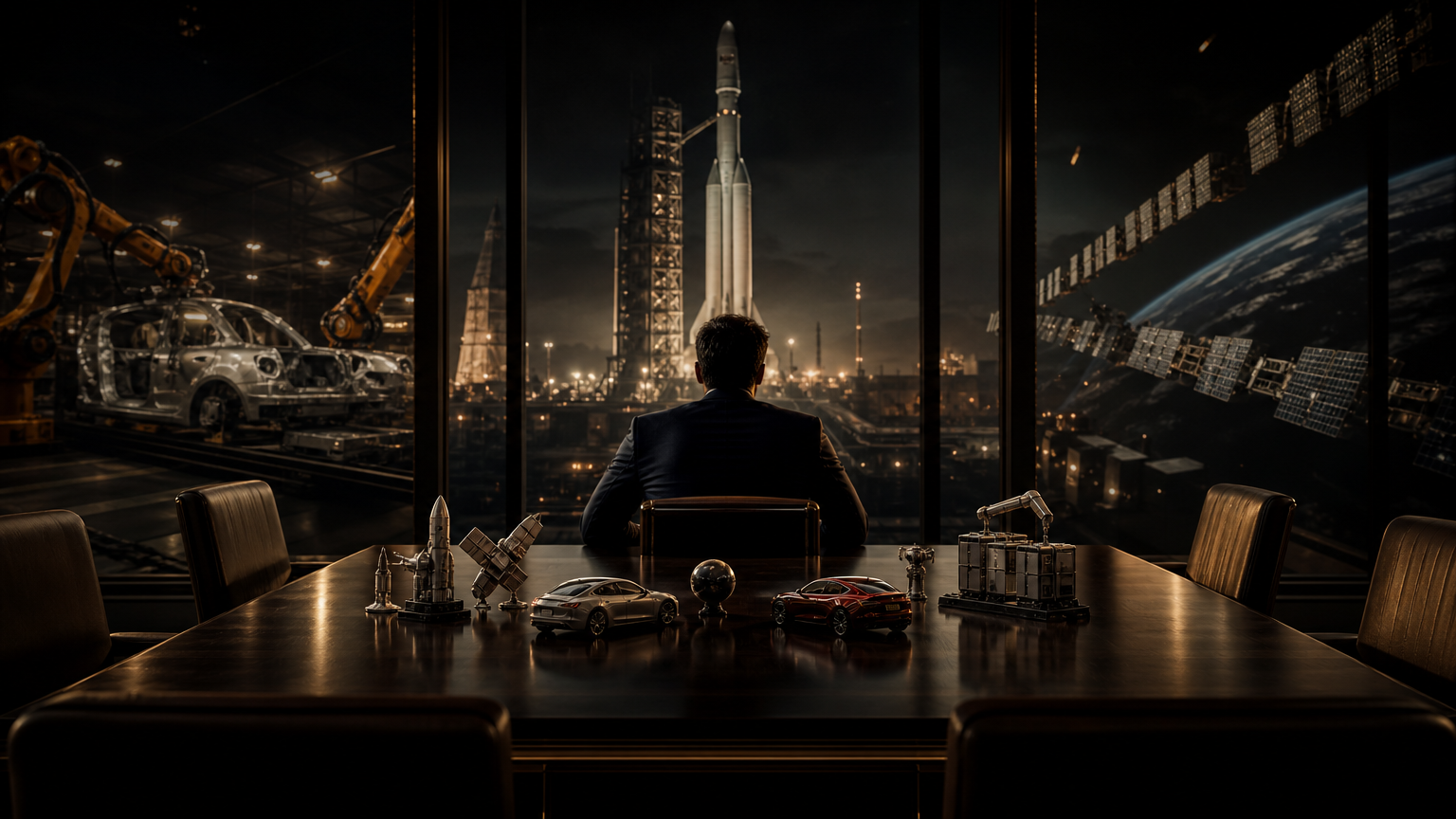
The five-person test of a $3.5 trillion idea
The working headline checks out: this is the story of Musk forming a $3.5 trillion merger team, not a broader roundup of Tesla, SpaceX or Musk news. The latest reports describe two special committees, guided by five directors, assigned to negotiate a possible all-stock combination of Tesla and SpaceX that would create a group valued at roughly $3.5 trillion .
The five names now attached to the process are Roelof Botha and Randy Glein from SpaceX, and Robyn Denholm, Kathleen Wilson-Thompson and Jack Hartung from Tesla . Their job is not ceremonial. They are being asked to set valuation terms, defend the process, win shareholder support and show regulators that a deal uniting rockets, satellites, electric vehicles, batteries, artificial intelligence, robotics and software can be governed without simply becoming an unchecked extension of one founder’s will .
That is why the phrase “five-director team” matters. In a normal merger, directors test price, strategy and execution risk. Here, they must also manage a conflict-of-interest architecture in which Musk leads both companies, owns large stakes and has already signaled that he likes the industrial logic of putting his companies under one roof . Reuters, summarizing the Financial Times report, said it could not independently verify the FT’s account and that Tesla and SpaceX did not immediately respond to requests for comment outside regular business hours . That caveat is important: the talks are real as reported, but this is not a signed merger agreement.
Why the committees exist
The committees are meant to create a process that can survive investor and legal scrutiny. Benzinga reported that the five appointees are considered financially “disinterested,” allowing them to guide negotiations over the proposed transaction . In practical terms, that means they are being positioned as the people who can evaluate the deal for shareholders rather than for Musk personally.
The governance problem is obvious. A merger between two Musk-led companies would not be an arms-length transaction in the ordinary sense. Musk’s influence runs through strategy, capital markets, product road maps, public communication and investor sentiment. Even if the strategic thesis is appealing, the process must prove that Tesla shareholders are not being asked to subsidize SpaceX, and that SpaceX shareholders are not being diluted into a slower-growth or more politically exposed structure.
The committees have brought in heavyweight advisers to do the financial modeling. Morgan Stanley and Goldman Sachs are advising SpaceX, while Evercore is advising Tesla . Reuters’ account also said the advisers are refining models that would form the basis of negotiating positions in an all-stock merger . That points to the central financial question: the exchange ratio. In plain English, the exchange ratio decides how much ownership Tesla shareholders receive in the combined company relative to SpaceX holders.
The exchange ratio is the battlefield
The proposed valuation grabs attention, but the exchange ratio will decide whether investors view the transaction as a strategic merger or a transfer of value. The $3.5 trillion figure describes the potential combined group rather than a cash purchase price for one company . That distinction matters because the deal being discussed is an all-stock combination, meaning ownership percentages, voting rights and future upside are the real currency.
If Tesla holders believe they are giving up a liquid, globally followed electric-vehicle and energy company for too little of a combined SpaceX-Tesla entity, they may resist. If SpaceX holders believe they are being merged into Tesla at a discount to the space company’s growth profile, they may also push back. The committees therefore have to do more than split the difference: they have to explain why the combined platform is worth more than the companies separately.
Benzinga reported that bankers are examining overlap in AI models, chip design and data centers, while also exploring possible synergies in rockets, robotics and solar panels . MarketScreener’s analysis framed the strategic upside similarly: one structure could pool investment in artificial intelligence, semiconductor design and data centers, while linking Tesla’s energy storage, solar and robotics work with SpaceX’s space and satellite communications ambitions . That is the optimistic version of the deal. The skeptical version is that these are different businesses with different customers, regulators, capital cycles and risk profiles.
The Musk factor
The directors’ hardest assignment may be separating strategic logic from founder gravity. Musk has argued that combining his AI, robotics, electric-vehicle and aerospace ambitions under one corporate roof would be “a good idea,” according to Reuters’ account of the FT report . Benzinga also reported that Musk recently said he should not receive extra Tesla shares simply for merging Tesla with SpaceX, while noting that, depending on terms, the deal could unlock about $6.1 billion in Tesla stock for him .
That is why the committees’ independence will be tested as much as their financial judgment. If the transaction is announced, investors will ask whether the board process was genuinely adversarial, whether independent advisers were empowered, whether minority holders had enough information, and whether Musk’s public comments shaped expectations before formal terms were settled.
Yahoo Finance reported that the arrangement could give Musk something he has long sought: more voting power at Tesla, depending on deal terms and the governance structure of the combined company . It also reported that Musk controls about 20% of Tesla voting power versus 84% at SpaceX, where he holds supervoting shares . If accurate, that gap explains why governance is not a secondary issue. It is the deal.
The regulatory wall
Even if valuation is solved, approval risk could be severe. Reuters reported that bankers are studying which parts of the proposed conglomerate overlap while the combination faces steep regulatory hurdles tied to SpaceX’s U.S. defense contracts and Tesla’s reliance on China . Finimize made the same point in market terms, warning that a merger mixing sensitive U.S. defense work with a business heavily exposed to China may be treated more like a national-security case than a standard corporate tie-up .
That could mean conditions, ring-fencing, information barriers or limits on how the combined company shares technology across units. Those remedies would not necessarily kill the deal, but they could dilute the strategic pitch. If the core argument is that one company can coordinate capital, data, engineering and software faster than two, then regulators requiring separation would weaken the synergy story.
What investors should watch next
The immediate milestones are clear. First, the committees must land on valuation and an exchange ratio. Second, they must decide whether governance of the combined company includes a chairperson, a new CFO structure, a refreshed board or special protections for minority holders. Benzinga reported that leadership and governance questions would follow once financial details are agreed .
Third, any proposal would need shareholder approval. Reuters reported that Musk had confirmed the companies formed independent director committees to discuss a union, but the existence of committees does not guarantee a transaction . Fourth, regulators would have their own timeline, especially if national-security issues become central.
The story is therefore no longer just “Will Musk merge Tesla and SpaceX?” It is now: can five directors design a transaction large enough to satisfy SpaceX shareholders, fair enough to pass Tesla scrutiny, disciplined enough to survive litigation, and transparent enough to calm regulators?
A $3.5 trillion industrial constellation may sound like a Musk-scale inevitability. But for now, it is still a negotiation. The boardroom, not the launchpad, is where the next ignition test happens.
Comments
Be the first to comment.