
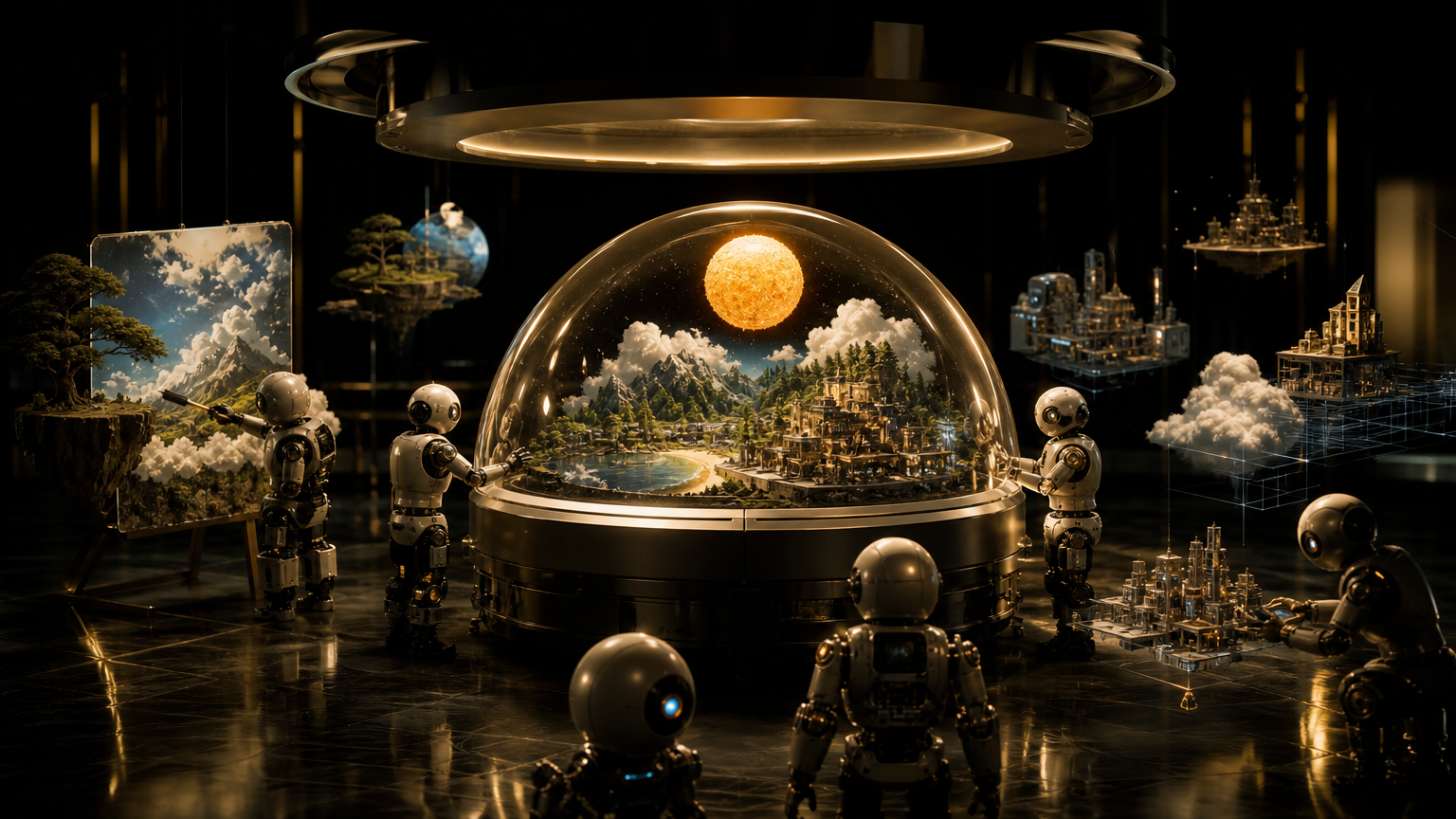
A model update with a bigger interface agenda
OpenAI’s GPT-6.2 story now has two tracks: Sol is becoming the everyday face of ChatGPT, while Astra is being positioned as the model family’s more ambitious engine for spatial, professional and simulation-heavy work. On November 23, OpenAI said a version of GPT-6.2 optimized for the Chat tab was rolling out to Plus, Pro, Business and Enterprise users, powered by GPT-6.2 Sol and tuned for everyday conversation . That makes the release more consequential than a behind-the-scenes quality bump: it brings the newest GPT-6.2 line into the place where most paying users actually type, upload images, compare options and ask follow-up questions.
The headline improvement is visual. OpenAI says GPT-6.2 scored 71.7% on image understanding in its Chat tab tests, compared with 47.4% for GPT-6 . FourWeekMBA calculated that as a 24.3-point increase and framed it as the largest reported gain over GPT-6 in the Chat release . For users, that means the upgrade is meant to show up when ChatGPT reads labels, signs, interface screenshots, product photos or other image details, not only when it writes prose.
OpenAI also says the Chat-tuned GPT-6.2 is better at complex requests involving detailed instructions or online information-finding, and can offer smarter follow-ups such as tracking whether a price drops after a shopping or travel query . That combination matters because it points to a ChatGPT that does not merely answer one prompt at a time; it increasingly interprets multimodal input, weighs constraints and decides when a task might continue after the conversation pauses.
Sol moves into the main room
The practical rollout is clear. GPT-6.2 in ChatGPT is available globally to Plus, Pro, Business and Enterprise tiers in the Chat tab, while Enterprise availability depends on admin settings . OpenAI also stressed that this change applies to the regular Chat experience, not the Work or Codex models, which are not changing as part of the Chat tab release . MacRumors separately reported that GPT-6.2 is not available to Free and Go plans in this rollout .
That separation is important. Work and Codex remain the more specialized environments for professional workflows and coding, while the Chat tab is the broad consumer and business front door. By putting Sol there, OpenAI is signaling that GPT-6.2 is not only for agents, developers or internal productivity suites. It is the new baseline for paid everyday interaction.
The company’s own metrics suggest the change is meant to be felt in three places: image understanding, instruction-following and web-assisted comparison. FourWeekMBA cited OpenAI’s figures showing 78.1% instruction-following on especially challenging prompts, up from 62.5% for GPT-6, while also noting that the scores are OpenAI’s internal tests and have not been independently verified . That caveat matters, but the direction is still obvious: OpenAI wants the normal Chat tab to handle messier, more visual and more decision-oriented work.
Dots turn ChatGPT into an always-on workspace
The second part of the release is the agent layer. TestingCatalog reported that GPT-6.2 Sol’s Chat tab rollout arrived alongside Dots becoming available to users in the European Union, after earlier exclusions from the initial Dots rollout . Dots are described as always-on agents inside ChatGPT, each with its own computer, connected apps and the ability to keep making progress between conversations .
This changes the metaphor of ChatGPT. A chatbot waits. A Dot persists. If Sol is the conversational surface, Dots are the operational layer underneath it: agents that can watch, act, resume and return with results. TestingCatalog also noted user sightings of a travel mode intended to keep a Dot working while its owner is abroad, plus a new ChatGPT design that gives the Dot a more central place in the interface .
That design direction helps explain why the Sol rollout matters. Better image understanding and better follow-up behavior become more valuable when an agent can maintain state over time. A price-drop alert, a travel comparison or a visual review of product options is no longer just a single answer; it becomes an ongoing loop between user intent, external information and an AI agent that can return later.
Astra is the spatial bet
Astra is where the release moves most clearly beyond text. Crypto Briefing reported on November 23 that OpenAI says GPT-6.2 can understand and simulate three-dimensional worlds, and help users create them . The report describes Astra as the model carrying the 3D headline, with a 1,318 Elo score on AA-3D, an independent benchmark for three-dimensional tasks, ahead of Claude Fable 5.2 at 1,271 Elo .
The demos point to a different class of output. According to Crypto Briefing, Astra can take a plain text prompt and turn it into a fully interactive 3D scene, with demonstrations including simulated mechanics and car dynamics . The same report describes a workflow in which Astra moved from a rough sketch to CAD parts, then to a Python motion solver and finally to a Blender scene with instructions .
That is why “beyond text” is the right frame. The target is not just a prettier answer. It is a pipeline: image or sketch in, structured model out, simulation logic added, interactive environment produced. For architects, game developers, product designers and simulation teams, this starts to look less like a writing assistant and more like a power user sitting inside CAD, Blender, browser-based 3D tools and code editors.
Creative software now has a new competitor and a new operator
OpenAI is not replacing creative software outright. The more accurate reading is that GPT-6.2 is being trained and productized to operate across those tools. Crypto Briefing explicitly notes that GPT-6.2 works by operating CAD and 3D tools rather than replacing them . That distinction is crucial for the market. Adobe, Autodesk, Unity, Epic, Figma-style design tools and browser-native creative platforms may not lose users overnight, but they face a new pressure: users may increasingly expect the AI layer to drive the interface for them.
In games, the pressure is even sharper. If a model can generate an explorable world, write the interaction logic and refine the scene from images or text, prototyping cycles shrink. Small teams could rough out levels, physics toys, educational simulations or virtual showrooms without waiting for a full art and engineering pass. Larger studios may use the same capability to explore more concepts earlier, then apply human direction and proprietary assets later.
The simulation angle is also strategic. Car dynamics, mechanical assemblies and CAD-to-Blender workflows are not just entertainment demos. They point toward engineering review, training environments, digital twins and synthetic data. The moment a model can help build a world and simulate behavior inside it, the boundary between “content creation” and “decision support” starts to blur.
The caveats are as important as the leap
The release still comes with limits. Crypto Briefing noted that early reports did not mention physical 3D printing or real-world testing of the designs Astra produced . OpenAI’s Chat tab benchmark numbers are internal, and FourWeekMBA emphasized that the scores have not been independently checked . The Dots-in-EU picture also appears, for now, through reporting and user sightings rather than a single broad formal OpenAI launch note .
Safety is another part of the story. OpenAI’s GPT-6.2 in ChatGPT system card says the November 23 model meets the Critical threshold for cybersecurity capabilities and the High threshold for biological and chemical capabilities, and that it is deployed with safeguards similar to those for GPT-6.2 Astra and Sol . The same system card says GPT-6.2 demonstrated the strongest overall safety performance of any chat model OpenAI had deployed on its evaluations . In other words, the capabilities are expanding into more powerful operating territory at the same time OpenAI is emphasizing tighter governance.
The net result is a ChatGPT that is less and less defined by text. Sol gives the main Chat tab stronger visual and instruction-following behavior. Dots push ChatGPT toward persistent agents. Astra turns prompts, sketches and tool use into interactive 3D worlds and simulations. The holodeck now has a version number, but the real story is more grounded: OpenAI is trying to make ChatGPT the place where users describe, see, manipulate and eventually run digital environments.
Comments
Be the first to comment.