
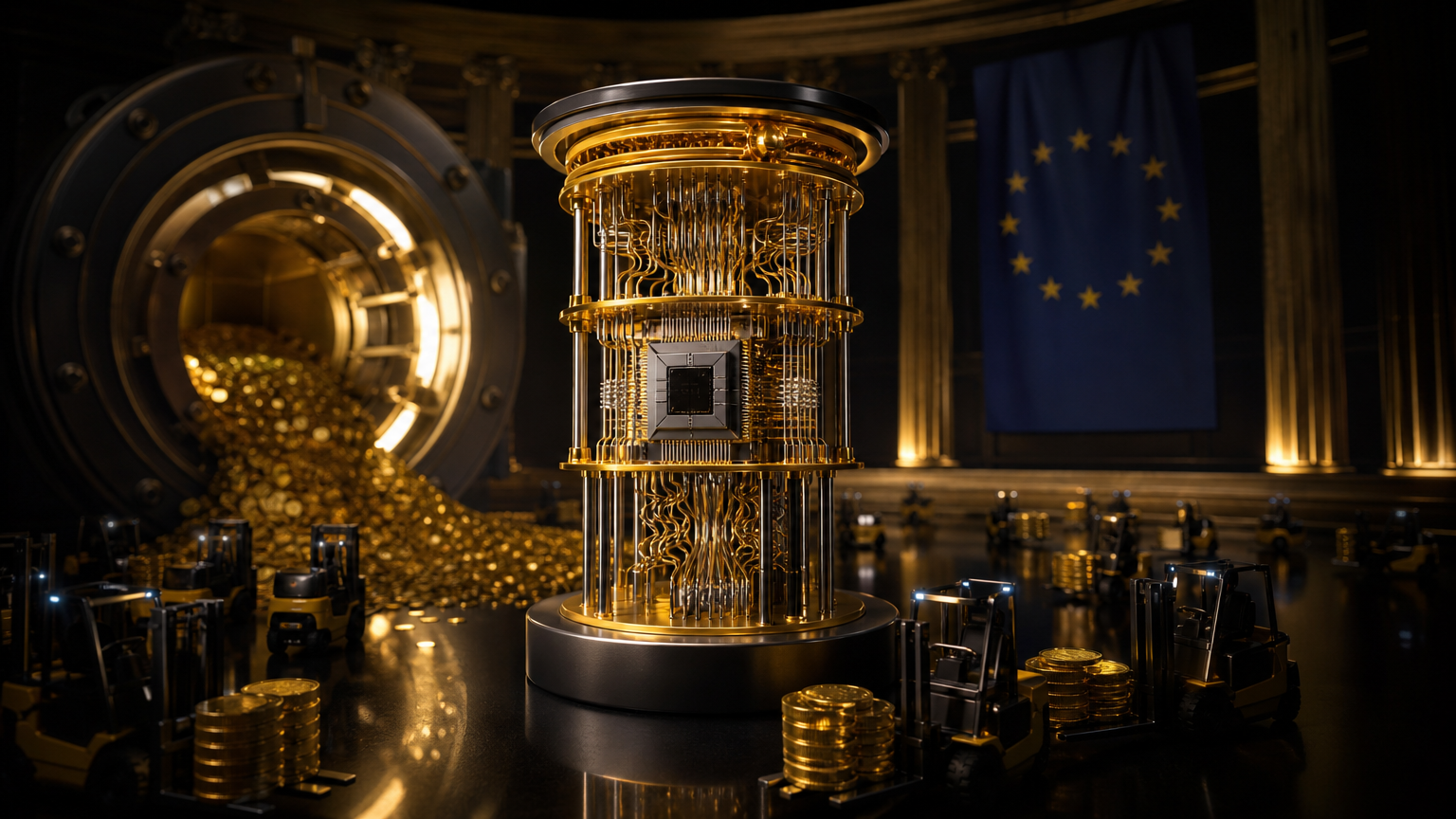
Brussels tries to turn quantum science into industrial scale
Europe’s new quantum push is not just another research programme. On 25 November 2026, the European Commission proposed a Quantum Act designed to turn the bloc’s research base into products, supply chains and deployable infrastructure, while also laying the groundwork for a new Sovereign Tech Equity Fund . Reuters reported the targeted size of that fund at €50 billion, or about $54.7 billion, with the Commission pairing finance with procurement measures intended to favour European-controlled suppliers in sensitive quantum markets .
The distinction matters. The Commission’s own public explanation says the Quantum Act does not allocate a fixed budget by itself; instead, it empowers the Commission to establish the Sovereign Tech Equity Fund and unlock large-scale equity investments for quantum and other critical technologies such as AI, cybersecurity, biotech and chips . In other words, the €50 billion figure is best understood as the political and financing ambition now attached to the vehicle, not as money already sitting in a bank account.
The timing is deliberate. The Commission wants Europe to be a global leader in quantum technologies by 2030, and its proposal frames quantum as a security, industrial and competitiveness issue at the same time . Quantum computing, quantum communications, sensing and metrology are expected to affect areas ranging from drug discovery and batteries to navigation without satellites and next-generation secure communications . Brussels is therefore trying to avoid a familiar European pattern: strong laboratories, strong patents, promising startups, and then too little late-stage capital to keep the industrial winners at home.
The fund is about the scale-up gap
The Sovereign Tech Equity Fund is aimed at a specific weakness in the European technology system: scale-up capital. Reuters reported that Europe had €8.6 billion in public quantum funding last year, compared with €5.3 billion in the United States and €13.6 billion in China, but that private funding for quantum startups in the EU was only €1.1 billion versus €7 billion in the United States . That mismatch captures the policy problem: European governments and universities can finance early science, but many deep-tech companies need far larger, longer and riskier rounds before they can build factories, hardware platforms or sovereign infrastructure.
The Commission’s proposed answer is equity, not only grants. The fund would complement existing instruments and target companies and technology infrastructure that need larger tickets than the EU’s current scale-up schemes typically provide . The logic is that quantum hardware, AI infrastructure and advanced chips are not built on normal software venture timelines. They require patient capital, specialized supply chains, long procurement cycles and tolerance for engineering risk.
This is also why the Quantum Act links money to demand. The Commission says the proposal rests on three pillars: research excellence, bringing quantum technology into use, and keeping systems and supplies secure . Those pillars are meant to be delivered through a Quantum Europe Framework Initiative that aligns EU and national programmes around common priorities . The financial vehicle is therefore only one piece of a wider industrial architecture: research networks, shared infrastructure, procurement, standards, post-quantum cryptography and supply-chain monitoring all sit in the same policy package.
Sovereignty, procurement and the security layer
The sovereignty language is not decorative. Reuters reported that the draft Quantum Act includes measures to favour European companies in procurement tenders and that concerns over foreign technology dependence, including the possibility that outside suppliers could disable or restrict products used in Europe, have helped push Brussels toward local alternatives . The Commission’s materials similarly emphasize resilient supply chains and secure deployment as central goals of the Quantum Act .
Post-quantum cryptography is another reason Brussels is moving now. Quantum computers powerful enough to break widely used public-key cryptography are not yet available, but the migration of public administrations, banks, telecoms and critical infrastructure will take years. The Commission’s FAQ says the Act supports transition planning, readiness monitoring and safeguards in public procurement for quantum-resistant cybersecurity . That turns quantum from a future computing race into a present-day security programme.
The legislative path is still ahead. Reuters reported that the draft must be negotiated with EU member states and the European Parliament before it becomes law, and that implementation will depend on the speed of those talks . That means the political signal is immediate, but the actual fund design, public contribution, private-investor leverage and governance rules remain to be worked out.
Jülich gives the strategy a hardware anchor
The larger Brussels story landed almost simultaneously with a concrete German hardware milestone. Forschungszentrum Jülich announced on 24 November 2026 that ARQUE Systems, a Jülich-Aachen spin-off, will test its semiconductor quantum approach at up to 200 qubits through the €35 million Q-STAR.NRW project . Quantum Computing Report described the programme as a €35 million, or about $38.4 million, initiative running through the end of 2029 to develop and integrate a semiconductor-based quantum computer with up to 200 qubits .
The architecture is important because ARQUE is working with electron spins in silicon and silicon-germanium structures, a route that draws on the manufacturing logic of the semiconductor industry . Jülich says the company has already integrated a five-qubit quantum computer into JUNIQ, the Jülich Unified Infrastructure for Quantum Computing, and that the next step is to test whether the approach can function reliably on a larger scale .
ARQUE’s key bet is shuttling. Instead of permanently wiring every qubit to its own control line and relying only on fixed neighbouring interactions, the company’s approach transports electrons and their quantum information across the chip to interaction zones . That could reduce wiring complexity, one of the practical bottlenecks in scaling quantum processors. Jülich says the long-term vision could place more than ten million qubits on a chip of roughly two by two centimetres, though Q-STAR.NRW’s actual project target is up to 200 qubits by the end of 2029 .
Why 200 qubits is not the finish line
A 200-qubit machine will not automatically mean useful, fault-tolerant quantum computing. The hard questions remain coherence, gate fidelity, readout, control electronics, cryogenics, error correction and software integration. Jülich is explicit that future useful systems may require hundreds of thousands or even millions of physical qubits once error correction is included . That context makes Q-STAR.NRW less a final product than a credibility test: can a European silicon-spin architecture be scaled, integrated and made accessible to researchers and companies?
The integration plan is therefore as important as the qubit count. The new system is to be connected to classical high-performance computers at the Jülich Supercomputing Centre and made available through JUNIQ to users from science and industry . The partners also plan to develop hardware, software, hybrid quantum-HPC algorithms, services, user support and training . That is exactly the kind of bridge Europe says it needs: from lab device to usable infrastructure.
The project is also regional industrial policy. Q-STAR.NRW receives 90% of its funding from German federal funds under the Coal Regions Investment Act, with the remaining 10% contribution from Forschungszentrum Jülich funded by North Rhine-Westphalia . The stated aim is to stimulate value creation in the Rhenish mining area and make the infrastructure especially open to small and medium-sized enterprises exploring applications in materials, chemistry, pharmaceuticals, logistics and industrial optimization .
The boss level is execution
Europe’s proposal now has two layers: a continental financing instrument that could reach €50 billion, and near-term hardware projects like Q-STAR.NRW that test whether European quantum technology can move from excellence to production. The opportunity is real. Le Monde reported that Europe accounts for 44% of quantum patent filings and one third of quantum companies, while the Commission has presented the Quantum Act as a way to move faster from laboratories to industrial use .
But the risk is equally clear. A sovereign fund that is too slow, too cautious or too fragmented would not solve the scale-up gap. A 200-qubit prototype that cannot deliver reliability, access and developer workflows would remain a scientific milestone rather than an industrial platform. The test by 2030 is not whether Europe can announce quantum ambition. It is whether it can finance companies through the expensive middle, procure from them, integrate their machines into real computing environments, and keep the resulting value chain in Europe.
Brussels has now proposed the boss-level funding tool. Jülich and ARQUE have supplied a tangible hardware checkpoint. The next phase is execution: capital that arrives at industrial speed, procurement that creates real demand, and engineering milestones that prove European quantum can scale beyond the press release.
Comments
Be the first to comment.