
A classified cadence, not a one-off stunt
SpaceX’s latest California run was striking less because of what the company revealed than because of what it did not need to reveal. In the space of several days, Falcon 9 missions for the U.S. Space Force and the National Reconnaissance Office lifted off from Space Launch Complex 4 East at Vandenberg Space Force Base, with two of them, USSF-317 and NROL-136, separated by only a little more than 32 hours from the same pad . Then USSF-266 followed from the same complex on November 24, carrying another classified Space Force payload on a first-stage booster flying for the 29th time .
That combination matters. A rapid pad recycle is not the same thing as reflying the same rocket overnight, and the NROL-136 flight used a different booster from USSF-317 . But in national-security launch, the bottleneck is not only the hardware. It is also range coordination, pad safing, inspections, propellant systems, ground crews, customer readiness and the ability to keep classified processing moving without making the operation look exceptional. On that score, the 32-hour turn is the headline.
The record turn: USSF-317 to NROL-136
The key sequence began with USSF-317, a classified Space Force mission that launched from Vandenberg’s SLC-4E on the night of November 20 local time, or early November 21 in UTC terms . Reporting on the subsequent NROL-136 mission says the Falcon 9 for NROL-136 lifted off from the same pad on November 22 at 7:23 a.m. Eastern time, 12:23 UTC, or 4:23 a.m. local California time . Space.com described NROL-136 as the second launch from that pad in a little over 32 hours and reported that the turnaround made history for SpaceX .
The most precise figure came from SpaceX launch leadership: 32 hours, 3 minutes and 21 seconds between launches from Pad 4E, beating the company’s earlier 45-hour pad-turn record at Space Launch Complex 40 in Florida . That number is the cleanest way to understand the achievement. The pad did not merely support a busy week. It was cleared, checked, reconfigured and committed again fast enough to compress two classified government flights into a weekend rhythm.
The NROL-136 booster profile also underlined the operational polish. Space.com reported that the Falcon 9 first stage separated about two minutes after liftoff and returned to Landing Zone 4 roughly seven and a half minutes after launch . That landing choice matters because a return to land can simplify some recovery logistics compared with a droneship return, even as the pad and range still have to be reset for the next mission.
USSF-266 adds the reuse signal
USSF-266, which launched on November 24 from Vandenberg, added a different kind of marker: booster depth. Anadolu reported that the SpaceX and U.S. Space Force mission lifted off from SLC-4E at 8:08 a.m. local time, 16:08 GMT, carrying a classified payload . NBC Palm Springs also reported the 8:08 a.m. launch and identified USSF-266 as part of the Space Force’s National Security Space Launch Program .
The first stage supporting USSF-266 was on its 29th flight . That is the part of the story that changes the mood from “busy schedule” to “mature fleet operation.” Anadolu listed earlier missions for that booster including Starlink deployments, Crew-7, CRS-29, PACE, EarthCARE and National Reconnaissance Office payloads . Starlust, citing SpaceX, reported that the booster’s record also included Transporter-10, NROL-186, Transporter-13, TRACERS, NROL-48, USSF-153, USSF-481 and 16 Starlink missions before USSF-266 .
The booster landed on the droneship Of Course I Still Love You after separation . NBC Palm Springs likewise reported a successful droneship landing minutes after liftoff and noted that the payload’s details remained classified . For commercial launches, a 29th booster flight is a reusability statistic. For a classified Space Force mission, it is also a procurement signal: the customer accepted a very high-mileage booster for a payload it was unwilling to describe publicly.
Classified payloads, visible tempo
The payload details remained intentionally opaque across the sequence. USSF-317 was described as classified, with uncertainty about what exactly went to orbit . USSF-266 was also reported as carrying a classified Space Force payload . NROL-136, for the NRO, similarly kept satellite count and onboard technologies undisclosed, according to Space.com .
Yet the missions were not invisible. Space.com reported that NROL-136 was the sixth NRO launch of 2026 and that all six had used Falcon 9 to deliver classified satellites to low Earth orbit . The same report described NROL-136 as the 15th launch tied to the NRO’s “proliferated architecture,” a distributed reconnaissance network whose satellites have been developed with SpaceX and Northrop Grumman . That creates an important contrast: the spacecraft remain secret, but the industrial pattern is increasingly public.
This is where SpaceX’s advantage becomes hard to separate into “commercial” and “military” categories. The company’s Starlink-heavy launch machine produces frequency, reuse experience and pad-team muscle memory. The U.S. national-security customer then buys into that cadence, without needing every payload to be publicly explained. Secrecy protects the mission; routine protects the schedule.
Why 32 hours matters
A launch pad turnaround is a compound metric. It includes cleaning and inspecting the pad, restoring ground support equipment, confirming telemetry and range assets, integrating mission-specific procedures, repositioning teams and making sure the next vehicle can proceed without hidden damage or unresolved anomalies. Cutting that process to 32 hours from the same pad does not mean every classified mission can now be launched that quickly. Weather, range availability, payload readiness and mission orbit all still matter. But it proves the floor can be pushed lower.
That is strategically useful for two reasons. First, the U.S. military and intelligence community increasingly talk about resilience in orbit: more satellites, distributed architectures, faster refresh and quicker replacement if assets are degraded. NROL-136’s link to a proliferated architecture fits that logic . Second, launch tempo becomes part of deterrence. If a country can replenish or expand space-based capabilities quickly, an adversary has to assume losses in orbit may be less decisive than before.
The USSF-266 booster’s 29th flight adds the other half of that argument. A national-security launch system that depends on pristine, rarely used hardware looks different from one that can assign a veteran first stage, launch on schedule and land it again. SpaceX has made booster reuse so common that the exceptional part is now the combination: classified payloads, same-pad acceleration and deep booster flight history.
The message to Washington
The most important audience for this run may not be space fans but procurement offices. SpaceX has long argued that reusability lowers cost and increases availability. This California sequence turns that argument into a national-security demonstration. USSF-317, NROL-136 and USSF-266 were not a public-relations rideshare; they were government missions whose details were partly or entirely hidden, flown in a cadence that looked almost commercial in its regularity .
That is why the 32-hour pad turn will likely echo beyond this week’s launch log. It gives SpaceX a simple claim: it can keep sensitive missions moving quickly without making secrecy incompatible with scale. For agencies that want responsive launch, proliferated constellations and an industrial base that can surge, that is a powerful sales pitch.
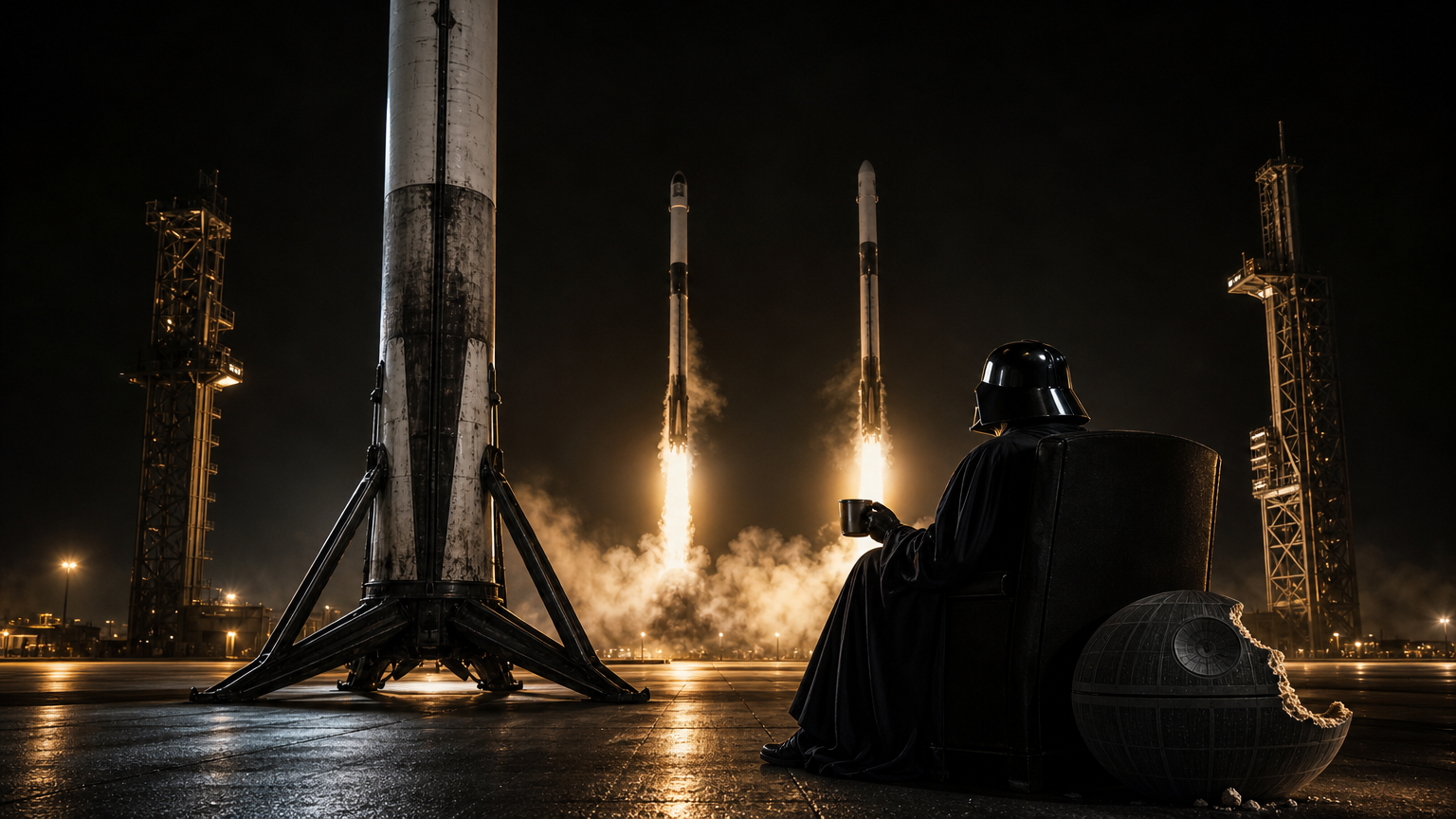
Even the Death Star procurement team would notice the refresh rate. The serious point behind the joke is that launch infrastructure is now part of strategic tempo. SpaceX did not disclose what was inside the fairings, but it did show how fast the pad, the people and the Falcon 9 system can come back for the next classified job.
Comments
Be the first to comment.