
What changed in the latest leak
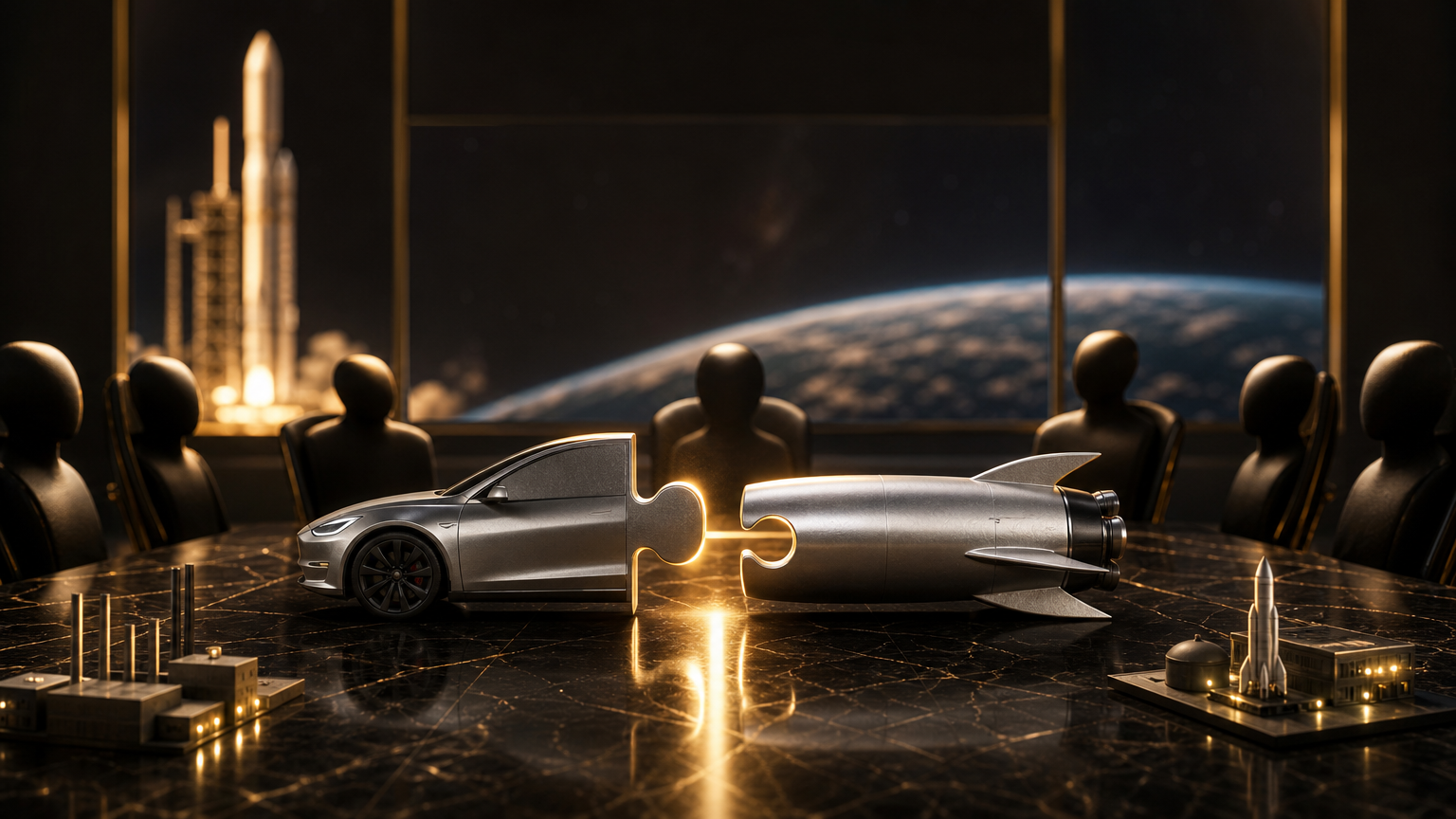
The working headline still matches the subject: Tesla & SpaceX Merger LEAKS (big if true). The newest development is not that Elon Musk suddenly likes the idea of putting his companies together; that part was already part of the market narrative. The fresh turn is that Tesla and SpaceX have reportedly put identifiable people and banks around the table, turning a speculative mega-merger into a more organized negotiation.
According to reporting first surfaced by the Financial Times and relayed across financial outlets, five directors are now guiding two special committees that would negotiate a potential all-stock merger between Tesla and SpaceX . The reported roster is three Tesla-side directors — Robyn Denholm, Kathleen Wilson-Thompson and Jack Hartung — and two SpaceX-side directors, Roelof Botha and Randy Glein . That is the core leak: the talks are no longer just “Musk thinks it is a good idea,” but a governance process with named intermediaries.
The possible transaction is described as a roughly $3.5 trillion combination, which would place it in the realm of the largest corporate mergers ever discussed . But that number should be treated as a reported framing, not a signed price tag. No definitive merger agreement, no agreed exchange ratio and no formal shareholder package have been announced in the latest reporting .
Why the committees matter
The two special committees are meant to handle the conflict problem at the center of the story. Musk leads both companies, controls far more voting power at SpaceX than at Tesla, and would have a personal interest in any exchange ratio between the two shareholder bases . That is why directors deemed financially “disinterested” are reportedly being used to steer the negotiations .
This does not eliminate the conflict; it structures it. Special committees are supposed to create a cleaner record: independent review, separate advisers, valuation work, and a defensible recommendation if the companies eventually ask investors to approve a deal. In this case, the committees would have to answer a brutally simple question: how much of the combined company should a Tesla share buy, and how much should a SpaceX share buy?
That exchange ratio is the heart of the merger. If SpaceX is valued too generously, Tesla shareholders could argue that their upside in EVs, energy storage, autonomy and robotics is being diluted. If Tesla is valued too richly, SpaceX shareholders could argue they are handing over launch, Starlink, AI and defense-contract exposure too cheaply. The current reporting says that the exchange ratio has not yet been agreed .
The banks are building the math
The latest reports say Morgan Stanley and Goldman Sachs are advising SpaceX, while Evercore is advising Tesla . Their role is not merely ceremonial. In an all-stock merger, the banks’ models become the battlefield: relative valuation, projected synergies, governance rights, voting power, tax structure, legal risk and market reaction all feed into what each side can defend.
The bankers are reportedly examining overlaps in artificial intelligence, chip design and data-center operations, as well as possible complementary areas such as rockets, robotics and solar panels . That is why this story is bigger than “car company buys rocket company” or “rocket company rescues car company.” The strategic pitch is that Tesla and SpaceX increasingly sit on the same stack: compute, AI models, robotics, communications, energy and manufacturing.
Still, the commercial logic is not the same as the legal logic. A merger could simplify joint projects, reduce related-party friction and give Musk a single corporate roof for his AI and robotics ambitions. But the same overlaps could also intensify regulatory scrutiny, especially because SpaceX has U.S. defense exposure while Tesla has major China-linked business sensitivities .
The shareholder vote is the wall
The biggest obstacle may not be valuation models. It may be votes. The current reporting emphasizes that Tesla shareholders would have to approve the deal, and one account notes that support would need to come from holders of more than half of all Tesla shares, not merely a majority of votes actually cast .
That distinction matters. Retail shareholders are a large and vocal part of Tesla’s base, and many of them are friendly to Musk. But getting more than 50% of all outstanding shares is a heavier lift than winning a normal meeting vote. Any non-vote effectively becomes a problem. Institutions would likely demand a clear explanation of the exchange ratio, governance protections and the effect on minority shareholders before backing a combination of this size.
The vote also frames the political problem inside Tesla. Musk has long sought more influence over Tesla’s direction, especially around AI and robotics. Yahoo Finance reported that a SpaceX-Tesla combination, depending on terms and governance, could give Musk greater voting power than he currently has at Tesla and potentially even majority voting control . For supporters, that could mean faster execution. For critics, it could mean weaker shareholder checks.
Why SpaceX investors may care about the S&P 500 angle
One unexpected thread in the latest coverage is index eligibility. Reuters reported that J.P. Morgan believes a Tesla merger could help SpaceX become eligible for the S&P 500 and trigger passive buying equal to roughly 10% of SpaceX’s free-float shares . In plain English, if the merger created a cleaner path into major indexes, index funds and ETFs could be forced buyers.
That does not make the merger a certainty. It does, however, create another financial incentive around timing and structure. J.P. Morgan’s note, as reported by Reuters, said SpaceX currently faces eligibility hurdles for S&P 500 inclusion, including a trading-history requirement and profitability measures under GAAP . A merger with an existing S&P 500 constituent could potentially change the path, although index committees retain discretion.
This is a reminder that mega-mergers are not only about factories, rockets and AI chips. They are also about market plumbing. Float, lockups, index rules, passive flows and governance classes can move billions before the first synergy is realized.
Why “before year-end” is ambitious
The leak says the parties are racing to complete the deal before the end of the year, and Reuters cited earlier Bloomberg reporting that a deal could be announced as early as December . That timeline is aggressive. Even if the committees reach agreement quickly, an announcement is not the same as closing. A transaction of this scale would still need board approvals, detailed filings, shareholder materials, investor outreach and regulatory review.
The current state, therefore, is best described as advanced exploration, not a done deal. The names of the directors and advisers make the process more concrete. The absence of an agreed exchange ratio keeps the outcome unresolved.
The bottom line
This is a “big if true” story because both halves are still alive. The “big” part is obvious: a Tesla-SpaceX merger would combine two of Musk’s most important platforms and could reshape AI, autonomy, launch, satellite connectivity and robotics under one corporate umbrella. The “if true” part is just as important: the latest reports rely on people familiar with the matter, the companies have not announced final terms, and Reuters said it could not independently verify the original FT report .
For now, the cleanest reading is this: Tesla and SpaceX appear to be building the machinery for a historic merger, but the machinery has not yet produced a deal. The next signals to watch are a formal filing, an agreed exchange ratio, committee recommendations, shareholder-vote language and any public statement from Tesla or SpaceX. Until then, the leak is real enough to move markets, but not final enough to settle the argument.
Comments
Be the first to comment.