
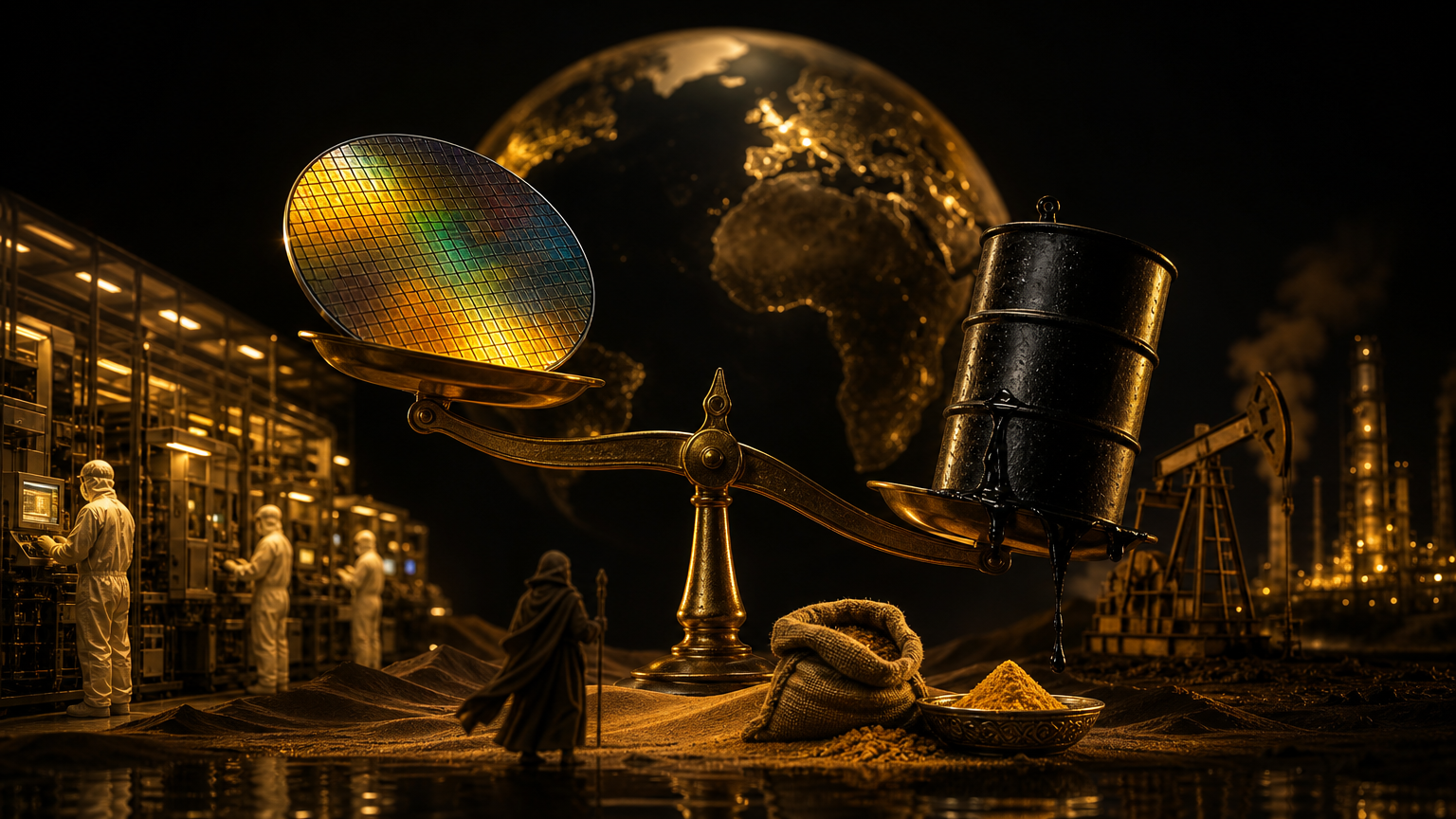
A commodity crossover with geopolitical consequences
Deutsche Bank says global semiconductor exports have surpassed oil and gas exports for the first time, using International Trade Centre data that put chips at about 1.61 trillion dollars against 1.53 trillion dollars for oil and gas on a four-quarter rolling basis in the first quarter of 2026 . The lead reportedly widened in the second quarter, with semiconductor exports near 1.60 trillion dollars and oil and gas exports around 1.47 trillion dollars .
That is not just a statistical curiosity. For half a century, energy exports sat at the center of global trade, financial recycling and diplomatic leverage. Oil revenues helped shape sovereign balance sheets, U.S. Treasury demand and the strategic vocabulary of supply security. Deutsche Bank’s point is that silicon is now moving into that role: not as a perfect replacement for oil, but as the input without which AI, cloud computing, smartphones, cars, weapons systems and industrial automation cannot scale.
The timing makes the milestone sharper. The same reporting that highlighted Deutsche Bank’s analysis also described a turbulent market backdrop: semiconductor shares had just suffered severe swings as investors reassessed the sustainability of AI capital spending . In other words, chips are now large enough to look like a strategic commodity, but still priced like a high-beta technology cycle.
From petrodollars to “chip dollars”
The conceptual shift is powerful because the export surplus may behave differently. Oil surpluses historically flowed heavily into bonds, including U.S. Treasuries. Deutsche Bank’s Jim Reid suggested that chip-export earnings, concentrated in Asian economies tied closely to U.S. technology companies, could instead recycle into U.S. tech equities, startups and data-center infrastructure .
That matters because the AI buildout is capital hungry. If the world’s chip exporters reinvest part of their earnings into the very ecosystem that creates more chip demand, the loop becomes self-reinforcing: fabs ship components, hyperscalers build compute, AI services increase appetite for accelerators and memory, and the trade surplus is partly recycled back into the next wave of infrastructure. The article’s key word is “could.” This is not yet a measured replacement for the petrodollar system; it is a hypothesis about where the next pool of strategic export income may go.
The comparison also has a physical side. Oil and gas are consumed as energy; semiconductors are embedded into systems that multiply productivity, surveillance, automation and military capacity. That gives chips a dual identity. They are a traded good, but also a lever over every sector that depends on compute. If Arrakis had spice, Earth increasingly has wafers.
Washington’s answer: industrial policy meets trade enforcement
The U.S. Trade Representative’s move against South Korea shows how fast the policy frame is changing. On November 25, 2026, USTR said it had made determinations in 14 Section 301 investigations into structural excess capacity and production in manufacturing sectors, covering China, the European Union, Korea, Japan, Taiwan and others, while not yet making determinations on Mexico or Norway . The agency said the practices it identified were unreasonable and burdened or restricted U.S. commerce under Section 301 of the Trade Act .
For South Korea, the proposed remedy is not framed narrowly as a chip tariff. USTR said it was considering tariffs on all goods of Korea of up to 15 percent, net of most-favored-nation rates and existing Section 301 tariffs, with exemptions for certain goods . In the Korea-specific notice, USTR added that if consultations and existing commitments are judged unsatisfactory, it would consider a tariff of up to 25 percent, again net of MFN rates and existing Section 301 tariffs, on all Korean products with specified exemptions .
The exemptions are crucial. The Korea notice lists, among other categories, “semiconductor articles” already subject to Section 232 treatment among proposed exemptions from the new additional tariffs . That means the immediate mechanism is broader than simply taxing memory chips at the border. But the political message is unmistakable: fabs, subsidies, power, water, permits and export targets are now trade-enforcement issues.
Why South Korea is in the spotlight
USTR’s Korea report identifies industrial and sectoral plans, preferential lending through state-owned banks, and failures to address global excess capacity linked to non-market-economy imports and investment as key concerns . It says Korea engages in these interventions across sectors including automotive, semiconductors and chemicals .
The semiconductor section is especially sensitive because Korea is not a marginal supplier. USTR said Korea’s production is overconcentrated in memory semiconductors, with two Korean companies holding more than 70 percent of the global DRAM market and 51 percent of the NAND flash market . Those figures are more than market-share trivia. They explain why Washington views Korean chip policy as a supply-chain security matter as much as a trade-balance matter.
Seoul is pushing back. The Korea Herald reported on November 26 that South Korea was not considering drastic changes to its industrial policies after the U.S. cited those policies in the tariff proposal . A Korean ministry official said Seoul expected the final tariff rate to remain at the level agreed between the two countries and argued that Korean chip exports were meeting surging global demand . The same report said USTR had cited Korea’s manufacturing share of GDP, goods-export share and the DRAM and NAND positions of two Korean chipmakers as evidence in its overcapacity case .
SBS similarly reported that Washington left open the possibility of raising the Korean rate to 25 percent if consultations or implementation of existing commitments are deemed unsatisfactory . SBS also said the measure followed Section 301 investigations into 14 economic entities and that the USTR pointed to Korean industry-specific promotion plans and preferential lending through policy financial institutions .
Chips are strategic, but not simple
The tension is that both sides can be partly right. Deutsche Bank’s export crossover suggests the world wants more chips, not fewer. AI data centers, electric vehicles, smartphones, defense systems and industrial equipment all require more silicon content. From Seoul’s perspective, building capacity is a rational response to demand and a way to secure national growth.
From Washington’s perspective, however, strategic demand does not automatically validate every subsidy. If governments race to finance fabs, smooth permitting, provide cheap infrastructure and push exports, the result could be a familiar cycle: shortages during booms, overcapacity after buildouts, price collapses, and political fights over who absorbed the adjustment. Memory chips are especially vulnerable because their pricing has historically been cyclical.
That is why the Deutsche Bank milestone and the USTR case belong in the same story. The former says chips have acquired energy-like macro weight. The latter says the supply chains behind that weight are becoming more political, more litigated and more conditional on trade agreements.
The new commodity map
The immediate question is procedural: USTR is taking written comments through January 5, 2027, and plans public hearings on January 25, 2027, before finalizing proposed actions . For South Korea, the near-term baseline appears to be a 15 percent cap consistent with prior understandings, but the 25 percent alternative gives Washington leverage over industrial policy, investment promises and perhaps related digital-trade disputes .
The larger question is structural. If semiconductors now exceed oil and gas in export value, then the world’s key choke points are not only straits, pipelines and tanker routes. They are also EUV tool supply chains, advanced packaging capacity, memory cycles, export controls, water and electricity for fabs, and the political bargains that decide where fabrication happens.
Oil made states think in barrels. AI is making them think in wafers. Deutsche Bank’s crossover captures the moment when that ceased to be a metaphor and became a trade statistic . The USTR action against Korea shows what follows: once chips become the new strategic commodity, chip policy becomes trade policy, industrial policy and national-security policy all at once.
Comments
Be the first to comment.