
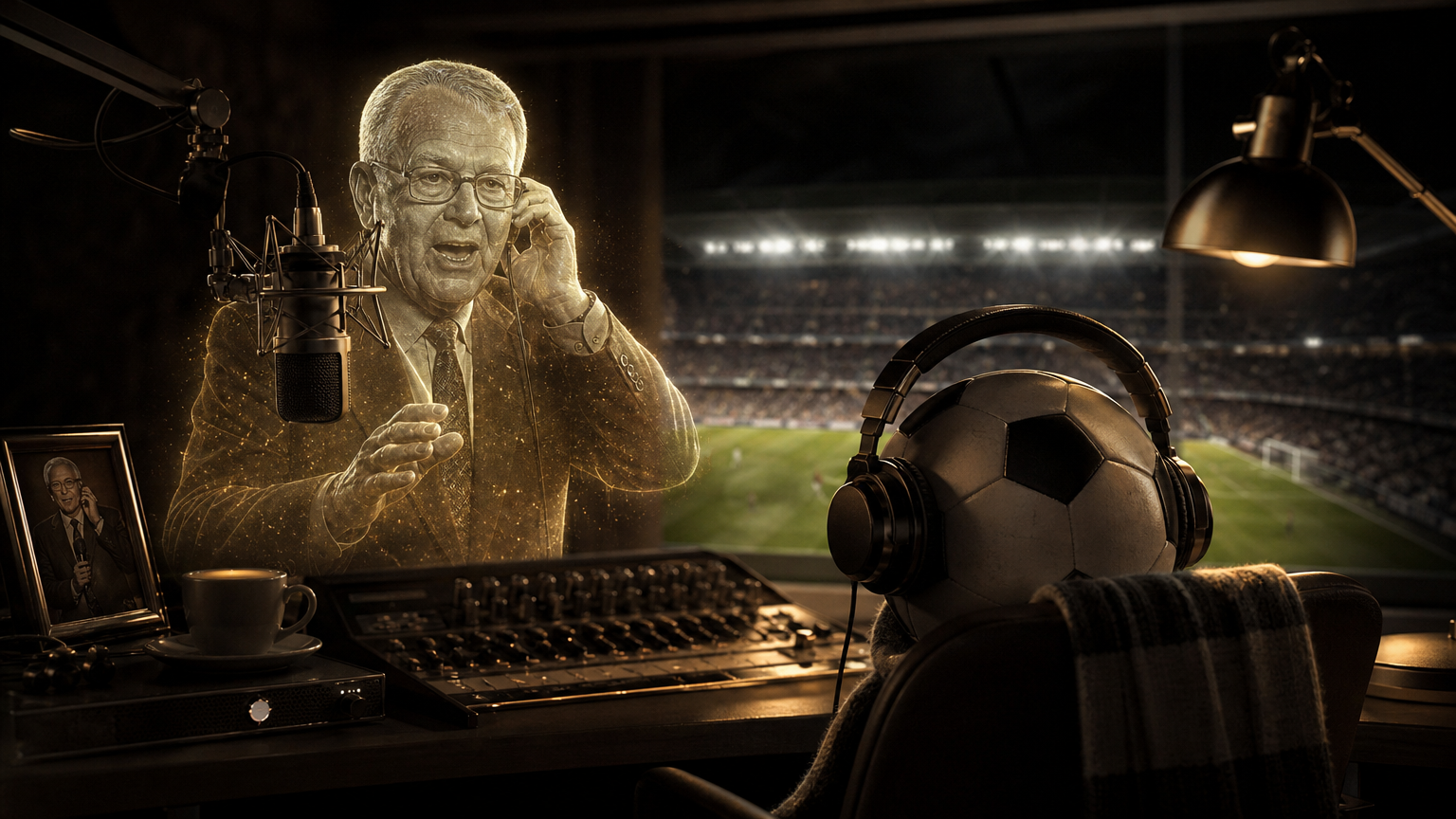
Motty returns to the booth
Electronic Arts has made John Motson an optional commentator in EA Sports FC 27, using a mixture of his original in-game recordings and an AI recreation trained on recordings of the late English football commentator . The feature arrives with Title Update v1.3.0 on November 26, 2026, and sits alongside the game’s existing broadcast teams rather than replacing them .
EA’s framing is deliberately reverential. In its own announcement, the company describes the addition as a “digital tribute” created “with the blessing and partnership” of Motson’s family . The official patch notes say the studio built on nearly ten years of Motson’s in-game recordings and used AI-assisted tools to update his commentary for the tribute . Players can choose him through the FC 27 audio settings menu, making this a selectable nostalgia layer rather than the default sound of the game .
That choice matters. Motson is not just another announcer in the history of EA’s football series. He was the voice of the franchise’s early commentary era, appearing across EA Sports football titles from 1996 to 2006 . For players who grew up with FIFA in the late 1990s and early 2000s, his voice is part of the memory architecture of the series: menus, goals, replays, late winners and rainy virtual afternoons.
Why EA needed AI
The practical reason for using generative AI is straightforward: Motson died in February 2023, aged 77, and there are no new recording sessions to capture his delivery on current players, clubs or match situations . EA says FC 27 uses a blend of original audio and AI-recreated lines trained on recordings “of the man himself” . Reporting on the announcement says the revived commentary is designed to include references Motson never recorded, including modern footballers whose names were not in the database during his FIFA years .
That is the basic promise of AI voice work in sports games: commentary can be expanded, adapted and refreshed without the physical recording burden of every new name, mode, patch and tournament scenario. In theory, that can make commentary feel more current. In practice, it raises the question of where a performance ends and a synthetic extension begins.
Motson’s case is especially sensitive because his voice is not merely a voice asset. It is a public identity built over decades at the BBC, where he covered more than 2,500 matches and 20 international tournaments, and where his career was recognised with a BAFTA Special Award in 2018 . EA is therefore not reviving an anonymous dataset. It is reviving a recognisable cultural figure whose microphone style carried emotional weight for football fans and gaming audiences alike.
Family approval, estate rights and the consent gap
EA says it worked with Motson’s family, and the announcement includes a statement from his son, Fred Motson, thanking the FC team for preserving his father’s memory in-game . VGC reported that Motson’s widow and son gave permission for the recreation, and that EA paid the family for the rights to use his likeness and voice, without disclosing the terms . Inven Global, also citing the BBC’s reporting, says EA would not have proceeded without the family being fully on board .
That does not end the ethical debate. It starts it.
The central question is not whether the project has legal permission from an estate. The harder question is whether family approval can substitute for the explicit consent of the person whose voice is being cloned. Peter Caulfield, founder of Save Our Voices Now, criticised the idea that relatives should automatically be able to authorise AI cloning after death, arguing that the person should have specifically agreed to it . Inven Global likewise reported his concern that Motson himself could not consent to the recreation .
This is the consent gap now confronting entertainment companies. Estates have long managed posthumous rights: likenesses, archive footage, unreleased recordings, hologram-style performances and biographical projects. Generative AI changes the stakes because it can create new performance-like material that the person never actually delivered. In Motson’s case, the AI can make him say names and phrases that fit today’s FC 27 world. The emotional effect is familiarity; the legal and ethical complication is novelty.
EA’s defence is that the project is a tribute, not a replacement strategy. Mat Prior, senior game design director at EA Sports FC, told the BBC that family permission was essential and that the studio wanted to honour Motson as the first voice of the game . He also rejected the idea that AI is being used to replace commentators, saying there are no future plans to replace anyone with AI . Still, even a sincere tribute can become a precedent. Once a publisher proves it can respectfully revive one beloved voice, other rights holders will ask why the same cannot be done for actors, athletes, presenters or streamers.
A nostalgia feature with industry consequences
The timing is important. Sports games are live-service products now, updated through seasons rather than frozen at launch. FC 27’s Title Update v1.3.0 is not only about Motson; EA’s patch notes also list gameplay tuning, matchmaking changes, Career updates and other fixes . Motson’s return is therefore part of the rhythm of a modern sports platform: the game keeps changing, and audio becomes one more system that can be patched, personalised and expanded.
The Standard reported that Motson can be selected as an optional commentary choice alongside the existing broadcast teams . That makes the feature feel closer to a cosmetic or presentation option than a wholesale editorial shift. Players who want the current team can keep it; players who want a classic FIFA atmosphere can summon Motty.
But optionality does not remove the broader labour question. Voice performers and commentators increasingly face contracts that must account for synthetic replication, future reuse and model training. Living commentators can negotiate those terms directly. A deceased commentator cannot. That is why the Motson tribute will be watched beyond the FC community: it is a test case for how a major publisher presents posthumous AI as respectful, consensual and additive.
The new normal, or a one-off tribute?
EA is trying to thread a very narrow needle. On one side is a genuinely affecting tribute to the first real-world voice many players associate with the series. On the other is a technology that can make the dead sound newly available, newly productive and newly marketable.
The best reading of the FC 27 update is that it gives longtime fans a carefully labelled, family-approved way to hear Motson in a football game again. The more cautious reading is that it normalises a new category of digital performer: the archived celebrity whose estate can license not just old recordings, but plausible new ones.
For now, the feature is optional, bounded and explicitly presented as a tribute. That restraint is important. The next test will be whether the industry treats Motson’s return as a special case, rooted in his unique history with EA’s football games, or as a template for reviving any recognisable voice with enough archive material and a signed agreement.
Either way, FC 27 has moved the commentary booth into a new era. John Motson is back in the game. The question now is who gets to decide when a voice has truly finished speaking.
Comments
Be the first to comment.