
A historic ceiling, not an instant constellation
SpaceX has won U.S. Federal Communications Commission clearance to deploy and operate up to 1 million orbital compute modules for a space-based data-center network called Starmind, a decision the agency framed as the first authorization of its kind in U.S. history . The FCC said the satellites are meant to process large volumes of data for use back on Earth and to support the United States’ push into what Chairman Brendan Carr called the “super intelligence” era .
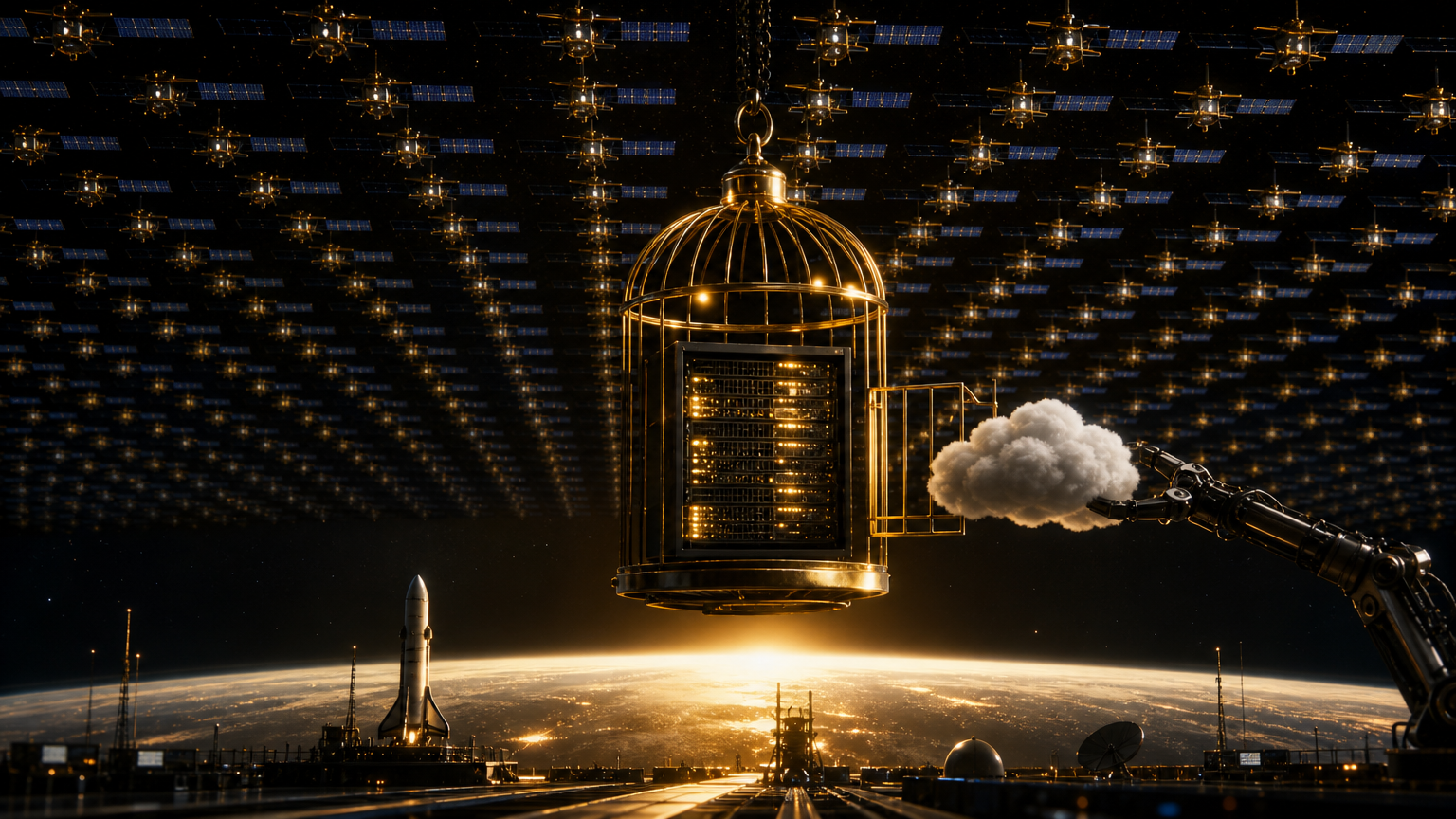
The headline number is extraordinary, but it should not be read as a promise that 1 million satellites will appear over Earth in the near term. The authorization is conditional and structured as a long deployment runway: SpaceX has years to begin service, then additional milestones stretching into the next decade . In practical terms, the FCC has given SpaceX regulatory room to attempt an industrial experiment at orbital scale, not evidence that the company has already solved the economics, thermal engineering, launch cadence or debris-management problems that such a network implies.
The agency’s own announcement describes Starmind as a constellation of up to 1 million orbital data centers designed to meet demand for compute . Reporting on the order adds that the satellites would operate at altitudes between roughly 500 and 1,002 kilometers, rely primarily on optical inter-satellite links, and use Ka-band radio frequencies in limited backup and emergency roles . That architecture matters because the approval is not simply about adding more broadband satellites to Starlink; it points to a broader SpaceX ambition to merge launch, satellite operations, cloud infrastructure and AI computing.
What the FCC actually approved
The FCC’s clearance allows SpaceX to establish Starmind at unprecedented scale and to maintain command, tracking and emergency communications for the system . The agency also authorized radiofrequency links in the 18.8–19.3 GHz downlink and 28.6–29.1 GHz uplink bands as backup for the constellation’s optical network .
Via Satellite reported that the approval covers 1 million optically linked satellites and that SpaceX plans to use Ka-band communications within Starlink’s existing authorization for limited backup and emergency operations . The same report says the authorization begins as a 15-year period once SpaceX launches a Starmind satellite, with the first-satellite deadline set for November 25, 2033, a 10 percent deployment milestone in 2035, a 50 percent milestone in 2038 and full deployment due by 2040 .
That schedule is central to understanding the decision. SpaceX is being handed time to prove the model. Ars Technica similarly described the order as giving SpaceX seven years to deploy a single operational Starmind satellite and until November 2040 for the full constellation . This is a regulatory green light for development and deployment; it is not confirmation that mass production, launch demand, orbital traffic management and compute performance are already settled.
Why orbital AI compute is attractive
The strategic logic is easy to understand. AI data centers on Earth are increasingly constrained by electricity supply, land use, grid connections, water demand and local opposition. SpaceX’s proposal reframes orbit as a power-rich environment: satellites can use solar arrays directly, avoid terrestrial zoning battles and link compute nodes through laser communications. The FCC echoed that vision, saying the system could help meet fast-growing demand for super-intelligence computing .
SpaceX’s broader advantage is vertical integration. It builds satellites, operates Starlink, flies Falcon 9 at high cadence, is developing Starship for heavier lift and now has regulatory cover to test whether orbital compute can become a new layer of cloud infrastructure. Via Satellite reported that analysts view orbital data centers as aligned with SpaceX’s long-term integration of compute, satellite operations and launch, while still technically and economically unproven .
If even a fraction of Starmind materializes, launch demand could be reshaped. A million-satellite ceiling implies not one megaconstellation but a continuous manufacturing and replacement pipeline. It could also intensify competition for spectrum and orbital shells, especially if other orbital data-center proposals advance. The FCC said it is reviewing additional orbital data-center applications and intends to move through them under regular procedures . Via Satellite identified other pending proposals, including Starcloud’s 88,000-satellite filing and Blue Origin’s 51,600-satellite Project Sunrise .
The hard physics behind the hype
The major caveat is that data centers are not ordinary payloads. High-performance computing produces heat, and removing heat in space is difficult because vacuum prevents convection. TechCrunch noted that SpaceX still faces major technical and economic challenges, including reducing satellite manufacturing and launch costs, cooling processors in space and financing chips destined for orbit .
Via Satellite reported that SpaceX describes Starmind satellites as carrying compute payloads averaging 175 kW and peaking at 250 kW, with deployable liquid radiators to handle heat and solar arrays derived from Starlink designs . Those numbers underline the ambition and the risk: every satellite would be a power plant, thermal system, compute node, communications terminal and maneuvering spacecraft at once.
Latency is another unresolved question. Orbital compute could be useful for workloads that can tolerate delay, especially batch processing, model training segments, or edge-like processing of data already in space. But many AI services depend on rapid round trips to users, data stores and terrestrial networks. Moving compute off-planet could reduce some energy constraints while adding new networking complexity.
Debris, astronomy and regulatory limits
The most immediate objections concern scale. TechCrunch reported that Amazon, Viasat and the American Astronomical Society objected to the application, raising concerns over orbital debris, congestion, radiofrequency interference and environmental consequences . Ars Technica reported that approximately 1,500 public comments were filed and that groups raised concerns including collision risk, atmospheric pollution from reentries and impacts on astronomical observations .
The FCC dismissed or narrowed several objections, saying some concerns fell outside its regulatory authority . It also declined to conduct broader environmental review after citing a recent policy shift under which the agency concluded that many space-based activities are generally outside its National Environmental Policy Act obligations . That part of the decision may prove as consequential as the approval itself, because it defines how far the FCC believes it must look when licensing systems whose physical footprint is in orbit but whose launches, reentries and debris risks affect Earth and near-Earth space.
The order did not give SpaceX everything it wanted. Ars Technica reported that the FCC did not grant SpaceX’s requested waiver for satellites above 600 kilometers to be disposed of into Earth-disposal or heliocentric orbits, saying the company had not provided enough information to show those methods would satisfy commission requirements . TechCrunch likewise reported that SpaceX must obtain approval for orbital-debris plans for satellites that would operate above 600 kilometers .
The bigger signal
The FCC’s decision is a marker for a new phase of space commercialization. Starlink made low-Earth orbit a communications platform. Starmind, if it progresses, would attempt to make orbit a compute platform. That shift could redraw the cloud market, increase the strategic importance of launch capacity, and make spectrum and orbital governance even more contested.
For now, the most precise reading is also the most cautious one: SpaceX has won an unprecedented ceiling, not a completed constellation. The cloud has been given a launch window, but the hardest engineering, financing and governance questions are still on the pad.
Comments
Be the first to comment.