
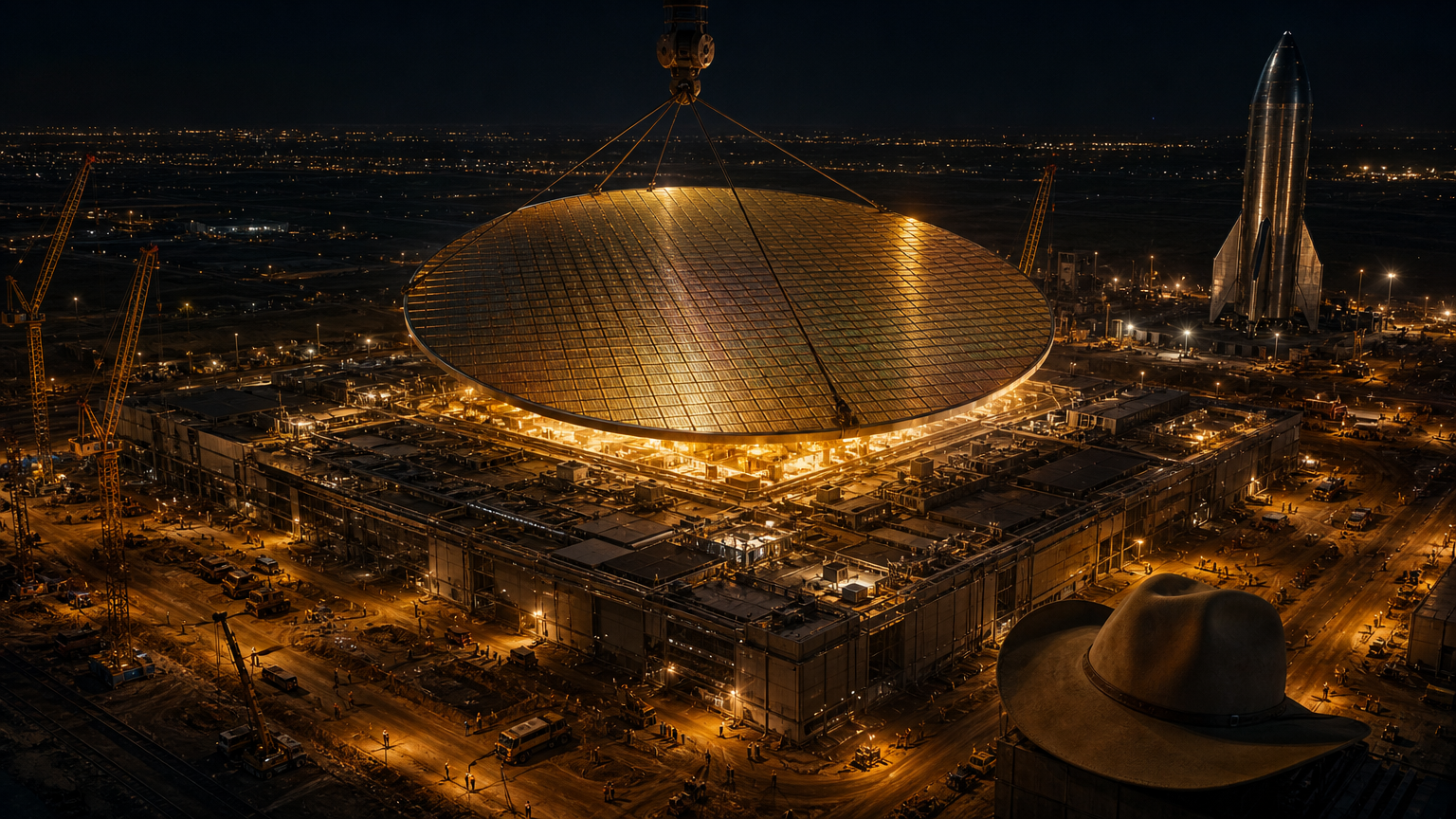
A Texas expansion, with an asterisk
TSMC’s Texas move is best read as a conditional expansion plan rather than a ribbon-cutting. The company’s U.S. unit has told Texas officials that a property-tax limitation would be a deciding factor in whether it builds a $22.6 billion chip-manufacturing facility in Brazos County, with Arizona still listed as a rival location . That distinction matters: the project is moving through the incentive pipeline, but the fab has not yet cleared the governor, the local school district and TSMC’s own final investment decision.
The proposed site sits in Brazos County, inside College Station ISD boundaries and within the City of College Station’s extraterritorial jurisdiction . In the filing described by Brazos County and College Station ISD, the campus is framed as the “TSMC Texas Advanced Semiconductor Manufacturing Campus,” a name that signals ambition but still depends on approvals . The plan calls for one semiconductor fabrication facility representing $22.6 billion in investment, producing leading-edge logic chips using 2-nanometer or more advanced process technology for artificial intelligence, high-performance computing and mobile applications .
If Texas wins, the project would immediately rank among the most consequential semiconductor siting decisions in the United States. Reuters reported that the planned campus could include one or more fabs and supporting infrastructure across more than 3,200 acres . College Station ISD separately said the public-hearing process concerns a proposed reinvestment zone of about 3,232 acres . In other words, this is not a small satellite factory; it is a full-scale manufacturing campus designed around future nodes.
Why Brazos County is suddenly on the chip map
The proposed location is notable because it places advanced semiconductor capacity in the Bryan-College Station orbit, not in the already established Arizona cluster. Local officials say the project is being evaluated in coordination with Brazos County, the cities of College Station and Bryan, College Station ISD, Texas A&M University and the Greater Brazos Partnership . That list shows what TSMC would be buying besides land: a university engineering pipeline, local political coordination and a region eager to position itself as a second U.S. semiconductor hub.
The economic pitch is large. Brazos County’s announcement says the proposed facility would create at least 2,099 direct jobs with an average annual salary of $133,000 . KBTX also reported that the proposal includes just over 3,200 acres, at least one fab, an estimated $22.6 billion investment and up to 2,099 direct jobs at the same average salary . Manufacturing Dive, citing filed documents, said the project would create at least 2,099 direct jobs by 2032 when fully operational and could produce $64.4 billion over 40 years in economic output or increased gross state product .
That scale explains why local leaders are treating the filing as transformational. It also explains why TSMC is still comparing Texas with Arizona. Arizona offers TSMC existing fabs, supplier relationships, infrastructure familiarity and workforce synergies, advantages the company itself cited as reasons an Arizona expansion could be operationally and economically attractive . Texas has land, political enthusiasm and proximity to a growing AI and electric-vehicle manufacturing ecosystem; Arizona has the installed base.
The tax break is the gate
The immediate story is not only chips. It is tax structure. TSMC is seeking relief under Texas’ Jobs, Energy, Technology and Innovation program, or JETI, which can limit the taxable value of eligible property for school district maintenance-and-operations taxes . College Station ISD said its board will consider whether to enter an agreement that would limit taxable value for 10 years, while interest-and-sinking taxes would continue to be assessed and paid on full taxable value .
KBTX reported that Deputy Comptroller Noah Betz signed a recommendation packet on Nov. 24 stating that TSMC meets eligibility requirements for the incentive program . The same report said the proposed project would receive an estimated $354 million school property-tax break over 20 years, while still generating about $405 million in school operating taxes during that period . Manufacturing Dive similarly reported that TSMC is seeking an estimated $354 million tax break for the $22.6 billion Texas facility .
The process now moves to public and political review. College Station ISD has scheduled a public hearing for 5 p.m. on Dec. 10 at its boardroom on Welsh Avenue, where trustees will address the JETI application and the proposed reinvestment zone . KBTX reported that both the governor and the district must agree for the project to proceed, and that one “no” can kill the deal . That is why the current phase is more than paperwork: it is the negotiation point at which a potential megafab either becomes a Texas commitment or remains leverage in a broader site-selection contest.
The Terafab and A14 backdrop
The Texas proposal also lands next to another semiconductor storyline: Elon Musk’s Terafab ambitions. A Yahoo Finance item citing The Real Deal reported that SpaceX is pursuing a Terafab in nearby Grimes County, expected to cost about $20 billion and rise roughly 15 miles from College Station . That proximity helps explain the strategic excitement around the TSMC filing. A foundry campus near a prospective high-volume AI and hardware customer ecosystem could shorten collaboration loops and logistics, even if no source has yet shown that the two projects are formally linked.
The technology backdrop is equally important. On Nov. 26, Tom’s Hardware reported that TSMC’s A14, a 1.4-nanometer-class fabrication technology, is ready for customer design work, with version 0.9 of its process design kit ready . The same report said A14’s Boost Cells can deliver 14% higher performance at the same power or 23% lower total power at the same speed compared with N2P using NanoFlex . That announcement does not mean the Texas fab will make A14 chips; current Texas filings point to 2-nanometer or more advanced technology . But it shows why a new U.S. campus is strategically valuable: TSMC’s leading-edge roadmap is moving past 2 nanometers just as AI chips, mobile processors and data-center silicon demand denser, more power-efficient manufacturing.
Power may be the most underappreciated part of the story. AI infrastructure is constrained not only by transistor count but by electricity, cooling, grid interconnection and manufacturing energy. A node that can offer lower power at the same speed has direct relevance to data centers and mobile devices . A fab campus in Texas, meanwhile, would intensify questions about skilled labor, water, power availability and grid reliability in a state already competing for major semiconductor, EV and energy-manufacturing projects.
What to watch next
The next milestones are clear. The Dec. 10 College Station ISD hearing will test local support and give residents a venue to question land use, infrastructure, taxes and public benefits . The governor’s review is the other gate, and KBTX reported that the statutory timeline gives the governor until Dec. 24 to decide whether to agree with the district, with notification to involved parties due by Dec. 31 . Until those steps are complete, “TSMC expands with $22.6B Texas plant” should be read as a live expansion bid, not a completed buildout.
The broader signal is already visible. TSMC is using U.S. site competition to decide where its next wave of advanced capacity should land. Texas is trying to convert land, incentives, universities and proximity to AI-industrial customers into a fab win. Arizona is defending its first-mover advantage. And chip buyers are watching because the location of new leading-edge capacity will shape supply chains for years.
For Texas, the motherboard may indeed need to get bigger. But first, the tax socket, power rails and local approvals all have to line up.
Comments
Be the first to comment.