
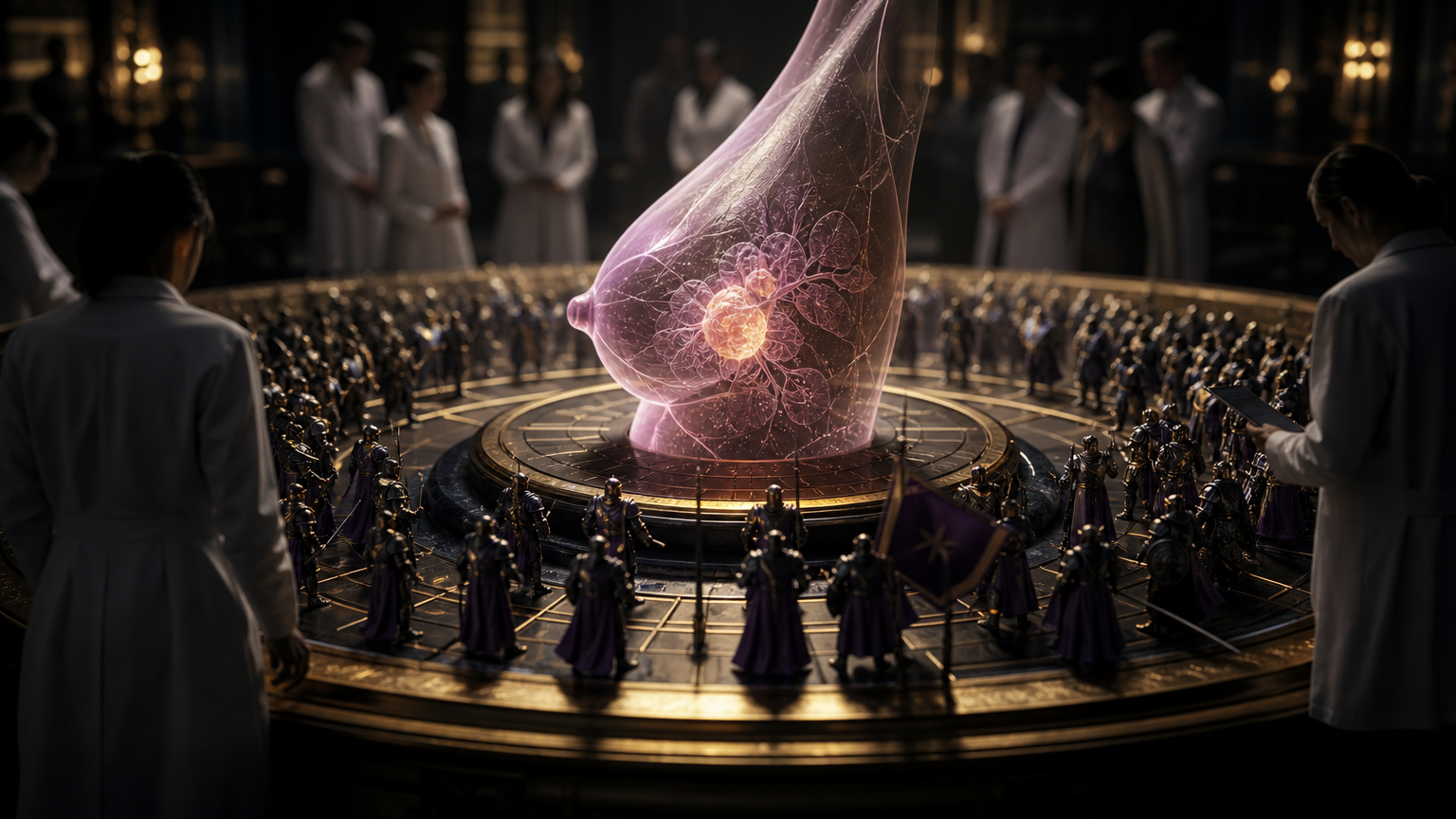
Two signals, one direction
Cancer AI has had many demos. This week brought two developments that matter because they move the technology closer to the places where evidence, regulation and clinical labour collide: national screening programmes and regulated imaging workflows.
In the UK, the EDITH trial has begun inviting women for what organisers describe as the world’s largest trial of AI-assisted breast screening, with nearly 700,000 women expected across 30 screening centres over three years . In the US, DeepHealth, a RadNet subsidiary, announced FDA 510(k) clearance for Mammo Risk, an image-based tool that estimates a woman’s three-, four- and five-year breast cancer risk from a routine 3D mammogram .
Taken together, the stories show two different but complementary bets. The UK is testing whether AI can safely change the labour model of screening. DeepHealth is betting that the mammogram can become not only a diagnostic image, but also a risk signal for future disease.
The UK trial is a scale test, not a victory lap
EDITH stands for Early Detection using Information Technology in Health. The trial will use AI to review mammograms collected during routine NHS breast screening, but it does not change the screening appointment itself . That detail matters. For participants, the visit remains the familiar mammogram pathway; the experiment sits downstream, in how the images are read.
The current NHS model uses two specialists to review each breast-screening mammogram . EDITH will test whether AI-assisted tools could mean that most images need review by one specialist rather than two, while maintaining safety and clinical standards . Cambridge is the first location to launch the trial, with the programme expected to expand to 30 breast-screening sites across the UK .
The numbers explain why the NHS is interested. Women aged 50 to 71 are invited for screening every three years, and about 2.1 million women in the UK have breast screening each year . Fewer than 1% of mammograms show signs of cancer, meaning a huge amount of expert time is spent reviewing normal images . If AI can reliably help triage or support reading, it could free radiologists and other specialists for diagnosis, treatment planning and direct patient care.
But EDITH is also designed to answer the questions that smaller studies cannot settle. Does AI perform consistently across real screening populations? Does it miss subtle cancers? Does it increase unnecessary recalls? Can it reduce workload without undermining trust? The trial’s size is the point: 700,000 women is large enough to expose problems that curated datasets and small pilots can miss.
Human oversight remains central
The trial is not replacing clinicians with software. Every mammogram will still be reviewed by at least one human radiologist, and the AI-assisted tool is being tested alongside the usual process rather than replacing it outright . The NHS has said it will only change how screening works if the evidence shows AI-assisted review is as safe and effective as current care .
That framing is important for public confidence. Breast screening creates unavoidable trade-offs: catching cancers early saves lives, but overdiagnosis and false positives can cause harm. A screening AI that finds more suspicious areas is not automatically better if it also drives unnecessary callbacks, biopsies and anxiety. EDITH’s value will depend on the balance between earlier detection, false positives, workload relief and clinical accountability.
The Health Research Authority also highlighted the governance behind the study. EDITH began after approval from a Research Ethics Committee and the Confidentiality Advisory Group, including scrutiny of the use of identifiable patient information without consent under the relevant UK framework . That does not remove every concern about data use, but it shows that the trial is being treated as health-system research rather than a simple technology rollout.
DeepHealth moves from detection to prediction
DeepHealth’s Mammo Risk clearance attacks the problem from another angle. Instead of focusing only on whether today’s image contains a suspicious lesion, the system estimates future breast cancer risk over three, four and five years from a completed 3D mammogram . DeepHealth says the software does not require an additional scan or lengthy clinical questionnaire because it analyzes existing mammogram images .
That shift is clinically significant. Detection tools ask: “Is there cancer here now?” Risk tools ask: “Who may need closer surveillance before cancer appears?” If reliable, that could support more personalised screening pathways, including supplemental imaging for women whose mammograms look normal but whose image-derived risk is elevated.
DeepHealth says Mammo Risk was trained on 220,000 studies and evaluated in an independent, multicentre pivotal study involving more than 65,000 screening mammograms across 10 US clinical sites . The company also says performance was consistent across important subgroups, including Black women and women with dense breasts . Those claims matter because breast density and demographic differences can affect both cancer risk and screening performance; they will also need close scrutiny as hospitals implement the tool.
MobiHealthNews reported that DeepHealth positions Mammo Risk as a move beyond lesion detection into longer-term risk assessment, and noted that the clearance follows a broader expansion of RadNet’s AI imaging portfolio [4]. Regulatory clearance gives hospitals a clearer path to adoption than a research-only model, but it is not the same as proof that the tool improves outcomes. The next question is whether clinicians acting on these risk scores can reduce late-stage diagnoses, avoid unnecessary imaging, and do so equitably.
The procurement question
Both developments point toward procurement decisions that will be harder than buying another piece of software. For the NHS, a positive EDITH result could influence national standards for breast-screening reads, staffing models and AI purchasing. It could also shape how screening services define acceptable false-positive rates and minimum human oversight.
For US providers, Mammo Risk enters a different system: fragmented payers, local hospital purchasing, malpractice concerns and reimbursement uncertainty. DeepHealth notes that the American Medical Association has established a Category III CPT code, effective January 1, 2027, to track use of image-based breast cancer risk assessment technologies and support evidence collection that may inform future reimbursement decisions . That is not full reimbursement, but it is a practical step toward measuring use in the real world.
The commercial challenge is therefore not just accuracy. It is integration. A risk score must appear in the right workflow, be understandable to radiologists and referring clinicians, and connect to an agreed follow-up pathway. Otherwise, predictive AI becomes another alert in an already noisy clinical environment.
What to watch next
For EDITH, the immediate milestone is expansion beyond Cambridge to the remaining planned sites. The longer-term evidence will need to show whether AI-assisted reading maintains cancer detection, avoids excess recalls, and meaningfully reduces workload across different populations and screening units . Until then, EDITH is best understood as a large evidence-generating trial, not confirmation that AI is ready to replace a second reader everywhere.
For DeepHealth, the key questions are post-clearance adoption and outcomes. Hospitals may be able to deploy Mammo Risk, but they still need protocols for what a high-risk result means: shorter screening intervals, supplemental imaging, genetic counselling, preventive medication discussions, or no immediate change. The clinical benefit will depend on those downstream decisions.
The broader story is that cancer AI is maturing from standalone pattern recognition into infrastructure. The UK is stress-testing AI at national-screening scale. DeepHealth is pushing mammography toward predictive risk stratification. Both are trying to move intervention earlier, before cancer becomes harder to treat. The promise is powerful, but the proof will come from real patients, real workflows and transparent reporting of both benefits and harms.
Comments
Be the first to comment.