
The week AI stopped feeling like one product category
The headline of the week is not just that Jensen Huang returned to Nvidia, or that Claude can now turn artifacts into desktop apps, or that ChatGPT users are suddenly parsing model allowances like airline fare rules. It is that all of these updates point in the same direction: AI is leaving the demo phase and becoming infrastructure.
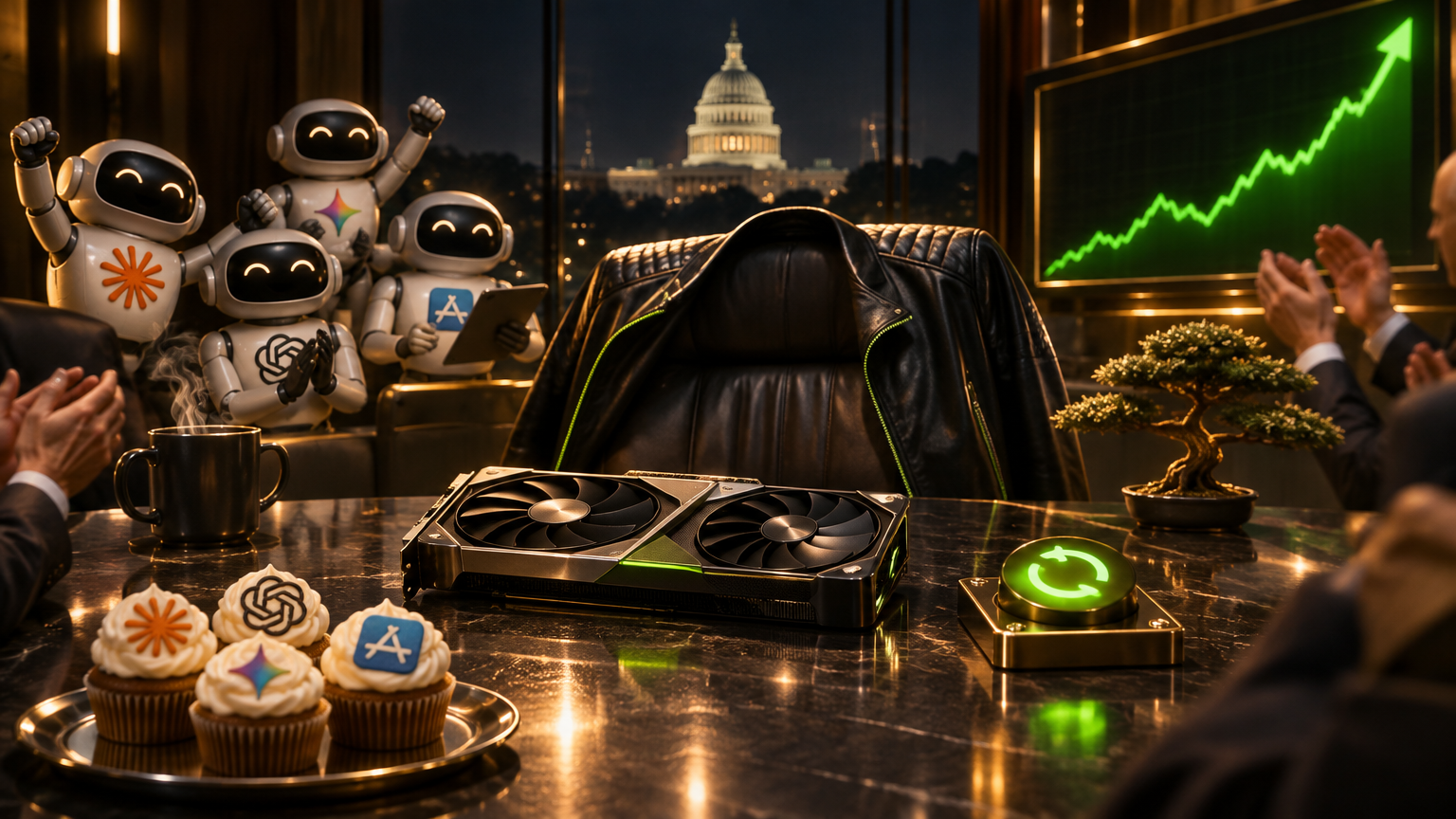
The weekly roundup that framed this story put Nvidia first for a reason. It reported that Huang, after stepping down on November 12, was reinstated on Monday as Nvidia’s president, CEO and board director, with the stock jumping about 33% at the open and the board still facing an independent investigation around the circumstances that triggered the crisis . That matters beyond Nvidia shareholders because the company remains the core supplier behind much of the modern AI stack: when the chip leader looks unstable, every AI lab, cloud provider and agent platform starts to look exposed.
But the market’s quick relief also says something about AI’s present psychology. Investors did not treat the episode as a normal governance story. They treated Huang’s return as a reboot of confidence in the broader AI buildout. The striking part is how closely that market mood overlapped with product news from Anthropic, OpenAI, Google and app developers: while Wall Street was stabilizing around Nvidia, the software layer was racing to make AI more autonomous, more embedded and more expensive to meter.
Jensen’s return: stability, but not closure
The updated reporting around Huang’s return adds a sharper political edge to the boardroom drama. Tom’s Hardware, citing a Washington Post report, said U.S. defense officials considered whether the Defense Production Act could be used to pressure Nvidia’s board into bringing Huang back, even though the law does not directly give the president power to appoint a private company’s CEO . That account also said defense leaders viewed Nvidia’s advanced AI chips as vital to national security, which helps explain why the company’s leadership became a government-level issue rather than a standard succession problem .
That is the central tension. On one hand, Nvidia’s business is so strategically important that continuity at the top can move markets and calm AI customers. On the other, a process that appears to involve political pressure, national-security assurances and possible congressional scrutiny raises questions about where corporate governance ends and industrial policy begins.
For the AI industry, the short-term read is simple: Huang’s reinstatement removes an immediate leadership vacuum. The longer-term read is harder. If Nvidia is now treated as a quasi-national asset, then every major decision about chips, exports, executive leadership and AI infrastructure may carry a political premium. That is good for the “too important to fail” narrative, but it is not the same as clean stability.
Claude’s “install as app” moment
While Nvidia supplied the market drama, Anthropic supplied the most concrete product shift. Claude users can now turn Claude Artifacts into desktop apps for Mac and Windows, with dedicated windows, icons and notifications . Tom’s Guide described the feature as rolling out in beta across all Claude plans, including the free tier, and emphasized that users do not need coding experience to start building small tools such as budgeting apps, meal planners or productivity dashboards .
This is why the “new Claude apps” part of the story feels genuinely important. Claude is not merely generating code snippets or mockups; it is giving casual users a path from prompt to working desktop utility. The workflow is simple: update Claude Desktop, describe the app, test the artifact, open the share menu, select “Install as app,” then approve the requested permissions . That turns the AI assistant into something closer to a personal software foundry.
The caveats matter. These installed apps are not fully independent software. Tom’s Guide notes that users need an internet connection and an active Claude login, and AI requests from those apps count toward existing usage limits . It also warns that Anthropic does not review apps before installation and that some permissions could allow an app to modify or delete files . In other words, this is not the end of traditional desktop software. It is the beginning of a messier middle period where users can generate tools quickly, but must also learn to judge permissions, reliability and hidden operating costs.
The practical implication is huge. The next wave of “apps” may not come from app stores. It may come from a user telling Claude, ChatGPT or Gemini: build exactly the tiny workflow I need, now.
ChatGPT’s update problem: power meets accounting
OpenAI’s week shows the other side of the same transition. The company is pushing more capable GPT-6.2 models into everyday ChatGPT use, but the conversation has quickly shifted from capability to consumption. TechRadar reported that OpenAI admitted a billing mistake at the launch of GPT-6.2 Astra and Sol: usage had been incorrectly discounted for many users, and after correction, users would reach limits 40% faster on Astra and 25% faster on Sol compared with the previous week . OpenAI said it would not retroactively charge users and would provide one banked reset to Go, Plus, Pro and Business users .
That is a classic “AI is becoming infrastructure” problem. When a chatbot was a novelty, users judged it by clever answers. When it becomes a work platform, users judge it by predictable capacity. If a coding task, research session or agent workflow burns through an allowance faster than expected, the product starts to feel less like software and more like a cloud bill.
The tension is not unique to OpenAI. Notion, another app moving deeper into AI agents, is facing similar user pushback over token usage. Tom’s Guide reported that Notion users complained recent AI features were draining tokens, and that Notion said it is working to make AI token usage more efficient while making it easier for people to use the AI subscriptions and systems they already rely on . Notion’s credit model was described as similar to systems adopted by Anthropic, OpenAI and Cursor .
That is the new normal: better agents, longer-running tasks and computer/browser use all require more compute. The companies want flexible pricing. Users want simple expectations. Those goals are colliding.
Google’s AI access fight
Google’s role this week is a reminder that AI access is not only about who gets the newest model. It is also about who can say no. The Associated Press reported that Los Angeles schools temporarily disabled Google’s AI Overview on district devices to keep student experiences “age-appropriate and safe,” amid broader school concerns about AI’s impact on learning . AP also reported that Google had said it would turn off Gemini and search tools by default for K-12 schools in the coming months unless administrators enable them, while maintaining that AI is deeply integrated into Search .
That matters because Google’s distribution advantage is enormous. AI features are not arriving as standalone products that users consciously install. They are appearing inside search, documents, classroom tools and mobile platforms. The battle over AI in schools previews a larger consumer issue: if AI becomes the default interface, opting out becomes harder than opting in.
The real story: assistants are becoming operating layers
Put the week together and the pattern is clear. Nvidia’s leadership crisis shows how strategic the hardware layer has become. Claude’s installable artifacts show how fast the app layer is being rewritten. ChatGPT’s GPT-6.2 usage dispute shows that model power is inseparable from pricing design. Notion’s token pushback shows that third-party apps are inheriting the same problem. Google’s school controversy shows that distribution and consent may become as important as benchmarks.
The “insane” part is not any single demo. It is the compression. AI companies are simultaneously shipping personal app builders, proactive agents, computer-use features, richer workspaces and more complex pricing systems. Users are getting more power, but also more responsibility: check permissions, watch usage, verify outputs, understand which plan unlocks which agent and decide when AI should be allowed into sensitive workflows.
This was not just another busy AI news cycle. It was a preview of the next interface war. The winners will not be the companies with the flashiest chatbot. They will be the ones that make AI feel powerful, predictable and safe enough to live where people actually work.
Comments
Be the first to comment.