
The backlog is now the story
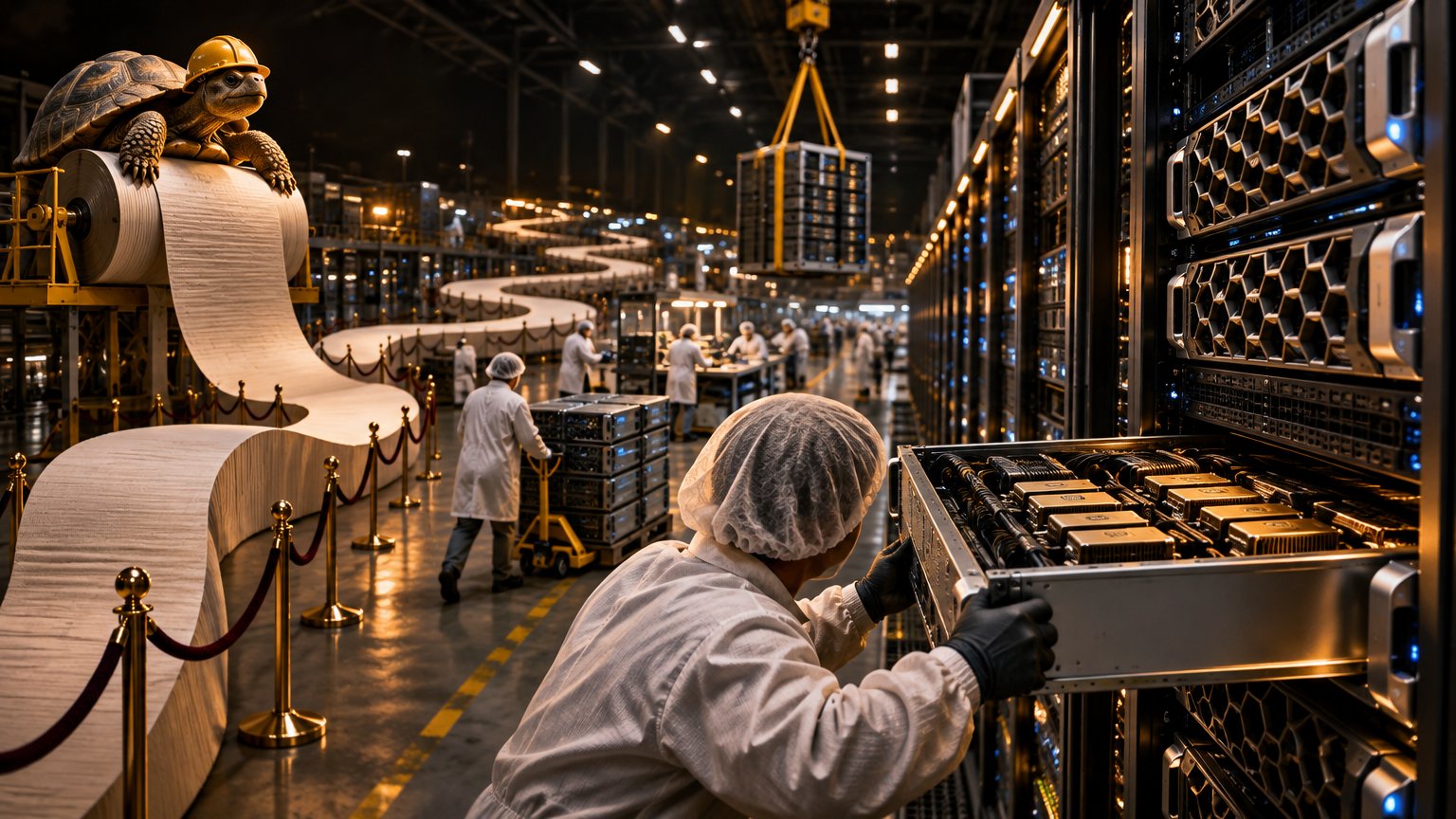
Dell’s latest AI moment is not about a model launch, a chatbot feature or a speculative software multiple. It is about a queue. The company ended its most recent quarter with roughly $132.3 billion in AI server orders still to fulfill, after booking $60.2 billion of new AI server orders during the period . That figure is large enough to change how investors, customers and suppliers read Dell: no longer primarily as a PC maker with a strong enterprise arm, but as one of the manufacturers standing between AI ambition and usable data-center capacity.
The company also reported quarterly revenue of $54.9 billion, up 103% year over year, while AI-optimized server revenue reached about $22 billion, up 291% from the prior year period . Dell raised its full-year AI server revenue forecast to $78 billion, but the headline number is still the backlog, because it captures demand that has been promised but not yet converted into shipped systems, accepted deployments and recognized revenue .
For Michael Dell, that makes execution the central issue. A backlog can signal powerful demand, but it is not cash in the bank. It becomes revenue only when servers are built, delivered, installed, accepted and accounted for. The harder part of the AI boom is increasingly physical: GPUs, memory, networking gear, liquid cooling, power distribution, factory testing, freight, site readiness and customer financing all have to line up.
Why $132 billion is not just a demand signal
The backlog shows that customers still want capacity at scale. Dell says it vets buyers for customer quality and access to capital, land and power before production, and it has described more than 7,500 customers as deploying Dell AI Factory offerings . That matters because the most expensive AI builds are not impulse purchases. They depend on data-center leases, utility approvals, cooling plans, financing schedules and end-customer contracts.
The order book also reveals a timing mismatch. Dell booked $60.2 billion in AI server orders in the quarter but recognized about $22 billion in AI server revenue . In simple terms, orders arrived much faster than Dell could ship and recognize them. The backlog rose from $95 billion to $132.3 billion, an increase of roughly $37.3 billion, even as Dell’s AI server revenue hit a record .
That is both a strength and a pressure point. It gives Dell unusual forward visibility in a cyclical hardware business, but it also creates a public scoreboard for execution. Each quarter now tests whether the company can reduce, maintain or further expand the queue without damaging margins, pushing customers into delays or leaving expensive inventory stuck in transition.
Nvidia supply and platform timing shape Dell’s calendar
Dell’s AI server business remains closely tied to Nvidia’s platform cycle. Reporting on Dell’s post-earnings commentary said most new AI server orders are now based on Nvidia’s Vera Rubin NVL72 rack-scale system, while Dell has not disclosed how much of total backlog, revenue or shipments that platform represents . That distinction is important: new bookings show where customers want to go next, but they do not prove how fast the new systems can be manufactured and deployed.
The same report said Dell has taken about $180 billion of AI orders over the past four quarters, and that management framed delivery timing as a central risk because demand continues to exceed supply . If a majority of new orders depend on a platform that is still ramping, Dell’s schedule is partly Dell’s own manufacturing challenge and partly Nvidia’s supply challenge.
Dell does have some diversification. It has promoted PowerEdge systems using AMD processors, which helps limit dependence on a single chip supplier . But the AI server market’s center of gravity remains Nvidia-based accelerated computing, and that means Dell’s backlog is tied not only to Dell’s factories but also to the cadence of GPU, networking and memory availability.
Export checks add a new bottleneck
A separate complication emerged this week around Southeast Asia. Reports said Nvidia froze or paused server shipments to Malaysia, Singapore, Thailand and Indonesia while partners reviewed compliance with new U.S. export requirements, and Dell and Super Micro were among the companies said to have passed that message to customers . The same report noted that Dell’s record backlog becomes revenue only when servers ship, and that Dell has not broken out how much of its backlog is exposed to those countries .
The policy backdrop matters because new U.S. rules require licenses for shipments of advanced AI chips to several countries, including Indonesia, Malaysia, Singapore and Thailand, with some data centers given a 90-day window tied to compliance . Even if the pause proves temporary, the episode shows how AI infrastructure is now governed by more than component supply and customer demand. Export controls, end-use checks and regional data-center relationships can slow the physical delivery of systems that are otherwise commercially booked.
For Dell, that turns backlog quality into a geopolitical as well as financial question. An order from a well-funded buyer is stronger if the chips can legally move, the site is ready, the end user is clear and the compliance paperwork does not freeze the shipment lane.
Investors like the demand, but question durability
The market’s debate is not whether Dell has AI demand today. It plainly does. The question is how durable that demand will be once the first waves of AI infrastructure are built, component prices shift and neocloud buyers reassess their capacity plans.
UBS reportedly cut its Dell price target to $365 from $500 while keeping a neutral rating, even as it raised earnings forecasts, because investors remain concerned about the longevity of the AI infrastructure spending boom and about whether rising component costs pulled some demand forward . Finimize, summarizing UBS’s argument, said the concern is not only the size of the backlog but also its composition and timing, with UBS estimating that a majority of orders may come from a relatively small group of fast-growing neocloud companies .
That customer-concentration issue cuts both ways. Large AI cloud buyers can place huge orders and move quickly, but they can also change capital spending plans quickly if financing conditions tighten, utilization misses expectations or model economics shift. Dell has said no customers had asked to reschedule business as of the latest earnings call, according to recent reporting . Still, investors are watching for the first sign that backlog converts more slowly than management expects.
Manufacturing is the hidden AI platform
The Dell story is a reminder that AI is no longer only a software race. The constraint is increasingly industrial. A modern AI rack is a dense, power-hungry system that must arrive with accelerators, high-bandwidth memory, networking, storage and cooling all integrated. Dell says it tests racks before shipment and can get one running within six hours of delivery, potentially accelerating time to first output for large customers . But that claim assumes the receiving site has the power, cooling, cabling, networking and physical space ready.
That is why the $132.3 billion backlog should be read less like a simple sales trophy and more like a delivery map. Each order depends on a chain: Nvidia and other component suppliers, Dell’s integration capacity, export compliance, customer financing, power availability and data-center readiness. A break at any link can delay revenue even if the customer still wants the system.
The upside is clear. If Dell keeps converting orders into revenue at rising scale, it can become one of the indispensable industrial platforms of the AI buildout. The company’s Infrastructure Solutions Group operating margin was reported at 17%, up from 12.4% a year earlier, suggesting that scale has not yet destroyed profitability . That is a crucial point in hardware, where revenue can grow quickly while margins disappoint.
The risk is equally clear. A backlog this large creates expectations. It invites questions about how many orders are concentrated in a few buyers, how much depends on new Nvidia platforms, how much is exposed to export reviews and how much requires customer sites that are not yet ready. Dell has demand. Now it has to prove that demand can survive the trip from purchase order to powered-on rack.
What to watch next
The key number in the next update will not be backlog alone. A growing backlog can mean demand is still strong, but it can also mean shipments are not keeping pace. The healthier combination would be strong AI server revenue, stable or rising margins, limited customer rescheduling and clearer evidence that large deployments are moving from factory-tested racks to operational data centers.
Dell’s $132 billion AI queue is therefore a symbol of the AI economy’s new bottleneck. The industry has spent years asking what models can do. Dell’s quarter asks a more physical question: how fast can the world build the rooms, power lines, cooling loops and server racks that make those models useful?
Comments
Be the first to comment.