
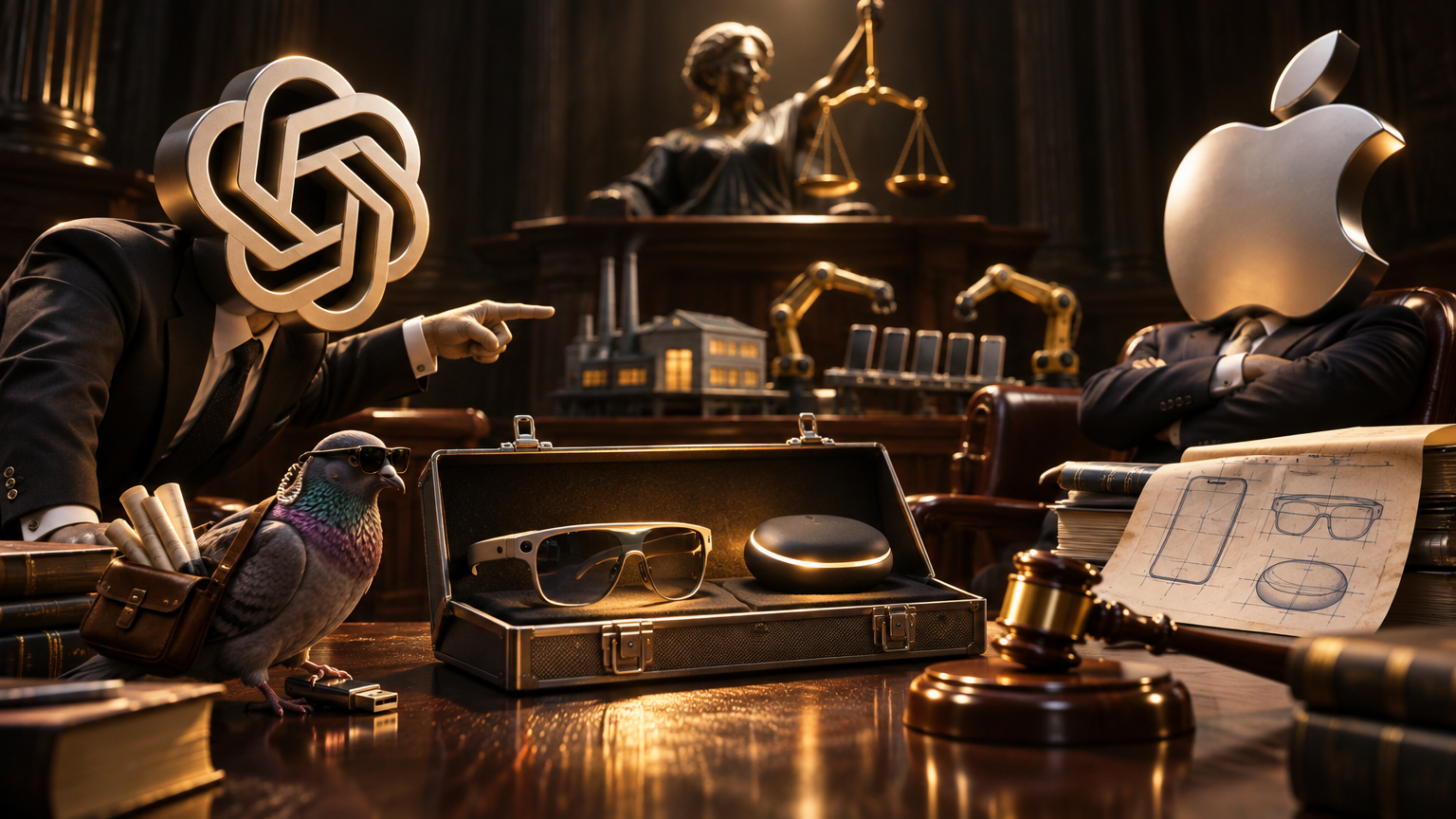
A courtroom rivalry moves onto Apple’s home turf
OpenAI has countersued Apple in federal court in California, escalating a dispute that began with Apple’s own July lawsuit over alleged hardware trade-secret theft and has now become a two-way fight about the next generation of AI devices . The new filing, made on November 27, accuses Apple of stealing OpenAI trade secrets, pressuring shared suppliers, and using employment rules in ways OpenAI says restrict competition for engineers and manufacturing capacity .
The stakes are larger than a conventional Silicon Valley hiring dispute. OpenAI says it is developing AI-enabled personal electronic devices that could “outcompete Apple” on territory Apple considers its own, according to reporting on the court filing . That phrasing matters because the case is no longer just about whether two former Apple employees carried information to OpenAI. It is also about whether Apple can use its position in hardware supply chains and employee contracts to slow a rival entering the device market.
What OpenAI is alleging
OpenAI’s counterclaims center on a former employee identified in reports as “Employee X,” who allegedly worked at OpenAI for about six months before returning to Apple . OpenAI claims that during that period, the employee sent confidential OpenAI material to personal accounts, including information about unreleased AI devices, device designs, manufacturing test data, and supplier information .
OpenAI further alleges that after the employee returned to Apple, he briefed senior Apple Asia-Pacific operations staff in July on OpenAI’s hardware development and product plans, an allegation Apple has not admitted and that remains untested in court . Anadolu’s report says OpenAI first raised related allegations in an October 14 filing, claiming the employee had sent more than 100 confidential files to personal accounts; Apple told the court at that time that its initial search found no confidential OpenAI information and that it had requested more details .
The counterclaims also broaden the case into the supplier arena. OpenAI says one supplier working with both companies moved OpenAI metal-finishing work to an overnight shift after Apple objected to parts for both companies being processed in the same place or at the same time . Another manufacturer allegedly told OpenAI it could no longer carry out planned work because of threats from Apple, forcing OpenAI to rearrange parts of its manufacturing operations .
Those allegations, if substantiated, would make the case about more than files and laptops. They would raise the question of whether a dominant hardware incumbent can influence a specialized supplier ecosystem in ways that make it harder for a new AI-device entrant to build at scale.
Apple’s position and the original lawsuit
Apple’s side of the story is sharply different. Apple sued OpenAI, io Products, and former Apple employees Chang Liu and Tang Yew Tan in July, alleging that confidential Apple hardware and manufacturing information was misappropriated to benefit OpenAI’s consumer-hardware ambitions . OpenAI denied misappropriating Apple’s trade secrets in its November 27 filing .
Apple has also pushed back against OpenAI’s counterclaims. Reuters reported Apple’s statement that OpenAI’s counterclaims are “a transparent attempt to distract” from Apple’s lawsuit, in which Apple says OpenAI has already been ordered to stop using Apple confidential information . Bloomberg reporting carried by Business Standard said Apple argues its case includes evidence that OpenAI employees used a stolen Apple-issued laptop and exploited an authentication bug to access Apple’s shared network .
The court has not decided the truth of either side’s core accusations. At this stage, both sets of claims are allegations, and the legal process will determine whether the information at issue qualifies as a trade secret, whether it was improperly acquired or used, and whether either company suffered provable harm.
Why the supplier fight may be the most important part
The supplier allegations are especially important because consumer hardware is not built by ideas alone. It depends on specialized manufacturing processes, engineering support, materials finishing, production scheduling, and access to vendors that may already have deep relationships with Apple.
Bloomberg’s report says OpenAI alleges Apple asked suppliers to identify their OpenAI projects and the names, locations, and assignments of workers with Apple experience . OpenAI also claims Apple sought to keep workers assigned to OpenAI projects away from Apple work, which OpenAI argues would discourage suppliers from dedicating experienced staff to OpenAI programs . The same report says OpenAI claims suppliers expressed fear of losing Apple business and moved or rescheduled meetings with OpenAI to avoid being seen by Apple .
If discovery supports those allegations, the litigation could expose how much power Apple still has over the high-end device supply chain. If the claims fail, Apple may strengthen its argument that OpenAI is trying to reframe a case that began with Apple’s accusations of trade-secret theft.
Either way, the case could become a map of the AI hardware race. OpenAI’s device ambitions became more concrete after its 2025 combination with io Products, the hardware startup associated with former Apple design chief Jony Ive . Apple, meanwhile, remains the company with the world’s most valuable consumer-device platform and one of the deepest supplier networks in technology.
Employment agreements become a battlefield
OpenAI is also challenging how Apple manages departing employees. Reuters reported that OpenAI says Apple’s employment practices are designed to “trap” employees and prevent them from working on competitors’ technology . CBS News reported that OpenAI alleges Apple created a situation in which it can accuse almost any departing employee, and that employee’s new employer, of stealing purported Apple trade secrets .
That line of argument cuts to a recurring issue in technology: the boundary between protected company secrets and the general expertise that engineers carry in their heads. OpenAI argues Apple’s intellectual-property agreements define confidential information too broadly, covering nonpublic information even when it is not necessarily a trade secret . OpenAI also challenges restrictions that bar former Apple employees from soliciting or recruiting Apple workers for one year .
For Apple, broad confidentiality protections are a core defense mechanism in a business where hardware road maps, prototypes, supplier processes, and manufacturing techniques can define product cycles. For OpenAI, those same rules may look like a moat around talent and suppliers at the moment AI-first devices are becoming a credible competitive category.
The bigger market question
This case lands at a moment when software companies are trying to move into devices, and device companies are trying to integrate AI more deeply into operating systems, assistants, and user interfaces. Apple integrated ChatGPT into Siri and Writing Tools in December 2024, according to Anadolu’s background on the dispute . That makes the relationship unusually complex: Apple and OpenAI have been partners in software while increasingly becoming rivals in hardware.
The fight could therefore complicate collaboration as well as competition. If the dispute intensifies, each side may become more cautious about shared integrations, supplier communications, employee movement, and confidential technical exchanges. Hardware partners may also become more reluctant to support OpenAI device projects if they fear jeopardizing Apple business, even before any court ruling.
What to watch next
The next phase will likely revolve around discovery, requests for injunctions, and attempts to narrow or dismiss claims. StockAnalysis, citing the case schedule, reported that Apple’s case is set for trial on July 19, 2027 . That gives both companies months to seek documents, depose witnesses, and test whether the supplier and employee allegations can survive beyond competing narratives.
For now, the clearest fact is that the OpenAI-Apple relationship has entered legal hard mode. What began as Apple’s claim that OpenAI benefited from Apple secrets has become a broader contest over who controls the knowledge, people, and suppliers needed to build the first truly mainstream AI-native device.
Comments
Be the first to comment.