
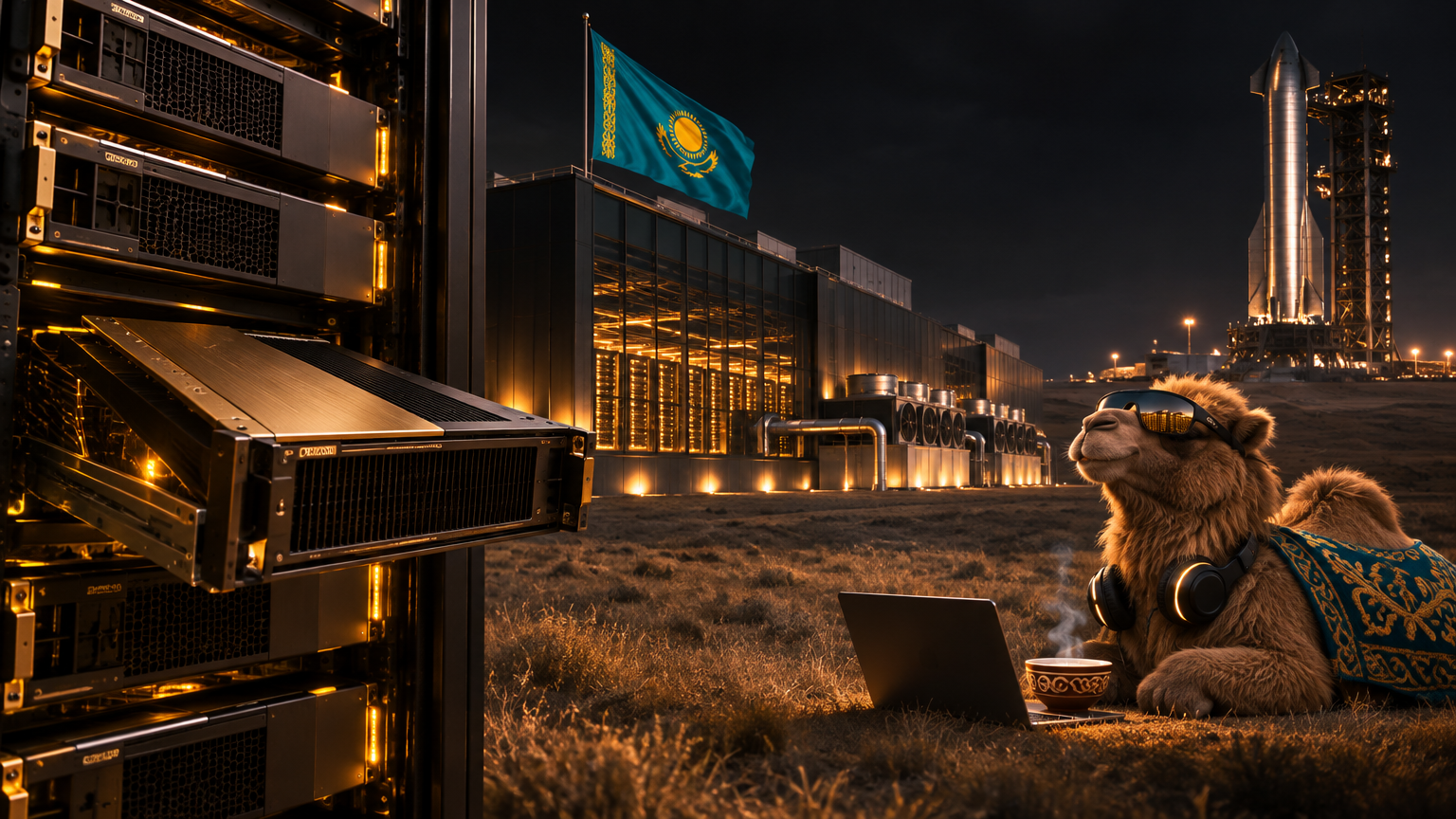
Two build-outs, one message: AI is becoming heavy industry
The newest wave of AI infrastructure is not just a software race. It is a race for accelerators, megawatts, local permitting, data-center sites and long-term buyers. Kazakhstan and SpaceX are now illustrating that shift from two very different angles: one is a state-backed sovereign AI push in Central Asia, the other is a Texas supercomputing build-out moving through a compressed approval window before a change in state leadership .
Kazakhstan’s plan centers on a $2 billion Sovereign AI Hub built around Nvidia B300 chips, with Freedom Holding placing an order for up to 300 B300-powered servers for an initial cluster . SpaceX’s Texas project, by contrast, is framed around a $24 billion Starbase data center and gas-fired power plant, with Texas officials reportedly moving quickly on approvals before Governor-elect Gina Hinojosa takes office in January and pursues a pause on new data-center approvals .
Together, the two projects show how “AI strategy” has become a physical infrastructure strategy. The decisive inputs are no longer only models, talent and venture funding. They are export-controlled chips, power plants, cooling systems, tax incentives, sovereign procurement and local political timing.
Kazakhstan wants a regional CUDA base
Kazakhstan’s project is designed to make the country a regional AI-compute player rather than just a consumer of foreign cloud capacity. ETDatacenters reported on November 28 that the planned Sovereign AI Hub includes a significant order of Nvidia B300 chips, with the first computing cluster expected to include up to 300 servers . Reuters, in a November 26 report republished by MarketScreener, said the plan was announced around Nvidia CEO Jensen Huang’s October visit to Astana, where Freedom Holding discussed the B300 order .
The structure matters. A $2 billion hub is not simply a large technology purchase; it is a national-capacity project. It potentially gives Kazakh companies, universities and public institutions access to high-performance compute without relying entirely on distant hyperscale clouds. If it is executed, Kazakhstan could position itself as a Central Asian venue for training, fine-tuning and serving AI models, especially for local-language, regional-business and government use cases.
The Nvidia connection also matters because frontier chips now function like strategic resources. Countries that cannot secure current-generation accelerators are forced to rent capacity abroad, buy older systems or accept slower model development. Kazakhstan’s B300 plan is therefore a statement about industrial policy as much as digital policy .
The Russia question adds sensitivity
The Kazakh build-out is also arriving in a geopolitically sensitive moment. Reuters reported that President Kassym-Jomart Tokayev told Vladimir Putin at Russia’s AI Journey conference that Russian companies including Sberbank and Yandex were welcome in Kazakhstan’s market . The same report noted that Russia’s AI sector faces major constraints because sanctions have limited imports of advanced U.S.-made chips needed to train AI models .
That does not mean Kazakhstan’s Nvidia-backed hub has become a Russian compute workaround. Reuters reported that Sberbank and Yandex did not publicly say whether they would move services to foreign data centers, and the available reporting does not confirm any agreement for Russian firms to use the new Kazakh hub . That distinction is important. Kazakhstan can court regional technology activity and still face scrutiny over whether its infrastructure could indirectly ease Russia’s access to advanced AI capacity.
Tokayev’s positioning reflects a balancing act: Kazakhstan wants Western technology, Nvidia-class hardware and a stronger domestic AI ecosystem, while also keeping commercial ties with Russian technology groups active . In sovereign AI, the question is not only who owns the data center. It is who gets access, under what rules, and how those rules intersect with sanctions and export controls.
Starbase turns permitting into an AI bottleneck
In Texas, the SpaceX story is less about sovereign compute and more about political timing. Yahoo Finance reported on November 27 that Texas had issued an air permit for the gas plant behind SpaceX’s $24 billion Starbase supercomputing campus, after the state resumed data-center permit reviews on November 16 . The same report said the approvals are moving ahead before Governor-elect Hinojosa, who defeated Greg Abbott on November 3, takes office in January with plans to halt new data-center approvals until lawmakers add protections .
That compressed timeline is the point. Advanced AI infrastructure can be constrained by chip delivery, but it can also be constrained by governors, county commissions and environmental regulators. SpaceX’s Starbase plan reportedly includes an on-site gas plant intended to generate electricity without drawing from the public grid, a design choice meant to reduce exposure to grid-connection disputes that have slowed other Texas projects .
Even then, self-generation does not remove all political risk. A project can bring its own power and still need air permits, tax treatment, local approvals and community acceptance. The Starbase case shows that permitting has become one of the new launch windows for AI infrastructure.
Local incentives are not automatic
SpaceX’s path is not frictionless. The Port Isabel-South Padre Press reported on November 26 that Cameron County commissioners voted 3-2 against advancing a proposed tax abatement for SpaceX’s planned $24 billion data center and natural gas power plant . The same report said the vote did not cancel the project, but it halted the county-level incentive process and left a separate City of Starbase incentive proposal scheduled for a December 9 public hearing .
The local debate is familiar across the data-center boom. Supporters see investment, construction work and permanent jobs. Critics ask whether huge data centers receive too much tax relief while increasing demand for public infrastructure, land, water and environmental oversight. In SpaceX’s case, the county report said the application projected about 500 permanent jobs and about 5,550 construction jobs, while also describing a proposed first-year taxable value of $13.8 billion .
For a $24 billion project, the tax question is not a footnote. It helps determine which public bodies share in the upside and which communities carry the burden of roads, emissions, emergency services and land-use change.
Compute demand is already waiting
SpaceX is not building in a demand vacuum. Reuters reported on November 28 that Elon Musk said Google was interested in renting more computing capacity from SpaceX, though he gave no details and the companies did not immediately comment . Reuters also reported that Google already has a multi-year cloud services agreement with SpaceX under which it will pay $920 million monthly from October 2026 to June 2029 for capacity that includes about 110,000 Nvidia GPUs plus CPUs, memory and related components .
That detail turns Starbase into more than a local Texas development fight. It suggests SpaceX is becoming a merchant supplier of AI compute to major model builders and cloud customers. Reuters also reported that SpaceX has disclosed compute-capacity agreements with Google and Anthropic worth more than $70 billion in aggregate, and that the company plans more than $74 billion of investment across Starbase and a second campus in Cochise County, Arizona .
The strategic logic is clear: if AI labs and cloud platforms cannot get enough capacity from traditional hyperscalers, companies that can assemble land, power, chips and interconnect at speed become infrastructure players in their own right.
The new AI map is drawn in power lines
Kazakhstan and SpaceX are not doing the same thing, but they are responding to the same scarcity. Kazakhstan is trying to localize access to frontier compute and build national AI capacity. SpaceX is trying to scale a privately controlled compute platform fast enough to serve major commercial customers while regulators still allow the project to move.
Both stories point to the same conclusion: AI advantage is moving down the stack. The winners will not only be those with the best models. They will be those who can secure chips, finance multibillion-dollar campuses, generate or procure power, win permits and define access rules before competitors do.
The steppe is getting its own Nvidia-powered AI hub. Starbase is turning into a permitting test for gigawatt-scale compute. The AI race now runs through data halls, substations and county agendas.
Comments
Be the first to comment.