
The headline check: this is the AI5-to-Optimus story
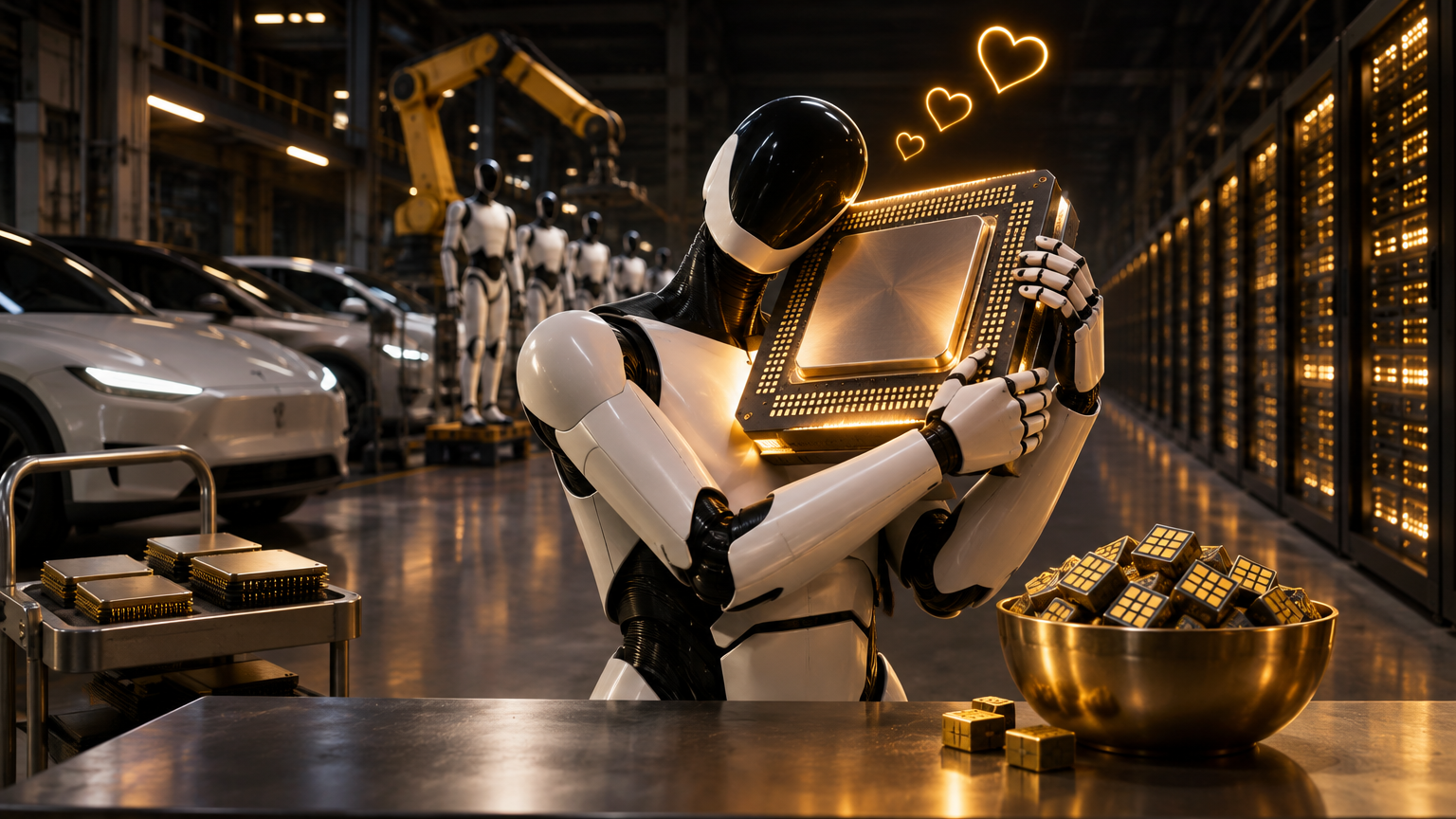
The working headline is the same story: New AI5 chip, 50x more power, Optimus’ amazing upgrade. The core development is that Tesla’s next-generation AI5 chip is no longer being treated as a uniform upgrade for every Tesla product line. Instead, the latest reporting says the chip is being aimed first at Optimus and AI compute systems, while Tesla vehicles remain on AI4 .
That sounds simple, but it is a meaningful pivot. Tesla has long sold investors and fans on the idea that the same AI stack could compound across cars, robots and data centers. AI5 was expected to be the next leap in that stack. Now the near-term priority appears narrower: give the most advanced silicon to the humanoid robot, not to the car fleet .
What Musk actually signaled
The essential quote remains Musk’s reply that AI5 is “going to Optimus,” that cars will remain on AI4, and that AI4 is enough for “superhuman driving,” as summarized in fresh coverage this week . That matters because it answers the practical question many owners were asking: should they wait for an AI5-equipped Tesla before upgrading?
Based on the current reporting, the answer is no if the buyer is waiting specifically for AI5 in a near-term production car. Drive Tesla reported that Musk’s position is that vehicles will continue using AI4, while Optimus takes priority for AI5 . That does not mean Tesla will never revise vehicle hardware again. It means the company’s public signal, as of the latest fresh coverage, is that AI5 is not the next must-have car upgrade.
The sharper question is why. Musk’s explanation is software confidence: AI4 has enough compute for driving. But the semiconductor coverage adds a second explanation: AI5 may be too scarce to put into millions of cars quickly .
50x, 12x and the problem with chip multipliers
The headline number around AI5 is huge: Tesla-focused summaries have described AI5 as a dramatic leap over AI4, with performance gains framed around the “50x” story . Fresh reporting also notes Musk describing AI5 as offering roughly 12 times more compute than AI4, though the comparison basis is not always fully defined in public reporting .
Those two numbers can coexist only if readers understand that “performance” is not one thing. A chip can be described by raw compute, memory capacity, memory bandwidth, accelerator efficiency, software utilization, cost per inference, power draw, latency and model-specific throughput. A “50x” headline may refer to a broader effective performance envelope, while “12x compute” may refer to a narrower compute comparison .
That is why the careful reading is not “AI5 is exactly 50 times faster in every task.” It is that Tesla sees AI5 as a step-change platform, especially for workloads that need more memory, more parallel inference and more specialized operations than today’s AI4 can comfortably provide .
Why Optimus gets the expensive brain
A car drives through a constrained environment: lanes, signs, maps, traffic participants and a relatively predictable task objective. A humanoid robot has to do all of that style of perception plus manipulation, balance, object recognition, force control, motion planning, instruction following and human interaction. The robot’s body creates a much wider action space.
That difference helps explain why AI5 is so attractive for Optimus. A self-driving car can offload some improvement to fleet learning and software refinement. Optimus, by contrast, needs richer onboard intelligence because the physical world of homes, factories and tools is messier than the road network. HelloBro’s summary frames the shift exactly this way: robotics, not cars, is where Tesla now appears to see the biggest need for additional compute .
The latest supply-chain reporting strengthens that interpretation. Electrek reported that Tesla’s AI5 vehicle rollout may be constrained by limited advanced-node capacity, with early chip availability better suited to a lower-volume product like Optimus than to a car fleet measured in millions . If true, Optimus is not just the product that most benefits from AI5; it is also the product that can realistically absorb early AI5 volumes.
The supply-chain layer: TSMC, GUC, Google and Microsoft
The most important new development in the last 72 hours is the semiconductor supply explanation. Electrek reported that Taiwan’s Commercial Times points to Global Unichip, Tesla’s reported AI5 design partner, facing limited 2027 access to TSMC’s 3nm capacity . Drive Tesla likewise reported that GUC is expected to receive more 3nm allocation in 2027, but that priority will reportedly go to data-center chip orders from Google and Microsoft .
TrendForce summarized the same supply-chain picture: GUC has reportedly secured Tesla’s AI5 project alongside orders from Microsoft and Google, but tight N3 capacity at TSMC could limit the near-term ramp . TrendForce also reported that large-scale AI5 deployment in EVs may have to wait until 2028, when more N3 capacity becomes available .
This is where the strategy becomes less mysterious. If Tesla has limited early AI5 allocation, putting chips into every vehicle would create a massive supply problem. Putting them into Optimus units, training systems or lower-volume strategic deployments is much more plausible .
AI4 remains the car platform — but not without tension
Tesla’s argument is that AI4 is enough for cars. The tension is that recent coverage also points to cost and memory pressure. Drive Tesla reported that Musk said rising memory and storage prices have doubled AI4’s cost, and that Tesla reduced planned AI4.5 memory from 32GB to 24GB because RAM is expensive .
That makes the vehicle strategy look pragmatic. AI4 remains the installed and manufacturing platform. AI4.5 may offer a smaller bridge. AI5 becomes the scarce premium resource. This is less like a clean generational rollout and more like allocation management: cars get the mature chip, Optimus gets the new one, and Tesla tries to keep software progress moving on both sides.
Shattered’s audit usefully separates the confirmed claim from the speculation: Musk’s statement that AI5 goes to Optimus and cars stay on AI4 is on record, while the exact supply volumes, allocation numbers and manufacturing details remain unconfirmed by Tesla . That caveat matters. The supply explanation is compelling, but it is not yet a Tesla filing or official production schedule.
What this means for owners, investors and Optimus
For Tesla owners, the near-term message is that waiting for an AI5 car is not supported by the latest public reporting . For investors, the message is more complex. Tesla is effectively saying that autonomy can continue advancing on AI4, while the next frontier of compute demand is humanoid robotics .
For Optimus, this is a major endorsement. A humanoid robot that receives Tesla’s best inference silicon is no longer a side project in the hardware roadmap. It becomes the product that defines the next compute generation. If AI5 delivers even a fraction of the promised leap, it could allow Optimus to run larger perception and control models onboard, react faster to changing scenes and handle more complex manipulation tasks.
But the risk is just as clear. If AI5 production slips, Optimus may feel the delay first. If AI4 proves less sufficient for cars than Tesla claims, the vehicle roadmap could face pressure. And if the supply-chain reports are correct, Tesla’s ambitions are now tied not just to model training and robot design, but to wafer allocation, memory pricing and foundry timing .
The bottom line
Tesla’s AI5 story is no longer simply about a faster chip. It is about choosing where scarce intelligence goes first. The current evidence points to a deliberate split: AI4 continues as the automotive platform, while AI5 becomes the high-value brain for Optimus and AI infrastructure .
That makes the “50x more power” headline less of a car-upgrade promise and more of a robotics bet. Optimus is getting the compute because Tesla appears to believe the hardest next problem is not just driving better. It is building a machine that can understand, move through and manipulate the human world.
Comments
Be the first to comment.