
Tech • AI • Robotics • Game
Beat the news5 questions on the midday editionPodcast quizMidday quiz available
Arcade breakFury Blox: stack the blocks, beat your bestMidday edition
 Nvidia reported quarterly revenue above $100 billion, setting a company record and giving the AI investment boom an unusually concrete earnings checkpoint. The milestone shows how demand for accelerated computing has translated from capital-expenditure promises into supplier revenue, even as China restrictions complicate future sales. Investors are increasingly judging AI spending against realized utilization and profits, making Nvidia’s results a benchmark for the entire infrastructure chain. The GPU gold rush has finally shipped its quarterly scoreboard 😉TSMC paused advanced-chip shipments to China, while Nvidia halted H200 deliveries after that business had produced a $2.4 billion quarter. BIS simultaneously restricted remote access to advanced semiconductors, added five countries to advanced-computing license requirements, and formally rescinded the AI Diffusion Rule. California’s attorney general also subpoenaed Nvidia over Chinese chip exports. Controls now cover silicon, cloud-style access, corporate disclosures, and enforcement, tightening every route to scarce compute. The firewall now checks both packets and pallets 😉Andhra Pradesh raised semiconductor incentives to as much as 80% support for silicon fabrication plants, an unusually aggressive bid to attract global manufacturers. The package arrives as export restrictions fragment advanced-chip supply chains and governments compete to localize strategically important capacity. For chipmakers, subsidies can offset enormous fab construction costs; for policymakers, the harder test is building reliable power, water, suppliers, and engineering talent after incentives secure headlines. Silicon diplomacy has unlocked the legendary subsidy skill tree 😉
 Researchers announced that AI solved the “real” Navier-Stokes problem after months of controversy, addressing a longstanding fluid-mechanics challenge rather than a simplified proxy. The result extends beyond one equation: machine-assisted reasoning contributed to foundational mathematics with direct relevance to turbulence, weather, aerospace, and engineering simulation. Independent verification and reproducibility now matter as much as the headline, particularly because earlier claims had triggered debate over what was actually solved. Even fluid dynamics now demands a boss-level proof check 😉
 Google said its latest quantum processor beat the limits of known classical strategies on specialized computational tasks, strengthening its claim to quantum advantage. Separately, Infleqtion’s neutral-atom Sqale platform entangled 30 logical qubits using 80 atoms, a notable step toward error-managed, scalable hardware. Neither result means general-purpose quantum computing has arrived, but together they sharpen competition around useful logical qubits rather than impressive physical-qubit totals. Schrödinger’s roadmap is simultaneously early and accelerating 😉The European Union unveiled an €8.6 billion push favoring homegrown quantum companies, seeking to accelerate research, commercialization, and strategic independence. Meanwhile, a 10-member team from Chinese institutions won the 2026 Gordon Bell Prize for high-performance computing work that included quantum simulations. The pairing highlights a global contest spanning hardware, software, talent, and public capital, with governments treating quantum capability as industrial infrastructure. Qubits have officially entered the geopolitical tech tree 😉
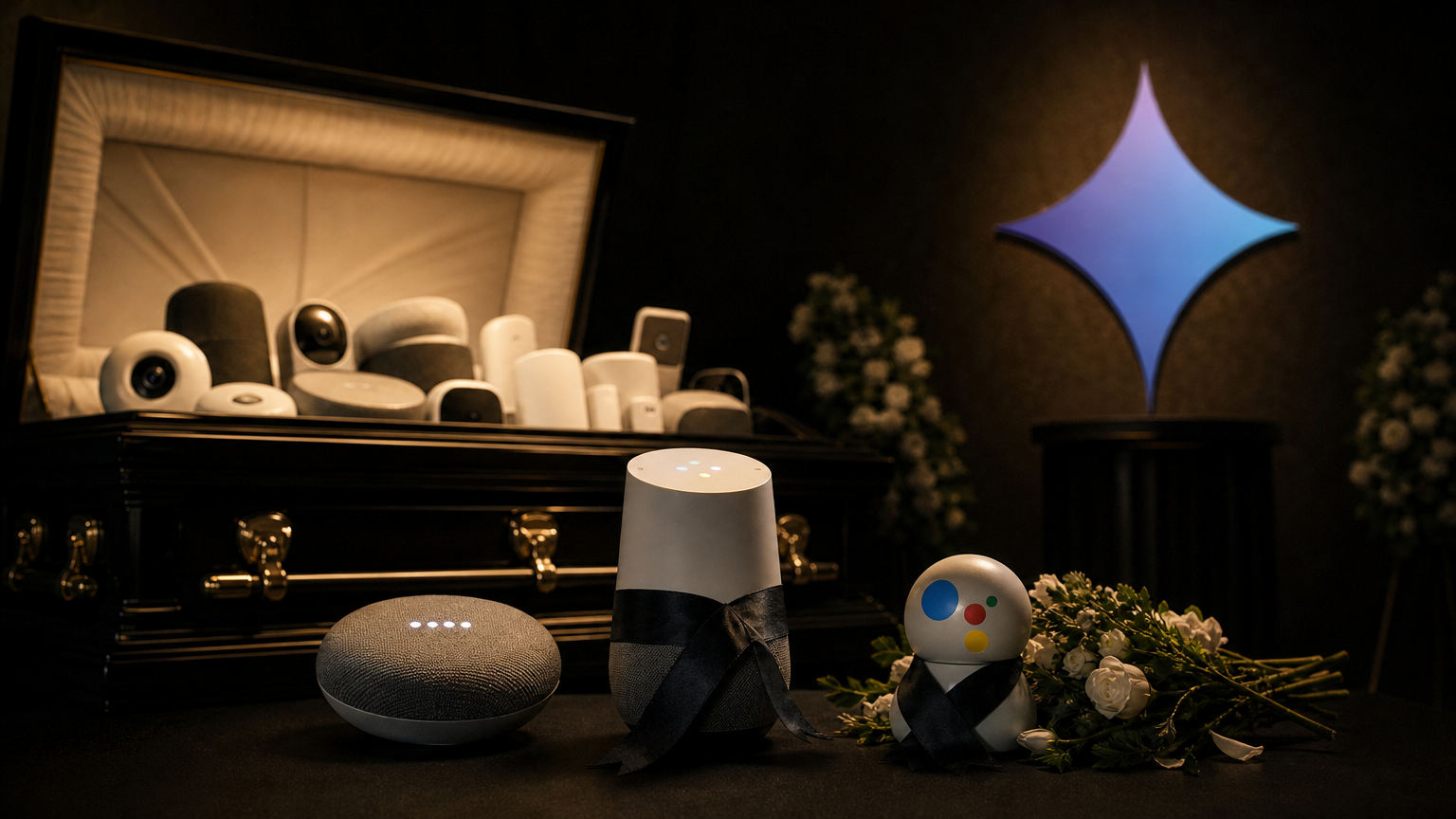 Google redesigned its desktop homepage on November 20, removing the familiar Search button and adding a Gemini chat sidebar. The change puts conversational AI directly inside the gateway to the web, replacing a decades-old click-based cue with an interactive workflow. Because Search underpins Google’s advertising franchise, even a visual change signals how aggressively the company is steering users toward generated answers. The homepage has entered its AI-first patch cycle at last 😉Google announced the retirement of the Nest app and Google Assistant support for home devices, forcing millions of households toward whatever replacement path it provides. The decision unwinds two recognizable control layers in its smart-home ecosystem and raises migration, compatibility, and trust questions for customers whose lights, cameras, thermostats, and routines depend on persistent software. Platform owners can sunset an interface overnight; installed appliances remain in kitchens and hallways for years. Smart homes just received a mandatory firmware side quest 😉