Daily Podcast full article
China Takes On Europe’s Last Technology Monopoly
China’s domestic DUV lithography push has not ended ASML’s EUV monopoly. But it has changed the risk calculation around the Dutch group’s China business, where export controls, local substitution and investor nerves now converge around a revenue pool still large enough to move the stock.
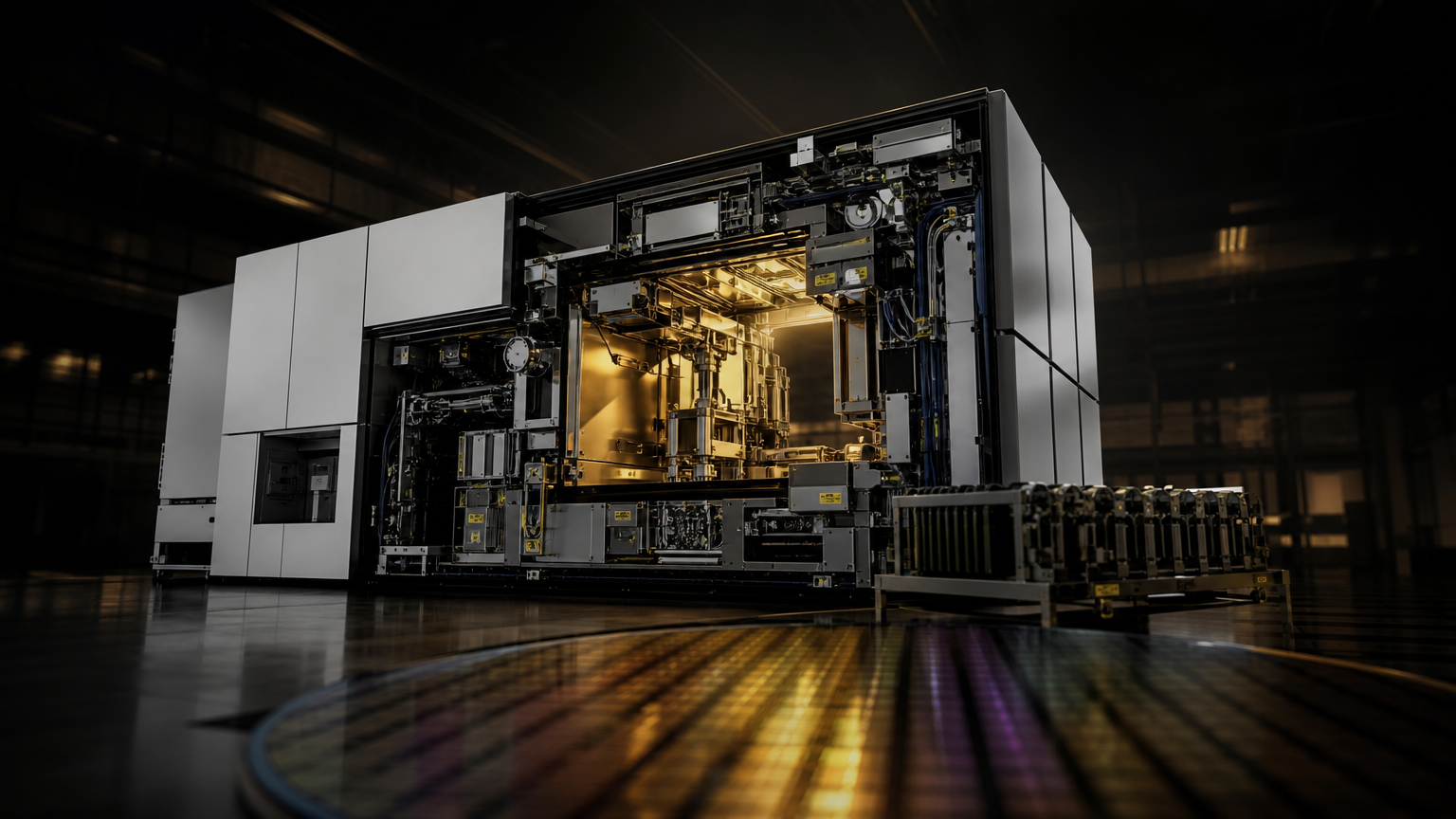
The panic was about DUV, not EUV
The working headline remains the story: China Takes On Europe’s Last Technology Monopoly. The important qualification is that China has not broken the monopoly that matters most. ASML’s crown jewel is extreme ultraviolet lithography, the EUV technology used for the most advanced logic and memory processes. The latest reports and market commentary still describe ASML as the only commercial supplier of EUV lithography systems, while China’s current challenge is concentrated in the older but still crucial deep ultraviolet, or DUV, tier [5].
That distinction explains why the market reaction looked excessive and yet not irrational. A domestic Chinese DUV machine does not give Beijing a plug-in replacement for ASML’s EUV tools. It does, however, threaten the category of equipment that Chinese fabs can still realistically use, service and localise under sanctions pressure. AInvest’s latest analysis frames the problem in precisely those terms: ASML remains a lithography monopoly, but roughly one-fifth of its 2026 revenue is projected to come from China, and U.S. restrictions have already forced it to withhold its most advanced EUV and DUV systems from Chinese buyers .
The result is a two-layer risk. At the top end, ASML’s EUV position remains intact. In the middle of the market, where DUV immersion systems matter for mature logic, memory and multi-patterned advanced nodes, China is trying to build a sanctions-proof fallback. That is why a limited Chinese production plan can erase tens of billions of euros in perceived equity value: investors are not pricing a full technological overthrow; they are pricing the erosion of a once-dependable China revenue stream.
Why DUV still matters
DUV is older than EUV, but “older” does not mean obsolete. Immersion DUV systems remain central to a large share of global semiconductor manufacturing, including mature-node chips used in cars, industrial equipment, communications hardware and consumer electronics. In China, they matter even more because EUV access is blocked, leaving DUV as the practical bridge between domestic manufacturing ambition and export-control reality.
That bridge is expensive, complex and imperfect. Chinese foundries can use multiple DUV exposures to reach smaller geometries, but doing so adds process steps, cost, overlay risk and yield challenges. The strategic goal, therefore, is not merely to own a machine that turns on. It is to qualify a production ecosystem: optics, light sources, resists, stages, metrology, service routines and engineers who can keep the tool productive inside a fab.
Recent discussion of Huawei’s role underscores that ecosystem problem. The company is reported to be acting less like a conventional buyer and more like a coordinator, backing component suppliers, connecting equipment developers with fabs such as SMIC, and helping organise a domestic lithography chain around Yuliangsheng and related firms . That is a different competitive model from ASML’s: not a single world-leading merchant supplier, but a national substitution project designed to keep Chinese fabs operating if foreign tools and services become unavailable.
ASML’s fundamentals are still strong
The market’s anxiety collides with a business that is, on current numbers, exceptionally strong. Zacks, distributed through Yahoo Finance on September 10, reported that ASML management expects advanced foundry logic revenue to rise about 25% in 2026, memory revenue to rise 75% and EUV revenue to grow about 45% . The same report says ASML lifted its 2026 net sales guidance to €43 billion to €45 billion, with gross margin guidance of 54% to 56% .
That matters because the Chinese DUV challenge is arriving at the same moment as AI-related demand is tightening ASML’s capacity. Customer commitments extend beyond the immediate year: ASML is described as close to receiving all EUV orders needed for 2027 and already holding many orders for 2028 . Management plans to raise 2027 low numerical aperture EUV capacity by about 30% from roughly 65 systems in 2026, while DUV immersion capacity is following a similar 30% expansion path from around 130 systems; another increase is under evaluation for 2028 .
In other words, ASML is not a weakened incumbent waiting to be displaced. It is a supply-constrained monopoly in the highest-end part of the market, trying to expand output into an AI capital-spending cycle. The China issue is not that ASML’s whole model is collapsing. It is that a politically exposed segment of that model may be worth less than investors assumed.
The stock now carries less room for doubt
That distinction is visible in valuation. Zacks put ASML at about 31.5 times forward 12-month earnings, above 23.7 times for its broader industry, 20.7 times for the technology sector and 20.0 times for the S&P 500 . A premium like that can be justified by monopoly economics, order visibility and AI-driven demand. It becomes harder to defend if investors also have to haircut future China sales, servicing income or DUV pricing power.
A separate market update published on September 11 said ASML’s U.S.-listed shares were trading below recent highs after a 2.4% Nasdaq decline on September 10, even though second-quarter 2026 net sales had reached €9.3 billion and the company had already raised full-year guidance . The same update stressed the balancing act now facing investors: strong Q2 figures and capacity expansion on one side; premium valuation, sector volatility and China policy risk on the other .
That is the correct frame. ASML can be fundamentally strong and still vulnerable to a repricing. If China falls from a strategic growth market into a managed-decline market, the effect is not only on today’s shipments. It also touches service revenue, upgrades, customer mix and the multiple investors are willing to pay for future earnings.
Export controls are accelerating the substitution race
The policy backdrop is the accelerant. Export controls were meant to preserve Western and allied advantages in advanced chipmaking. They have also told Chinese industry exactly which bottlenecks it must attack first. DUV lithography is one of those bottlenecks because it is both less advanced than EUV and still indispensable for a broad range of production.
AInvest’s September 11 note argues that tariff de-escalation would not solve the core issue for semiconductor equipment makers because export controls, not tariffs, are what restrict access to China’s chip-equipment market . It also says ASML’s China share has fallen sharply from earlier levels to a projected roughly one-fifth of 2026 revenue, even as the company’s order book remains full through 2027 . That combination creates a paradox: restrictions reduce ASML’s China opportunity while encouraging China to fund the domestic alternatives that could reduce the opportunity further.
The proposed U.S. MATCH Act deepens that logic. Current reporting describes it as going beyond EUV by targeting sales, servicing and technical support for DUV and other chokepoint tools destined for key Chinese semiconductor companies [5]. If servicing installed ASML tools becomes more restricted, Chinese fabs have an even stronger incentive to qualify domestic machines that are inferior but locally maintainable.
Europe’s monopoly is becoming a geopolitical asset
Europe has few technology platforms with ASML’s strategic weight. Its machines sit at the centre of the global semiconductor stack; its suppliers span optics, lasers, mechatronics, software and precision manufacturing; and its customers include the world’s leading chipmakers. That is why China’s DUV push is not just a corporate rivalry. It is a test of whether Europe can protect, monetise and politically manage one of its last uncontested technology monopolies.
For now, the answer is mixed. ASML’s EUV monopoly remains intact. Its order book is strong. AI demand is pulling production higher. But China’s domestic DUV progress, however limited, has made the downside more concrete. The market panic was triggered by a narrow announcement, yet the fear behind it is broader: if export controls keep shrinking what ASML may sell to China, and if Chinese tools become good enough for domestic use, a market that still matters to ASML can erode from both sides.
The best reading is neither triumphalist nor complacent. China has not caught ASML. It has identified the layer of ASML’s business most exposed to sanctions, substitution and political bargaining. That alone is enough to change the valuation debate around Europe’s last great hardware monopoly.
Sources from the last 72 hours
- [1]The Tariff Headline Doesn't Fix the Export Control ProblemSep 11, 2026, 4:00 AM UTC
- [2]ASML Holding stock eases as strong Q2 2026 figures meet premium valuationSep 11, 2026, 1:15 PM UTC
- [3]Huawei drives China’s push to make advanced chipsSep 11, 2026, 12:00 AM UTC
- [4]The US Suspects China Smuggled In ASML's Best Chip Machine, ASML Says NoSep 13, 2026, 10:28 AM UTC
AI-generated article based on recent web research, then preserved as a dated editorial snapshot.
Comments
Be the first to comment.