
Daily Podcast full article
World's First Solid-State Battery Announces Price!
Gotion High-Tech’s $150-per-kWh target gives solid-state batteries something the EV industry rarely gets: a public price benchmark. The number is still well above today’s low-cost LFP cells, but it could make sense first in premium long-range EVs if Gotion can scale production, prove durability, and keep its sulfide-based Jinshi technology stable outside the lab.
The headline is a price, not just a promise
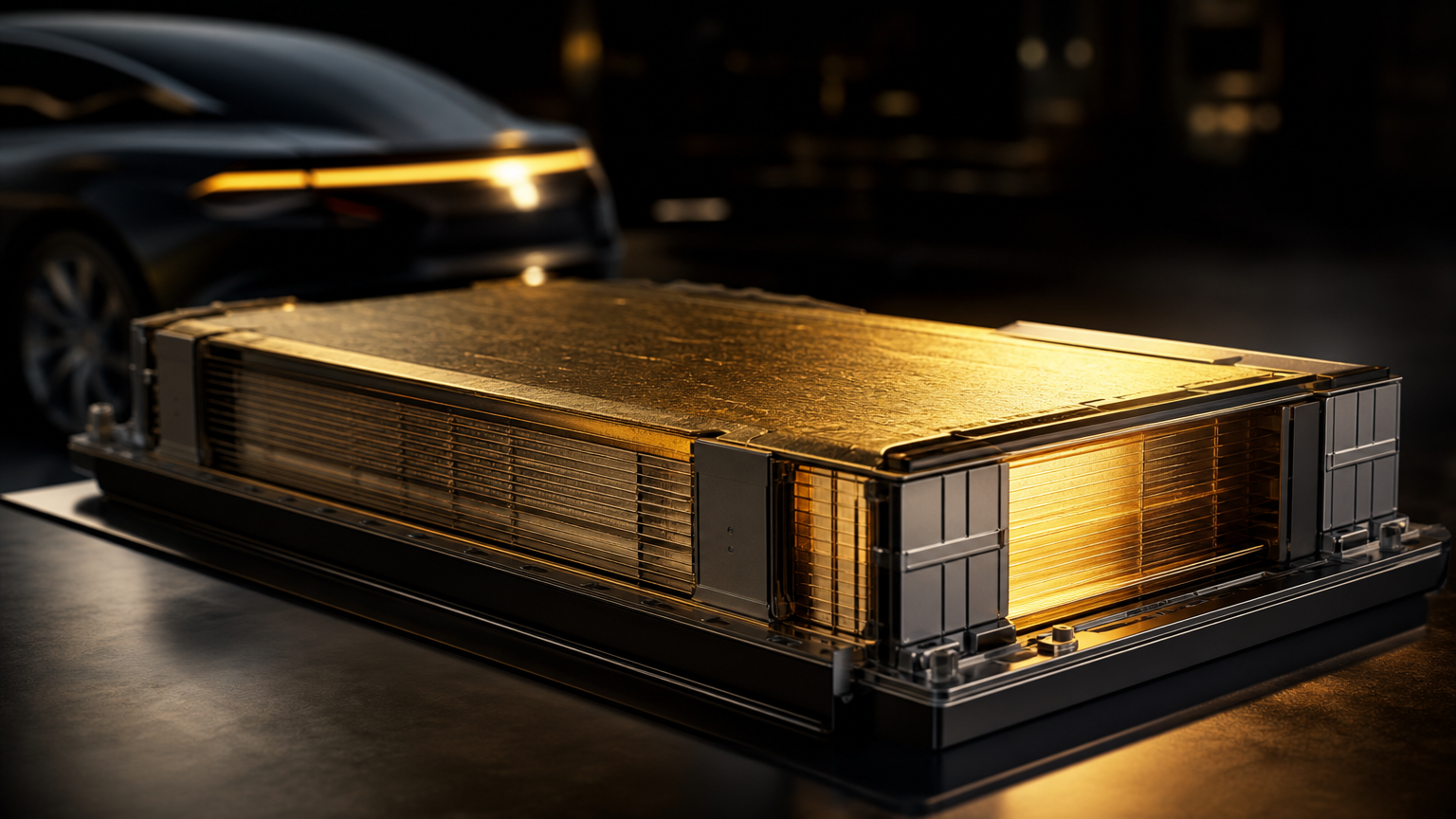
Solid-state batteries have been surrounded by spectacular claims for years: more range, better safety, faster charging, and lower fire risk. What has usually been missing is a number buyers, automakers, and investors can test against a real vehicle program. Gotion High-Tech has now put one on the table: about $150 per kWh for its solid-state battery target .
That figure is the center of this story. It does not mean a mass-market EV with an all-solid-state pack is arriving tomorrow. It does not mean Gotion has already reached low-cost mass production. It means one of China’s major battery makers has publicly defined the cost level it believes can bring solid-state cells from prototype status toward commercial EV use .
The HelloBro subject page frames the $150-per-kWh figure as rare because solid-state battery pricing is usually undisclosed, making this one of the clearest cost signals yet for assessing commercialization . Troy Technical’s October 4 update describes the same Gotion target alongside a 400 Wh/kg energy-density benchmark and a sulfide-based solid electrolyte for the Jinshi cell . BatteryTech’s October 4 weekly roundup also listed Gotion’s item under battery technology and innovation, restating the 400 Wh/kg and $150/kWh targets and the company’s reported safety-test progress .
Why $150/kWh is both expensive and important
On paper, $150 per kWh is not cheap. HelloBro notes that this target sits far above roughly $55 to $60 per kWh often cited for LFP cells, which means a 75 kWh battery would imply about $11,250 in solid-state cell cost versus roughly $4,125 to $4,500 for LFP at those lower cell prices . That gap matters because batteries remain one of the most expensive parts of an electric vehicle.
But “more expensive than LFP” does not automatically mean “commercially irrelevant.” LFP has become the benchmark for affordable EVs because it is durable, comparatively inexpensive, and increasingly capable. Solid-state cells are being pitched for a different first market: vehicles where buyers pay for range, performance, packaging efficiency, and perceived safety. In that segment, automakers may accept higher cell cost if the pack enables a lighter vehicle, longer range, or stronger premium positioning.
The key distinction is between a cost target and a value proposition. At $150/kWh, Gotion’s solid-state chemistry would not replace LFP in entry-level cars. It could, however, compete for high-end EVs if the 400 Wh/kg target translates into meaningful pack-level benefits . A luxury SUV, long-range sedan, or performance EV can absorb a battery premium more easily than a compact commuter car.
The Jinshi cell: 400 Wh/kg and sulfide chemistry
Gotion’s solid-state effort is built around its Jinshi cell, also referred to as Gemstone in English-language coverage . Troy Technical reports that Gotion’s Jinshi solid-state battery is targeting 400 Wh/kg and uses a sulfide-based solid electrolyte . That matters because gravimetric energy density determines how much energy a cell stores for a given mass.
A 400 Wh/kg cell would be a significant headline number, but it should be read carefully. Cell-level energy density is not the same as pack-level energy density. An EV battery pack also needs structural protection, electronics, cooling or thermal-management hardware, busbars, sensors, sealing, and crash protection. Those components reduce the final pack number. Even so, a higher cell-level figure gives engineers more room to design either a lighter pack with similar range or a larger-capacity pack without the same weight penalty.
HelloBro notes that Gotion previously unveiled a solid-state cell around 350 Wh/kg and is now pointing to a next-generation 400 Wh/kg target . That movement from 350 to 400 Wh/kg is important because solid-state batteries are not being judged only by whether they work in a lab. They are being judged by whether they improve enough, reliably enough, to justify new factories and new vehicle designs.
Safety claims are necessary, not sufficient
Gotion’s announcement also leans heavily on safety. Troy Technical reports that the Jinshi battery demonstrated no smoke or flames in nail-penetration and high-temperature tests . BatteryTech’s weekly update likewise summarized Gotion’s claim that the sulfide-based solid-state cells passed puncture and high-temperature testing without smoke or flames .
That is encouraging, but it is not the same as complete automotive validation. A production EV battery must withstand vibration, cold, heat, fast charging, calendar aging, thousands of cycles, crash loads, manufacturing variation, and abuse cases. Solid-state designs can reduce some risks associated with liquid electrolytes, but they introduce their own engineering problems, including solid-solid interface resistance, material cracking, and dendrite-related concerns in some architectures .
So the safety result is best understood as a milestone, not a finish line. It helps support the case that high energy density and improved safety can coexist, but durability and manufacturability will determine whether automakers trust the cells in customer vehicles.
Manufacturing is the real test
The difference between a battery breakthrough and a battery business is yield. HelloBro reports that Gotion has completed a pilot production line with 0.2 GWh of designed annual capacity and says product qualification rates have exceeded 90% . That is meaningful because it suggests the company has moved beyond isolated lab cells.
Still, 0.2 GWh is small in EV terms. A single 75 kWh vehicle pack consumes 0.075 MWh, meaning 0.2 GWh equals enough annual cell output for only a few thousand such packs before accounting for losses and allocation. Troy Technical adds that Gotion had already finalized the design for a 2 GWh solid-state production line in March 2026 . A 2 GWh line is a more serious industrial step, but it remains modest compared with the scale of conventional lithium-ion production.
This is why the $150/kWh figure should be treated as a target tied to scale, not a store price. Costs fall when equipment runs efficiently, yields rise, materials are secured, and production processes become repeatable. For sulfide-based solid-state cells, the route to scale also depends on material handling and electrolyte supply. HelloBro identifies lithium sulfide as a key cost driver and says Gotion plans to produce it in-house to improve supply stability and reduce costs as output rises .
Why Volkswagen’s connection matters
Gotion is not an obscure lab startup. HelloBro describes Gotion High-Tech as a Chinese battery manufacturer whose largest shareholder is Volkswagen . That relationship matters because battery chemistry becomes commercially meaningful only when it has a credible path into vehicles. A supplier with automotive ties can work earlier on pack design, validation standards, and customer requirements.
That does not guarantee Volkswagen, Audi, or any other brand will launch a Gotion solid-state pack on Gotion’s preferred timetable. Automakers are conservative with battery safety and warranty exposure. But the shareholder link makes Gotion’s roadmap more relevant than a standalone technology demo. If the Jinshi cell can be made reliably, Gotion already sits closer to real vehicle programs than many early-stage battery developers.
The realistic first market: premium long range
The most likely early home for a $150/kWh solid-state cell is not a budget hatchback. It is a premium long-range EV, where extra cost can be justified by headline range, lower weight, faster charging potential, and a stronger safety narrative. HelloBro makes the same point: the target price is difficult for mainstream low-cost EVs but potentially viable for premium long-range models if production and durability targets are met .
The phrase “if production and durability targets are met” is doing a lot of work. A battery that looks attractive at cell level can become unattractive if it requires expensive pack compression, strict dry-room handling, poor yields, or conservative charging limits. Conversely, if Gotion can combine 400 Wh/kg, credible safety results, and falling cost, $150/kWh could be a bridge price: too high for the cheapest cars, but low enough for the first commercially defensible solid-state EVs.
The bottom line
Gotion’s announcement matters because it moves solid-state battery discussion from vague promise to measurable economics. The company is not merely saying that solid-state cells will be safer or denser. It is putting a number beside the technology: $150 per kWh .
That number is not a victory lap. It is a test. If Gotion can scale Jinshi production, control lithium-sulfide-related costs, maintain safety performance, and prove long cycle life, the $150/kWh target could mark the beginning of solid-state batteries as a premium EV product. If not, it will join the long list of battery breakthroughs that looked impressive on slides but struggled in factories.
For now, the most important development is that the industry finally has a benchmark. At $150/kWh and 400 Wh/kg, Gotion has given automakers, competitors, and EV buyers a concrete way to judge whether solid-state batteries are approaching commercialization or still waiting for their flux capacitor moment.
Sources from the last 72 hours
- [1]World's First Solid-State Battery Announces Price! · Tesla · HelloBro.aiOct 5, 2026, 1:29 PM
- [2]Gotion High-Tech: Jinshi battery specs and $150/kWh cost | Troy TechnicalOct 4, 2026, 2:00 AM
- [3]BatteryTech News & Updates — 2026 #40 - Battery-Tech NetworkOct 4, 2026, 2:00 AM
AI-generated article based on recent web research, then preserved as a dated editorial snapshot.
Comments
Be the first to comment.