
Daily Podcast full article
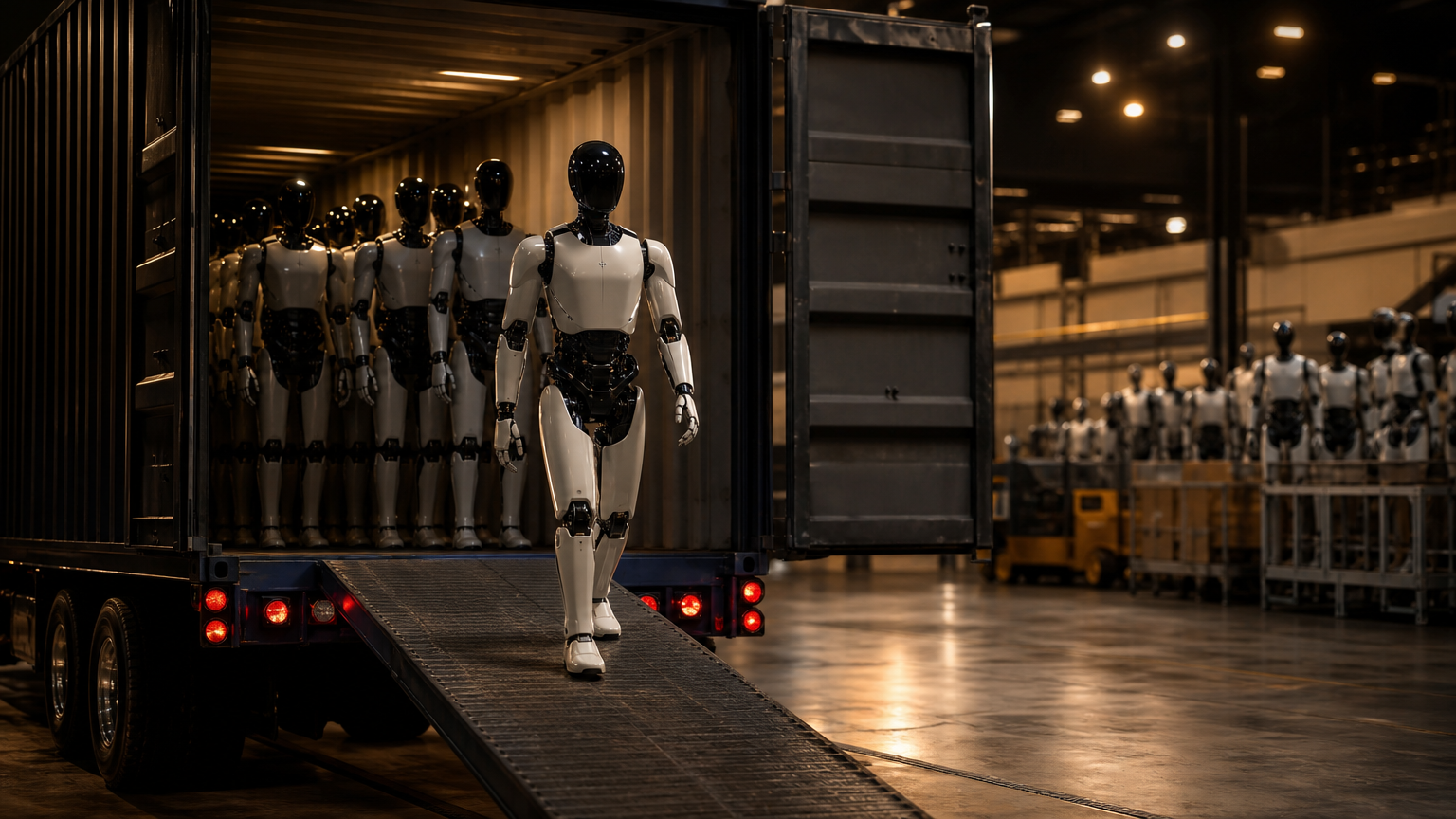
Humanoid robot shipments quadruple, but the real race is profit
Global humanoid-robot shipments have leapt from prototype-era volumes into commercial-scale numbers, with China’s vendors dominating the leaderboard. The latest data, however, shows a more complicated market than the headline suggests: cheap models are driving unit volume, expensive machines are carrying revenue, and Unitree’s Wang Xingxing says embodied intelligence may be only one or two years from a tipping point.
The headline is real: volume has arrived
The working headline is simple: humanoid robot shipments quadruple. On the latest IDC count cited by 36Kr, global humanoid-robot shipments in the first half of 2026 reached nearly 25,000 units, up 432.1% year on year, while market revenue rose 322.7% to about 740 million dollars . A separate Sullivan count put first-half shipments even higher, at 36,000 units, with revenue of 540 million dollars, already above the full-year 2025 level .
That is the first important point: this is no longer a category made only of laboratory demos, trade-show prototypes and cinematic promises. A market that can ship tens of thousands of humanoid units in six months has crossed into a different industrial phase. Supply chains matter more, product mix matters more, and the question shifts from “can anyone build one?” to “who can build many, deliver them reliably and collect cash?”
But the second point is just as important: shipment growth does not automatically mean mature adoption. The same reports show that the market is being pulled in two directions at once. Low-cost and half-size models are driving the eye-catching unit numbers, while full-size, higher-priced embodied-intelligence robots account for most of the money . That makes “shipments quadruple” a true headline, but not a complete diagnosis.
Cheap robots sell the story; expensive robots carry the revenue
The clearest split is between units and revenue. 36Kr’s analysis says affordable models under 30,000 dollars make up most of the first-half shipment volume, while high-priced devices generate the overwhelming majority of industry revenue . By Sullivan’s size-based breakdown, full-size models sold about 8,400 units in the first half of 2026, or roughly one-fifth of shipments, yet generated more than 408 million dollars, more than 75% of industry revenue . Small-size models, by contrast, sold about 19,700 units, more than half of shipment volume, but produced only 19 million dollars in revenue .
This explains why the average selling price can fall while the strategic stakes rise. IDC’s implied average unit price fell from about 37,000 dollars a year earlier to about 29,600 dollars in the first half of 2026, but 36Kr argues that the change is mainly structural: cheaper models are expanding faster, rather than every comparable robot becoming one-fifth cheaper .
For investors and industrial buyers, that distinction matters. A surge in small or mid-size humanoids can validate supply chains, motors, reducers, batteries, controllers and assembly capacity. Yet it does not prove that full-size robots are ready to perform economically useful work on factory floors. The industry is moving from prototype theater toward commercial volume, but the volume is not all the same kind of volume.
China’s leaders are not following one business model
The leading names also reveal different strategies. In Sullivan’s revenue ranking cited by 36Kr, the top five global humanoid-robot companies in the first half of 2026 were all Chinese: UBTECH, AgiBot, Unitree, Galbot and Leju . UBTECH ranked first by overall revenue share at 16.5%, and also led the full-size embodied-intelligence segment by revenue share at 26% .
Yet leadership by revenue is not the same as profitability. 36Kr reports that UBTECH lost 339 million yuan in the first half of 2026, while Unitree had shipped more than 5,500 humanoid robots in 2025 and had a non-recurring net profit margin of about 34.8%, including its quadruped-robot business . The difference reflects business-model choice: Unitree’s main humanoid products are half-size models such as the G1 series, sold largely into research and education, while UBTECH’s full-size systems require deeper deployment in factories and real operating environments .
That makes Unitree the clearest example of the current profit logic. Standardized hardware, quicker delivery, faster payment and a research or education customer base can produce a healthier financial profile. Full-size industrial deployment may offer a larger long-term prize, but it is heavier: more customization, longer acceptance cycles, higher service costs and more operational risk.
A Chinese tech commentary published the same day captured the tension bluntly: shipments may be “lively,” but profit remains thin unless robots are doing repeatable, valuable work rather than merely filling order books or data-collection centers .
The “doing real work” problem
Application mix is the heart of the story. Sullivan divides humanoid use cases into entertainment performance, research and education, data collection, and production operations . In the first half of 2026, production-operation revenue reached 78 million dollars, up 65.9% compared with the full-year 2025 level of 47 million dollars, but it still represented less than 15% of the industry’s 540 million dollars in first-half revenue .
That means the sector is advancing, but most of the market is not yet robots replacing or augmenting labor in stable daily operations. 36Kr notes that many production-operation orders remain between customer pilot and paid deployment, with few reaching normalized operation . This is the missing bridge between a shipping boom and an automation revolution.
Data collection complicates the picture. Embodied AI needs enormous volumes of real-machine interaction data, and 36Kr cites China Academy of Information and Communications Technology figures showing more than 70 embodied-intelligence training fields completed and in operation in China by mid-2026, with another 46 under construction or planning . These facilities can be useful because robots need to learn from the physical world. But they can also blur end-demand signals if purchases occur through related parties or if the buyer’s real objective is ecosystem building rather than immediate labor substitution .
Wang Xingxing’s one-to-two-year clock
This is where Unitree founder Wang Xingxing’s latest comments fit. Speaking at the 26th China International Industry Fair in Shanghai on October 12, Wang said global AI technology is advancing quickly, with major updates every one to two months, and that the embodied-intelligence industry’s understanding had improved significantly after GPT-6 . He said the overall tipping point could arrive “within one to two years” at the earliest, adding that next year’s GPT-7 might directly break through core embodied-intelligence challenges .
Wang also acknowledged the current bottlenecks. He said robotics companies are running factory pilots, but large-scale application still needs better generalization and efficiency . BigGo’s account of the same remarks says Wang expects commercial-service deployments to move faster than industrial use cases, while home scenarios may lag further behind .
That ranking makes sense. Factories demand uptime, safety, cycle-time predictability and integration with existing processes. Commercial services may tolerate narrower tasks, supervised operation and visible novelty value. Homes are hardest of all because they combine unstructured spaces, fragile objects, pets, children, privacy concerns and low willingness to pay.
What to watch next
The next stage will not be decided by a single shipment figure. Three indicators matter more.
First, watch the share of full-size operation models. 36Kr cites Morgan Stanley research suggesting full-size operation models may rise from 30% of 2026 shipments to 50% in 2027 and 70% in 2028 . If that happens, the market will be moving from hardware diffusion toward labor-relevant deployment.
Second, watch production-operation revenue. If the “real work” category remains below 15%, the boom will still depend heavily on education, performances, demonstrations and data infrastructure . If it climbs toward one-third or one-half of revenue, the adoption story becomes much stronger.
Third, watch comparable-model pricing. A lower blended average price can simply mean more cheap robots in the mix. A lower price for similar full-size, capable machines would mean manufacturing scale is finally attacking the cost curve.
The C-3PO joke writes itself: at this pace, humanoids may soon need quarterly shipment forecasts. But the more serious lesson is that the industry has entered its first scale test. Shipments have quadrupled; now the machines have to prove they can earn their keep.
Sources from the last 72 hours
- [1]Shipments of humanoid robots have skyrocketed four times. Who has earned all the profits?Oct 12, 2026, 8:09 AM
- [2]Unitree Technology's Wang Xingxing: The tipping point for embodied intelligence will arrive in as soon as one to two years.Oct 12, 2026, 2:00 AM
- [3]Unitree Robotics' Wang Xingxing: Embodied Intelligence Tipping Point Could Arrive Within One to Two YearsOct 12, 2026, 2:00 AM
- [4]出货涨4倍,公司全在亏!人形机器人正在上演一场‘数字狂欢’Oct 12, 2026, 8:11 AM
AI-generated article based on recent web research, then preserved as a dated editorial snapshot.
Comments
Be the first to comment.