
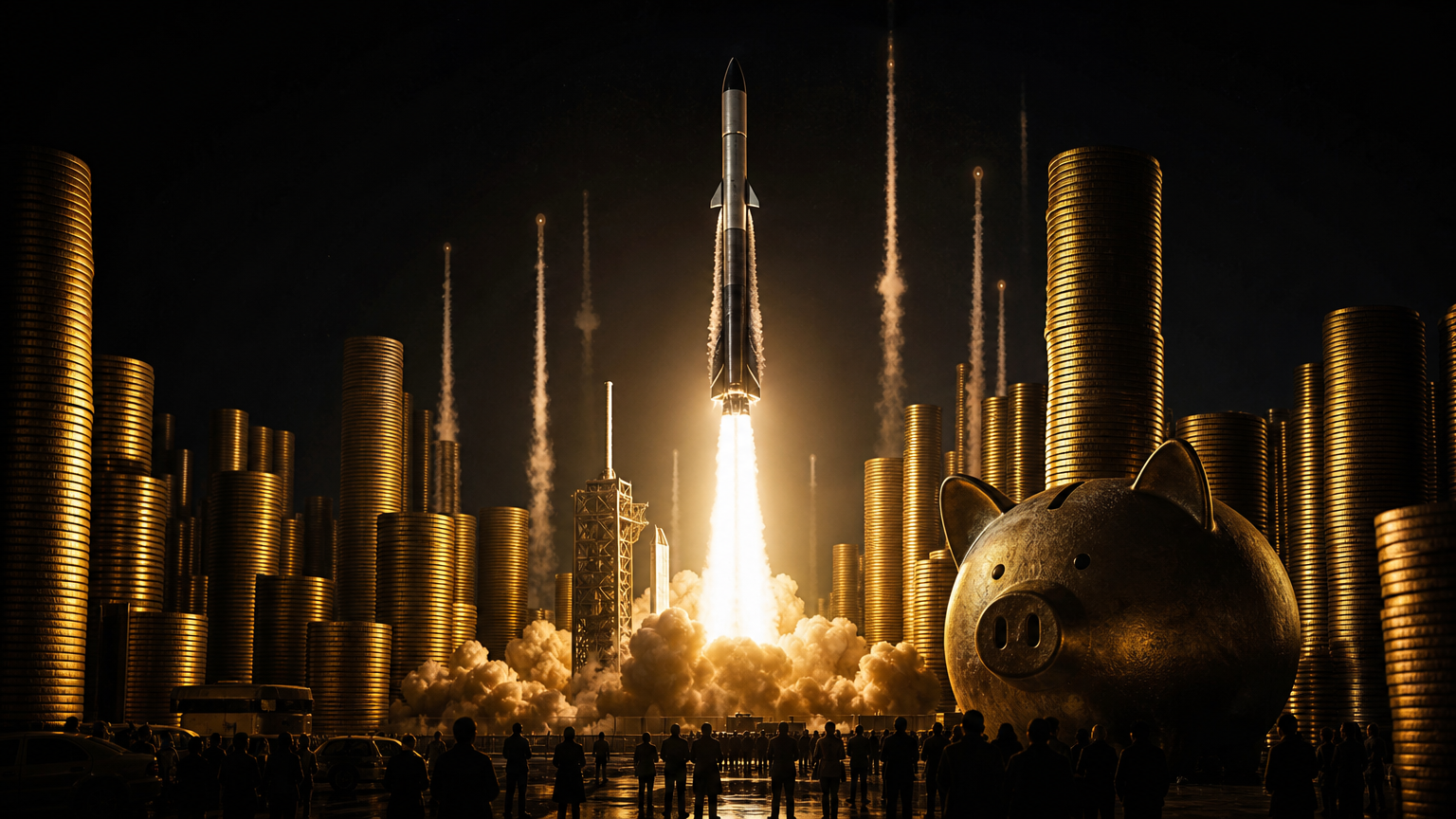
The forecast that reset the SpaceX debate
The current SpaceX conversation is no longer only about rockets, Starlink subscriptions or launch cadence. In the latest burst of investor discussion, Sequoia partner and SpaceX shareholder Shaun Maguire published a bottoms-up model that reframes the company as a possible AI-infrastructure giant by 2028, not merely the dominant private launch provider . The headline number is enormous: about $731.1 billion in 2028 revenue, after an estimated $51.5 billion in 2026 and $273.8 billion in 2027 .
That trajectory implies a roughly 39-fold increase versus the anticipated 2025 revenue base used in the debate, a scale that would normally sound like an upside case rather than a baseline. Maguire, however, presented the work as a forecast with “wide error bars” but also described the companywide projection as his 50th percentile case, while later saying the figures were closer to a 25th-to-50th percentile estimate once political, supply-chain and other risks were considered . In other words, he was not pitching the numbers as fantasy upside; he was trying to define the middle of his probability range.
Elon Musk’s response amplified the model far beyond investor circles. Replying to Maguire’s post, Musk wrote, “I think we can do better” . That short answer matters because the model was already aggressive. It effectively invited the market to ask whether SpaceX’s next act should be valued through the lens of launch, connectivity, cloud infrastructure, AI compute, or some combination of all four.
What is inside the $731 billion number
The model’s center of gravity is not the familiar SpaceX business mix. According to summaries of Maguire’s figures, the largest expected contributor is “Space Infrastructure,” a bucket that includes Grok, Cursor and other AI revenue, terrestrial compute, orbital compute and a Terafab line . Within that, terrestrial compute alone is modeled to rise from about $19.6 billion in 2026 to roughly $569 billion in 2028, driven by capacity rising to 21 gigawatts and a rough assumption of $40 billion of annual revenue per gigawatt .
That is the core of the story. Maguire is not merely saying Starlink becomes much larger or that launch revenue accelerates. He is arguing that SpaceX can become a low-cost physical infrastructure builder for the AI economy, especially where power, land, logistics, networking and hardware deployment speed matter . In his framing, gigawatt-scale AI compute is one to two orders of magnitude harder than yesterday’s data centers, and SpaceX’s engineering culture is unusually suited to that challenge .
Connectivity still matters. The model cited by Dealroom has Starlink plus direct-to-cell revenue growing from $19.1 billion in 2026 to $88.5 billion in 2028, while space revenue moves from $5.2 billion to $17.3 billion . But the debate is now dominated by compute because that is where the step-change sits. If terrestrial compute reaches anything like the figures in Maguire’s spreadsheet, SpaceX would be competing in economic territory usually associated with the largest global hyperscalers.
Musk’s bigger twist: orbital compute
Musk’s second intervention may be even more important than his “we can do better” reply. In a follow-up thread, he said terrestrial compute would be “peanuts” compared with orbital compute and predicted that orbital compute deployed per month would probably exceed terrestrial deployment around the end of 2028 before far exceeding it in 2029 . That statement pushes the discussion from data centers on Earth toward the more radical idea that SpaceX’s launch system, satellite manufacturing and power-in-space ambitions could eventually create compute infrastructure off planet.
This is also where Starship becomes the strategic bridge between SpaceX’s past and the model’s future. Maguire calls Starship one of the largest moats in modern industry and argues that SpaceX’s vertical integration, launch economics and operational intensity are not easily copied . In his article, he reasons that each fully utilized Starship flight could support very large revenue opportunities across Starlink, direct-to-cell and future orbital compute use cases .
The key distinction is that Starship is not treated as a product line in isolation. It is treated as a logistics engine for everything else. If Starship flies frequently and cheaply, it can lower the cost of expanding satellite networks, enable more ambitious direct-to-cell coverage and potentially support orbital compute architectures. If it does not, the model becomes far harder to defend.
The cost of the ramp
A revenue surge of this magnitude would not be free. Dealroom’s summary of the model says capital expenditure rises from $88 billion in 2026 to $290 billion in 2027 and $369 billion in 2028 . The same summary says the model shows cash burn of $77.8 billion this year and $122.6 billion next year before turning cash positive by $114.9 billion in 2028, with operating income reaching $483.9 billion that year .
Those figures explain why the model is controversial. It assumes not only massive customer demand but also the ability to finance and execute one of the largest infrastructure buildouts in corporate history. Supporters see SpaceX’s advantage in speed, integration and cost control. Skeptics will focus on permitting, power availability, supply chains, GPU access, customer concentration, pricing pressure and the risk that AI compute economics normalize faster than expected.
Maguire anticipates some of that pushback. He argues that revenue per gigawatt and capex per gigawatt are linked: if compute pricing falls, he expects build costs to fall as well, while SpaceX’s position as a low-cost producer lets it gain share as weaker providers struggle . That is a commodity-cycle argument applied to AI infrastructure. It may prove powerful, but it depends on SpaceX being able to deploy capacity faster and cheaper than almost everyone else.
Why this is a valuation argument, not just a forecast
The most important takeaway is that Maguire’s model changes the unit of analysis. SpaceX is no longer being debated only as a space company. It is being modeled as an infrastructure platform whose assets include launch, satellites, broadband distribution, AI compute, software demand and eventually orbital deployment .
That is why Musk’s endorsement matters. “I think we can do better” is not formal guidance, and Maguire repeatedly flags bias, uncertainty and the fact that the model is not investment advice . Still, the remark signals that Musk is comfortable with a conversation in which SpaceX’s plausible 2028 revenue is measured in hundreds of billions of dollars, not tens.
The market now has a sharper question to answer. If Maguire is even partly right, the 2027 inflection is the year to watch: revenue must jump from tens of billions to hundreds of billions, compute capacity must scale dramatically, Starship must move toward high cadence, and major AI customers must keep paying premium prices for capacity . If those milestones slip, the 39x story quickly becomes a lesson in spreadsheet exuberance. If they land, SpaceX could become something stranger and larger than either a rocket company or a telecom network: a physical operating system for the AI economy.
Comments
Be the first to comment.