
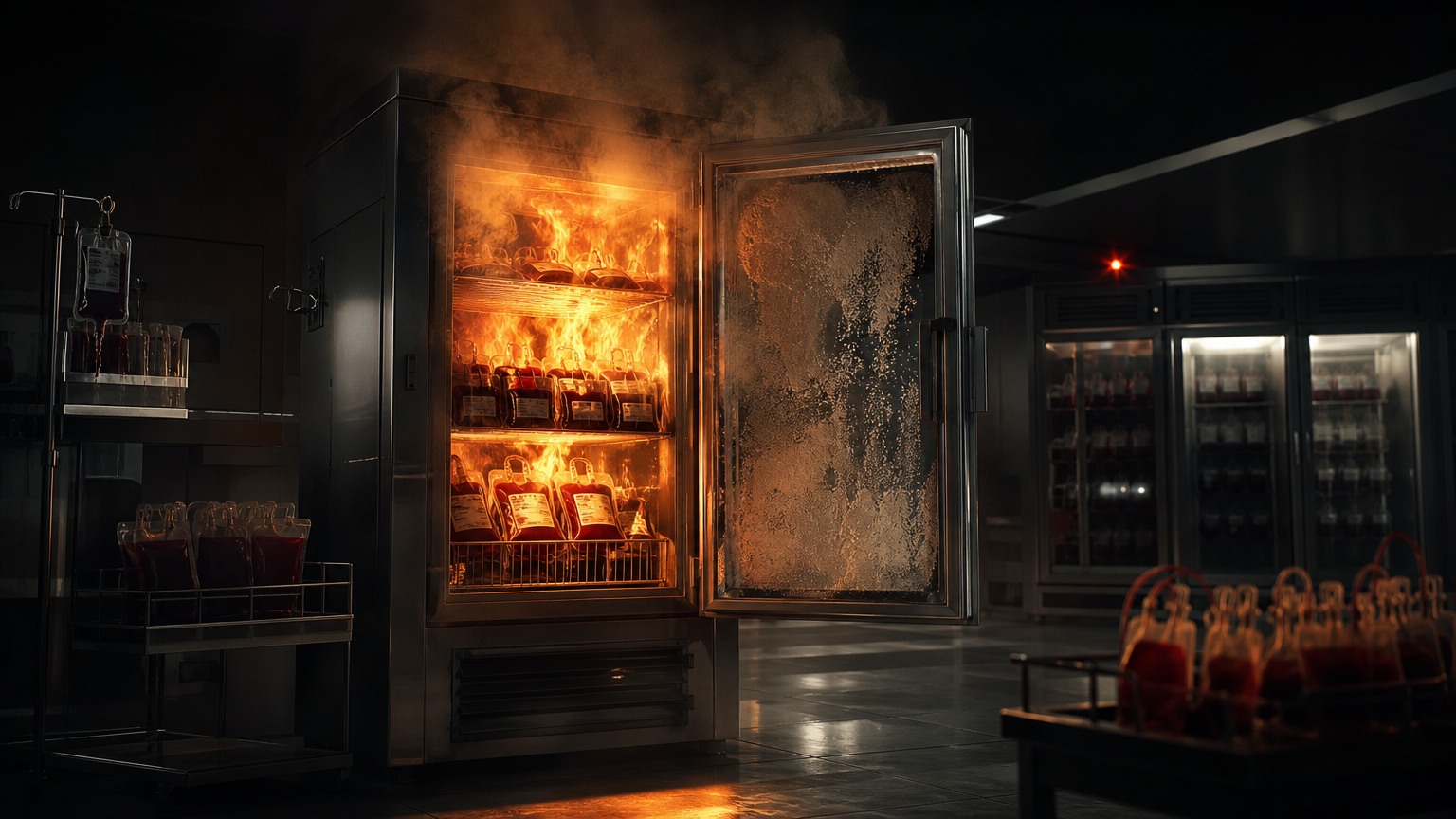
The cold chain became the attack surface
The attack that hit France’s blood cold chain was not a classic hospital data breach. It targeted refrigeration systems used by the Établissement français du sang, or EFS, the national blood service that supports hospitals with blood products and plasma. According to the EFS account reported by the Associated Press, temperature and defrosting thresholds were raised to extremely high levels on Monday, November 2, across three cold-storage sites for plasma, but monitoring systems detected the anomaly quickly enough for staff to intervene .
That distinction matters. In a ransomware incident, the first question is often whether files are encrypted or records are stolen. Here, the central question was whether plasma and donor samples stayed inside approved storage conditions. EFS said no blood products or samples were compromised, no health consequences were identified, and blood collection and distribution continued without interruption .
The eye-catching number, 110°C, came from Le Canard enchaîné’s reporting, cited by multiple outlets. The report said attackers tried to reset systems normally kept around −30°C to as high as 110°C, or 230°F . But the current evidence does not show that bags of plasma or samples actually reached 110°C. Cybersecurity reporting has stressed that the number appears to be a setpoint entered into a control system, not a measured temperature inside the freezer, the stored air, or the medical products .
A supplier route, not a direct EFS compromise
The attack also shows why healthcare security cannot stop at hospital networks. Reuters reported that refrigerators at three regional blood-bank sites were hit overnight between Sunday and Monday, while hackers were also striking supermarket refrigeration systems from Sweden to Belgium . The French Health Ministry described the affected systems as cold-room monitoring and control systems, and EFS spokesperson Charley Dubois said there was no impact on blood supplies .
The supplier angle is central. AP reported that the attack hit a supplier of refrigeration equipment at three EFS sites, and that products in the rooms included plasma for transfusions and plasma used to manufacture medicines . Coolworld, named in public reporting as the refrigeration supplier, said it was aware of the cybersecurity incident and described the reported vulnerability as involving a third-party component outside its direct control .
This is exactly the kind of dependency that tends to hide in plain sight. Hospitals and blood services rely on specialized contractors to maintain chillers, freezers, defrost cycles, remote monitoring dashboards, alerts, and emergency service agreements. Those systems are operational technology, not office IT, but they are increasingly reachable through the same remote-access assumptions that make maintenance efficient. When those assumptions fail, the consequences are physical.
Why “110°C” should be read carefully
The headline number is alarming because it turns cold storage into something closer to an oven. But accuracy is essential. Numerama reported that the Coolworld-linked incident involved a change from −30°C to 110°C and that the anomaly was detected in time, with no consequence for patients . It also reported that EFS president Frédéric Pacoud said on BFMTV that there had been no breach of product safety, while acknowledging that plasma for transfusions, not only surveillance samples, was among the material that could have been lost if the incident had gone unchecked .
That is the right balance: no confirmed product loss, but a serious near miss. A freezer setpoint is an instruction to equipment. The actual temperature path depends on hardware limits, compressor behavior, heating or defrost functions, ambient conditions, how long the command persists, and whether alarms trigger human action. Public reporting has not identified the maximum internal temperature reached, the duration of any excursion, the exact equipment model, or the exploited access path .
This is why “hit 110°C” should be understood as “the attackers pushed the control setting toward 110°C,” unless and until official technical findings say otherwise. The patient-safety risk was real because plasma has strict storage requirements, but the available evidence supports a near-miss narrative rather than a confirmed destruction-of-supply narrative .
The alarms did what they were supposed to do
The strongest line of defense in this incident may have been boring, redundant monitoring. AP reported that EFS monitoring systems quickly detected the problem, enabling staff to act before blood products or samples were compromised . Reuters added that staff were present around the clock, received alerts, and moved blood to refrigerators that were not connected .
That last detail is important. Connected systems failed; operational resilience came from people, alarms, and alternative storage. The affected equipment was either brought under control, neutralized, or bypassed by transferring products to other facilities, according to EFS reporting summarized by The Record . Remote access to affected refrigerators was disabled while investigations continued into how the attack was carried out, what equipment was involved, and when systems could safely return to service .
For healthcare operators, the lesson is not “never connect anything.” Remote maintenance can prevent failures and speed repairs. The lesson is that life-critical cold storage needs layered safeguards: segmented networks, tightly controlled vendor access, multi-factor authentication, independent temperature probes, local audible alarms, offline escalation paths, manual overrides, and rehearsed transfer procedures. If the dashboard lies or the controller is hijacked, the room still needs a way to shout.
Part of a wider refrigeration campaign
The EFS incident did not occur in isolation. AP noted that the blood-bank attack followed refrigeration attacks on supermarkets across France, Belgium, and the Netherlands in mid-October, and that this week’s attacks on fridges and freezers in several European countries caused spoiled food and major financial losses . Reuters likewise reported that supermarket refrigerators in eight European countries were tampered with around the same time as the French blood-bank incident .
The Record described the EFS case as the first reported French case in the second wave to affect a healthcare organization, while noting that businesses in at least 11 countries had reportedly been affected in the recent refrigeration attacks . It also emphasized that no group had claimed responsibility and that it remained unclear whether the same perpetrators were behind the different waves .
That uncertainty should prevent overclaiming. Similar tactics do not prove the same attacker, the same vulnerability, or the same vendor path. But the pattern is still a warning: attackers have discovered that poorly protected cooling controllers can produce visible, costly, and potentially dangerous outcomes without stealing a single medical record.
Healthcare cyber risk is becoming operational risk
A separate incident in Australia underlines the same strategic point from the data side. On November 4, ABC reported that NSW Health had declared a major cybersecurity incident involving the Oral Health Fee For Service Scheme website; officials said patient data had not been compromised, the affected system was an isolated server, and police were investigating . That case is not the French freezer attack, but it reinforces the same direction of travel: healthcare cyber incidents are judged not only by confidentiality, but by their potential to disrupt care, trust, and essential services.
The French freezer case is sharper because the threatened asset was not a database. It was the cold chain that keeps plasma usable. The result was less a privacy story than a clinical-continuity story. A few degrees for too long can decide whether a product remains fit for transfusion; a malicious 110°C command turns a convenience feature into a safety hazard.
Hospitals, suppliers, and regulators should treat this as an operational technology wake-up call. The urgent fixes are practical: remove direct internet exposure, inventory all refrigeration controllers, review vendor remote access, verify defrost settings, test independent alarms, and practice manual transfer of critical stock. The strategic fix is cultural: stop treating connected building and storage systems as peripheral just because they do not look like medical devices.
At 110°C, this was not cold storage. It was a Doom level with a fortunately working alarm system. The good news is that French blood supplies were protected. The bad news is that attackers now know exactly how close connected infrastructure can get to the patient’s bedside.
Comments
Be the first to comment.