
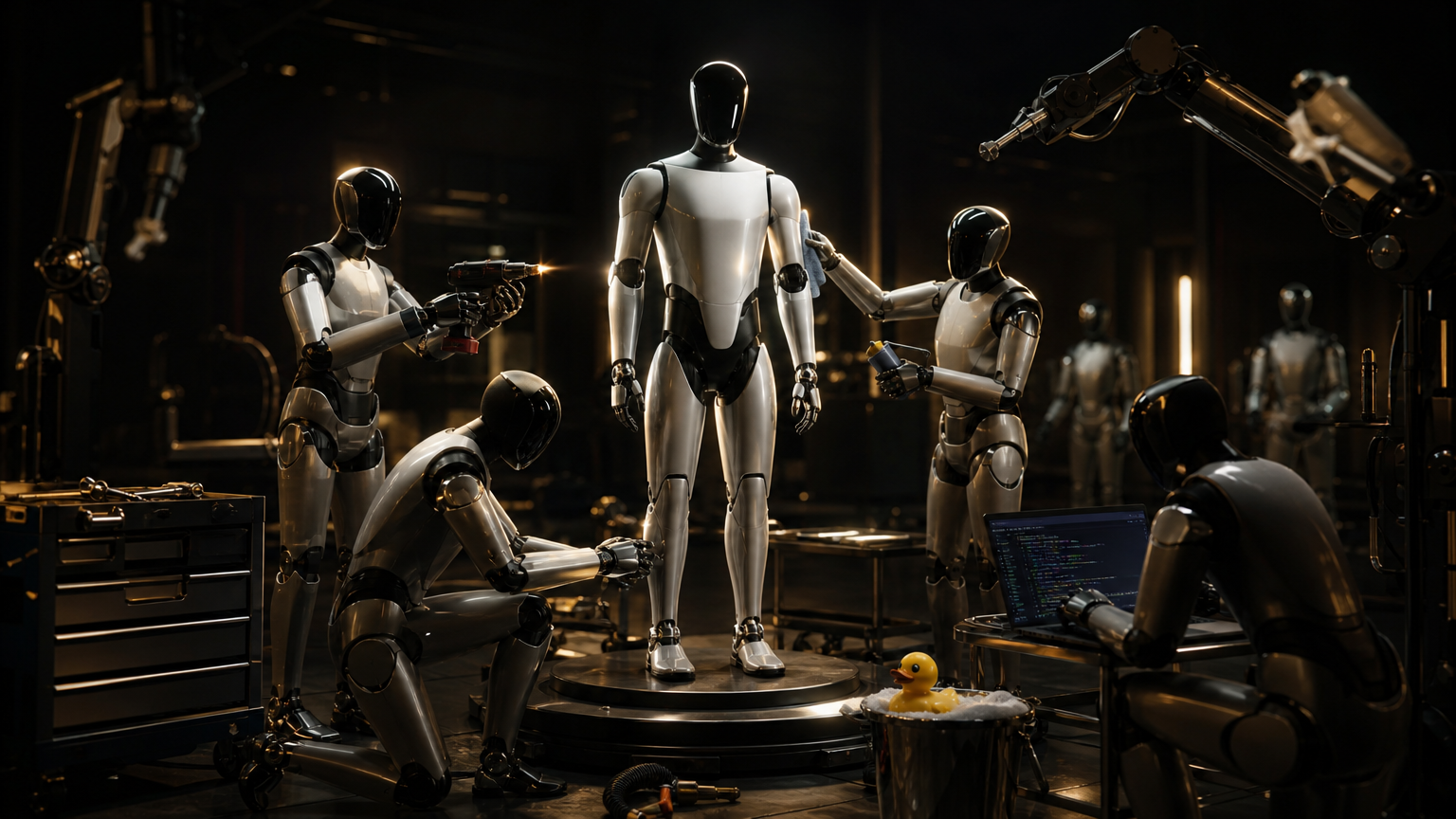
The leak is bigger than a new shell
The latest Optimus Gen 3 leak is not just about how Tesla’s humanoid robot may look. It points to a broader product shift: Tesla is trying to turn Optimus from a public demo machine into a manufacturable platform with improved dexterity, more onboard intelligence, longer useful runtime and a business model that may start with leasing rather than direct sales .
That distinction matters because Optimus Gen 3 has not been formally launched. The freshest reporting still treats the robot as an expected next version, not as a shipping product with a published spec sheet, order page or guaranteed delivery date . The current picture is therefore a layered one: visible design clues, reported hardware targets, production signals from Fremont, and recent public demonstrations that show where Tesla is focusing its engineering effort.
The strongest takeaway is simple: Gen 3 is being positioned as the first Optimus that must look, move and work less like an experimental robot and more like a product.
Design: smoother, more humanlike, less exposed
The reported Gen 3 redesign centers on a cleaner humanoid form. The new robot is described as having a smoother exterior shell that hides more of the joints, gaps, wiring and mechanical clutter visible on earlier versions . That is not merely cosmetic. A humanoid robot that operates near people needs surfaces, proportions and motion cues that feel predictable, safe and durable.
Tesla is also said to have reworked key lower-body elements, including hips, knees and ankles, to improve proportions and mobility . If accurate, that suggests the redesign is not only a new skin over old mechanics. It would be a move toward a robot that can carry itself through work zones more naturally, maintain balance under load and navigate human spaces without looking like a fragile lab prototype.
Still, the important caution is that Tesla has not presented a final Gen 3 unveiling. Current reporting says the model is expected by late 2026, while deliveries to outside customers are targeted around the end of 2027 . In other words, the design story is promising, but it remains pre-launch.
Hands: the real upgrade
The most consequential reported change is in the hands. The latest summary says earlier Optimus versions were described with roughly 11 degrees of freedom, later moving to about 20 on an intermediate version, while Gen 3 is said to target 22 degrees of freedom . That would move the robot closer to the range needed for useful object manipulation, even if it still falls short of the full complexity of the human hand.
This is the part of the robot that decides whether Optimus can become more than a walking display. A humanoid can be impressive on stage while still being commercially limited if it cannot reliably grasp, align, pass, sort and release everyday objects. Tesla’s reported focus on dexterity points toward tasks such as factory handling, small-parts assembly, food preparation, household organizing and other work that requires controlled contact rather than brute strength .
The fresh CoRL appearance reinforces that point. At the Conference on Robot Learning in Austin, Tesla showed an Optimus 2.5 unit handing snack packets to attendees; the interaction was reported as teleoperated rather than autonomous, which means it should not be mistaken for a finished Gen 3 capability . But the choice of demo was revealing. Passing a flexible packet to a human tests arm reach, wrist pose, finger pressure, timing and body stability in one small action .
Touch, strength and the path beyond vision
Tesla’s reported hand work is not only about joints. The Gen 3 brief also points to a denser sensor system, with hand sensor counts potentially rising by nearly three times, and to tactile sensing that would let the robot detect pressure and contact instead of relying only on cameras . That is a crucial step if Optimus is expected to handle deformable, fragile or irregular objects.
The reported strength target is also notable: the robot is said to aim for handling objects around 40 pounds, or more than 18 kilograms . If Tesla can combine that force with reliable tactile feedback, Optimus could move beyond simple pick-and-place routines toward tasks that need both delicacy and load-bearing ability. If it cannot, more degrees of freedom will mostly make the hand more complex, not necessarily more useful.
That is why Tesla’s recent public demos should be read carefully. The snack handoff at CoRL was not proof of autonomy, but it was a public stress test of the manipulation problem that Gen 3 must solve . The leak is exciting because it targets the right bottleneck: not walking alone, but working with human objects.
AI5 and the onboard brain
The leaked update also highlights a move toward Tesla’s AI5 chip. The current Gen 3 summary says AI5 would replace earlier AI3 hardware, with previously discussed targets pointing to roughly eight times the compute of AI4, more than nine times the memory capacity and about five times the memory bandwidth .
For a humanoid, that matters more than a benchmark headline. Optimus must process cameras, track people, understand objects, maintain balance, coordinate many joints, respond to spoken instructions and recover from mistakes with minimal delay. More compute and memory would support more complex perception and control loops, especially if Tesla wants the robot to become less dependent on scripted behaviors or remote control.
Recent CoRL reporting adds a software clue. Tesla AI engineer Patrick Cho presented work on “World Models for Optimus,” describing a system focused on physical accuracy and real-time policy-in-the-loop control . In practical terms, that suggests Tesla is trying to let Optimus practice and evaluate actions inside a predictive model of the world, not just generate pretty simulation video .
Battery, motion and factory reality
The leaked Gen 3 outline says Tesla may keep a battery around 2.3 kWh while possibly shifting toward 4680 cells for higher energy density and lower weight . The same report frames the robot at about 125 pounds, or 57 kilograms, with projected runtime of up to six hours on typical tasks and around four hours during heavier lifting or transport . Charging is described as taking roughly one to two hours, with the robot able to return to its charging point automatically .
Mobility is another headline. Reported running speed of up to 4 mph would help Optimus move between work zones instead of remaining tied to one station . But speed is not the real finish line. A humanoid in a factory has to stop, turn, carry, avoid people, manage slippery surfaces and recover from unexpected contact. Safe movement in cluttered environments is harder than a top-speed number.
On production, Tesla is no longer only talking. A current Optimus tracker says production continues on Tesla’s high-volume Fremont line, while Tesla’s Q3 2026 update described the Fremont units as the company’s first “production-quality” bots and listed California as “Early Ramp” and Texas as “Construction” . The same tracker emphasizes that output has not been disclosed and that no robots have been sold to outside customers .
Leasing may be the first real business model
The business model may be as important as the hardware. The latest Gen 3 brief says Elon Musk has indicated Tesla is leaning toward renting or leasing Optimus before selling it widely, with an expected purchase-cost range often discussed around $20,000 to $30,000 but no official pricing announced .
A lease-first model would fit the state of the technology. Early customers may not want to own a robot whose maintenance cycle, productivity, safety case and software roadmap are still evolving. Leasing would let Tesla control deployment, collect operating data, manage repairs and upgrade hardware more tightly. It would also shift the customer’s question from “What does the robot cost?” to “How much useful work does it perform per hour?”
That is also why the end-of-2027 customer target matters. The current tracker lists zero robots sold to outside customers and points to external sales no earlier than the second half of 2027 . For now, Gen 3 is best understood as a bridge: from internal production and training toward commercial access, not from leak to mass-market household robot overnight.
Bottom line
The Optimus Gen 3 leak is significant because it concentrates on the right problems: hands, touch, compute, battery life, mobility, manufacturability and service model. The recent CoRL demonstrations and world-model reporting add context, showing that Tesla is working not only on the body but also on the autonomy stack that would make the body useful .
But the sober reading is still necessary. Gen 3 has not been formally launched, the public demo involved Optimus 2.5 rather than a confirmed final Gen 3 unit, no official price exists, no outside customers have received robots, and the earliest commercial access appears to remain a 2027 story .
If Tesla delivers on the leaked direction, Optimus Gen 3 could be the moment the robot stops being mainly a symbol of ambition and starts becoming a product platform. For now, it is a credible but unfinished promise: smoother shell, smarter hands, stronger compute, and a lease-first path that may determine whether humanoid robots enter workplaces before they ever enter homes.
Comments
Be the first to comment.