
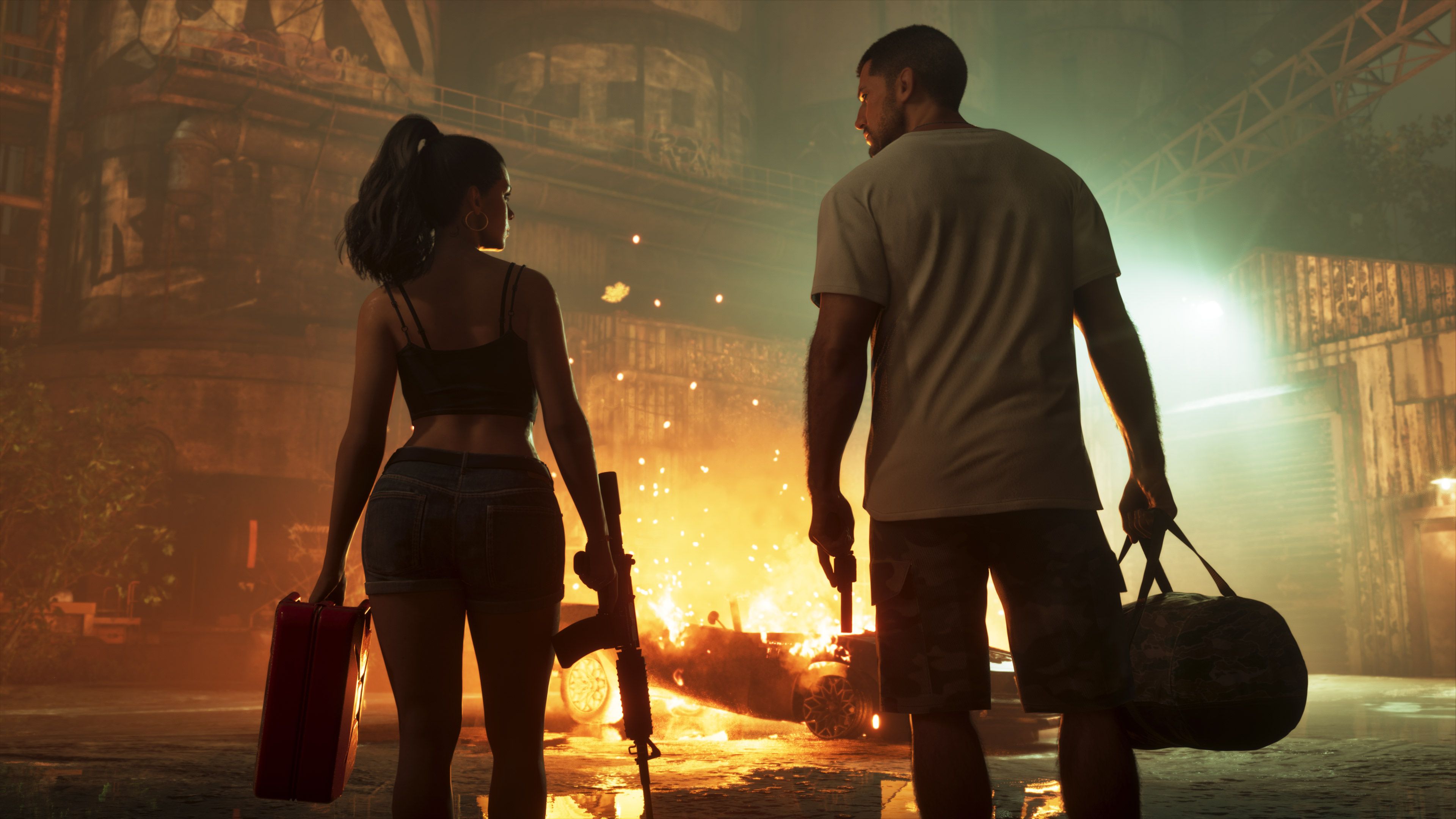
A 99 that instantly rewrites the conversation
The working headline is the story: GTA 6 Hits 99 on Metacritic, Crowned Best Game Ever in Wave of Rave Reviews. On November 18, 2026, as the review embargo lifted ahead of the game’s worldwide rollout, Grand Theft Auto VI became the rarest kind of critical event: a blockbuster expected to dominate culture that still managed to shock reviewers with the height of its scores.
At the time of writing in the reviewed coverage, Rockstar’s sequel was reported at 99 on Metacritic, with outlets describing it as either the joint-highest-rated game ever or the best-reviewed game in the database depending on how they weigh review volume and historical context . Radio Times reported the same headline number, noting that GTA 6’s 99 put it beside the original The Legend of Zelda: Ocarina of Time, the 1998 Nintendo 64 landmark that has long been treated as Metacritic’s untouchable benchmark .
That distinction matters. Ocarina of Time’s 99 has endured for decades as a symbol of critical consensus from an earlier era. GTA 6’s arrival at the same number, with modern review volume and modern expectations behind it, changes the debate. One report counted 115 critic reviews behind the early Metascore, all positive, while also noting a 99 listing for Xbox Series X from a smaller batch of reviews . Another report placed the PS5 version at 99 from 109 reviews and said the figure gave GTA 6 the best score in the series, ahead of GTA IV’s 98 and GTA V and Red Dead Redemption 2 at 97 .
So did GTA 6 “surpass” Ocarina of Time? Numerically, the current public framing is more careful: it has matched the sacred 99. Historically and practically, however, reviewers and roundups are already treating it as a new all-time crown because the score has been achieved in a far more crowded, fragmented, and statistically demanding review environment . That is why the phrase “best game ever” is not just hype; it is now part of the critical record around the launch.
The embargo lifts, and the numbers hold
The first striking fact is not merely that GTA 6 reached 99. It is that it did so after years of expectations that might have crushed almost any other release. OnPoint 4 Gamers reported that the review embargo lifted at 6:00 a.m. ET on November 18, and by 6:20 a.m. ET the game held a 99 Metascore based on 115 critic reviews . Radio Times, publishing later the same morning, still reported the score at 99 out of 100, suggesting that the earliest wave of praise was not an unstable blip .
OpenCritic told a similar story with a slightly different number. OnPoint reported a 98 Top Critic Average and 100% critic recommendation across 59 reviews . Radio Times also described OpenCritic as one point lower than Metacritic, at 98, while still showing a 100% recommendation rate . Leonida Verse, a GTA-focused outlet, reported OpenCritic at 99 with 100% of critics recommending the game, while also warning that averages could still move as more reviews arrived . The slight discrepancy illustrates how fast the numbers were moving during the review window, but the larger message is consistent: reviewers were not merely positive; they were overwhelmingly aligned.
The Metacritic record is especially significant because Rockstar already occupied rare territory. GTA IV’s 98 had long stood as one of the studio’s highest critical achievements, while GTA V and Red Dead Redemption 2 both sat at 97 in the comparisons cited by Leonida Verse . GTA 6, at 99, therefore does not simply continue Rockstar’s streak. It raises the studio’s ceiling.
What critics are praising
The reviews are not united around one isolated strength. They are praising density, performance, scale, acting, world design, character writing, music, satire, and the emotional center of Jason and Lucia’s story.
Radio Times’ roundup pulled from major outlets and framed the consensus as almost absurdly strong. It cited IGN’s 10/10 review, GamesRadar’s 5/5, Eurogamer’s 5/5, The Guardian’s 5/5, VGC’s 5/5, Giant Bomb’s 5/5, and Kotaku’s strongly positive take . The same roundup emphasized that critics were not just praising the scope of the game but the way Rockstar turned that scope into a believable place, with reviewers returning again and again to the texture of Leonida, the Miami-inspired state that contains Vice City and its surrounding regions .
The Guardian’s Keza MacDonald went further, arguing that Rockstar had created “the most extraordinarily, indulgently detailed virtual world” yet seen in games, while also describing GTA VI as a love story centered on Jason and Lucia . Her review highlighted the emotional surprise of the game: beneath the chaos, provocation, crime, and vulgarity, the central pair become characters the player genuinely cares about .
That emotional core may be the most important difference between GTA 6 and the older image of Grand Theft Auto. The franchise has always been associated with satire, crime fantasy, excess, and technical ambition. This time, reviewers are also foregrounding empathy. The Guardian described Jason and Lucia not as blank avatars but as people with a bond strong enough to carry the story through the wildness around them . Radio Times’ roundup similarly selected review excerpts that focused on the protagonists, the density of the city, the soundtrack, and the sense of awe produced by the world .
A new benchmark for open worlds
Open-world games have spent more than two decades chasing Rockstar. GTA III helped define the modern 3D city sandbox. San Andreas expanded the scale and personality of that template. GTA IV pushed urban realism. GTA V became a generational platform. Red Dead Redemption 2 raised expectations for animation, environmental detail, and systemic immersion.
GTA 6 now appears to have become the new measuring stick. OnPoint’s roundup described critics calling it a “modern masterpiece,” an “absolute triumph,” and one of the largest and most ambitious games ever created . Radio Times quoted VGC’s conclusion that Rockstar is operating at the peak of its power and that the scale of GTA 6’s achievement will be felt across the next decade of game development .
This is where the 99 matters beyond the scoreboard. A Metascore at that level does not merely mean “excellent.” It signals an industry-wide consensus that the game may reset design expectations. The phrase “best game ever” can sound simplistic, but the underlying claim is specific: GTA 6 appears to combine technical scale, cinematic writing, open-ended play, and cultural weight in a way few games have attempted and fewer have delivered.
The comparison with Ocarina of Time is revealing. Nintendo’s 1998 classic became the shorthand for what 3D adventure games could be. GTA 6 is being discussed in the same register for the contemporary open world: not just a successful sequel, but a new reference point for how much life, authored storytelling, incidental detail, and player freedom a single game can hold.
The caveats: not flawless, but still historic
The most credible wave of praise includes caveats. OnPoint summarized several criticisms from major reviews: The Guardian pointed to complex controls and moments that could feel frustrating or unfair, TheSixthAxis raised concerns about the need to keep raising story stakes over a long campaign, VGC noted occasional frame-rate issues in dense zones, and Pure Xbox found the story less personally favored than other GTA entries despite remaining invested .
The Guardian’s own review made the strongest case for why those flaws may be inseparable from the achievement. MacDonald wrote that the world’s density and realism create situations where systems collide with player intent, producing moments that can feel unwieldy or unfair . In other words, some of GTA 6’s friction comes from the same ambition that makes it feel alive.
That does not erase the criticism. It contextualizes it. A game this vast can be both astonishing and occasionally messy. The reviews suggest that critics are not pretending GTA 6 is perfect. They are saying its highs are so consistent, so broad, and so historically significant that the flaws do not meaningfully diminish the verdict.
Why this launch feels different
Grand Theft Auto VI was never going to be an ordinary release. It arrives after a 13-year gap since GTA V, after years of leaks, speculation, delays, trailer analysis, and industry-wide anticipation. ScreenRant, as aggregated by KhanList, framed the launch as the end of a long wait and reported that the game’s 99 Metascore made it the highest-rated game of 2026 and, in that framing, the highest-rated game of all time on Metacritic .
That timing amplifies the impact. GTA 6 is not simply launching into a calendar slot; it is arriving as a cultural event. The review embargo lifted just as the game became available in certain regions such as New Zealand, with global rollout following across PlayStation 5 and Xbox Series X/S . The critical wave therefore merged almost immediately with player excitement, launch-day clips, and the ritual of a worldwide entertainment phenomenon unlocking by time zone.
The danger for any game in that position is that it becomes more symbol than software. GTA 6 seems to have avoided that trap. The praise is not only about hype fulfilled. It is about specific craft: world density, character chemistry, production value, mission variety, environmental storytelling, sound design, and a more emotionally grounded tone than many expected .
The crown, for now
Review scores can still move. Several sources stressed that averages may shift as more reviews arrive . A 99 can become a 98 with a handful of lower scores, and the language of “best ever” will always remain partly subjective. Metacritic rankings are not a philosophical answer to what games are for, nor can they measure personal attachment, influence, or genre preference with perfect fairness.
But the present fact remains extraordinary: GTA 6 has entered the Ocarina of Time tier. In a modern review ecosystem that is larger, harsher, and more diffuse than the late 1990s, Rockstar has delivered a game that critics are treating as a historic benchmark . Whether one calls it tied for the top, effectively ahead by scale, or simply the most acclaimed game of the modern era, the result is the same: GTA 6 has become the new center of the “best game ever” argument.
For Rockstar, that is more than a marketing victory. It is a rare confirmation that the most anticipated game in the world could still exceed expectations. For the industry, it creates a new standard. For players, it means the conversation around Leonida, Vice City, Jason, Lucia, and the future of open-world design has only just begun.