
Tech • AI • Robotics • Game
Next roundin 2h 46m · 06:00Podcast quizNext quiz in 2h 46m
Arcade breakFury Blox: stack the blocks, beat your bestToday's edition is not ready yet — showing the latest available briefing.
Evening edition
 Nvidia experienced a significant surge after reinstating Jensen Huang as president, CEO, and board director just 11 days following his resignation. The company's board expressed satisfaction with his disclosures and, after consulting senior U.S. government officials, determined his return did not pose national security concerns. This reinstatement drove Nvidia shares up approximately 33% at Monday's opening, positively influencing sentiment across AI-focused stocks amid expanded access to advanced AI tools from Anthropic, OpenAI, Google, and various app developers. Even AI knows a good reboot when it sees one 😉
 Shopify said AI-powered shopping agents generated 3.3 times more sales this Black Friday than a year earlier, offering one of the clearest commercial signals that autonomous interfaces are moving from demos into checkout flows. In a separate UK first, an AI agent ordered pizza without a bank card, showing that machine-led purchasing can bridge product selection and payment. Retail’s new power user apparently runs on extra cheese and API calls 😉Delaware plans to introduce legislation in January 2027 allowing AI agents to legally run companies, a potentially foundational change in the jurisdiction that dominates US corporate formation. The proposal would push governance questions from software design into fiduciary law: who authorizes an agent, audits its decisions, and bears liability when it fails. For technology builders, legal operating authority could turn agent platforms into operating systems for firms. Delaware is testing whether the boardroom accepts sudo 😉AI-agent startup Linq raised $90 million in a Series B led by Andreessen Horowitz, reaching a $1 billion valuation. The round shows investors are still assigning unicorn prices to companies building autonomous software, even as questions about permissions, identity and accountability remain unresolved. That capital gives Linq room to scale products and distribution while incumbents race to embed agents across enterprise workflows. Venture mode unlocked; now avoid the NPC dialogue loop 😉
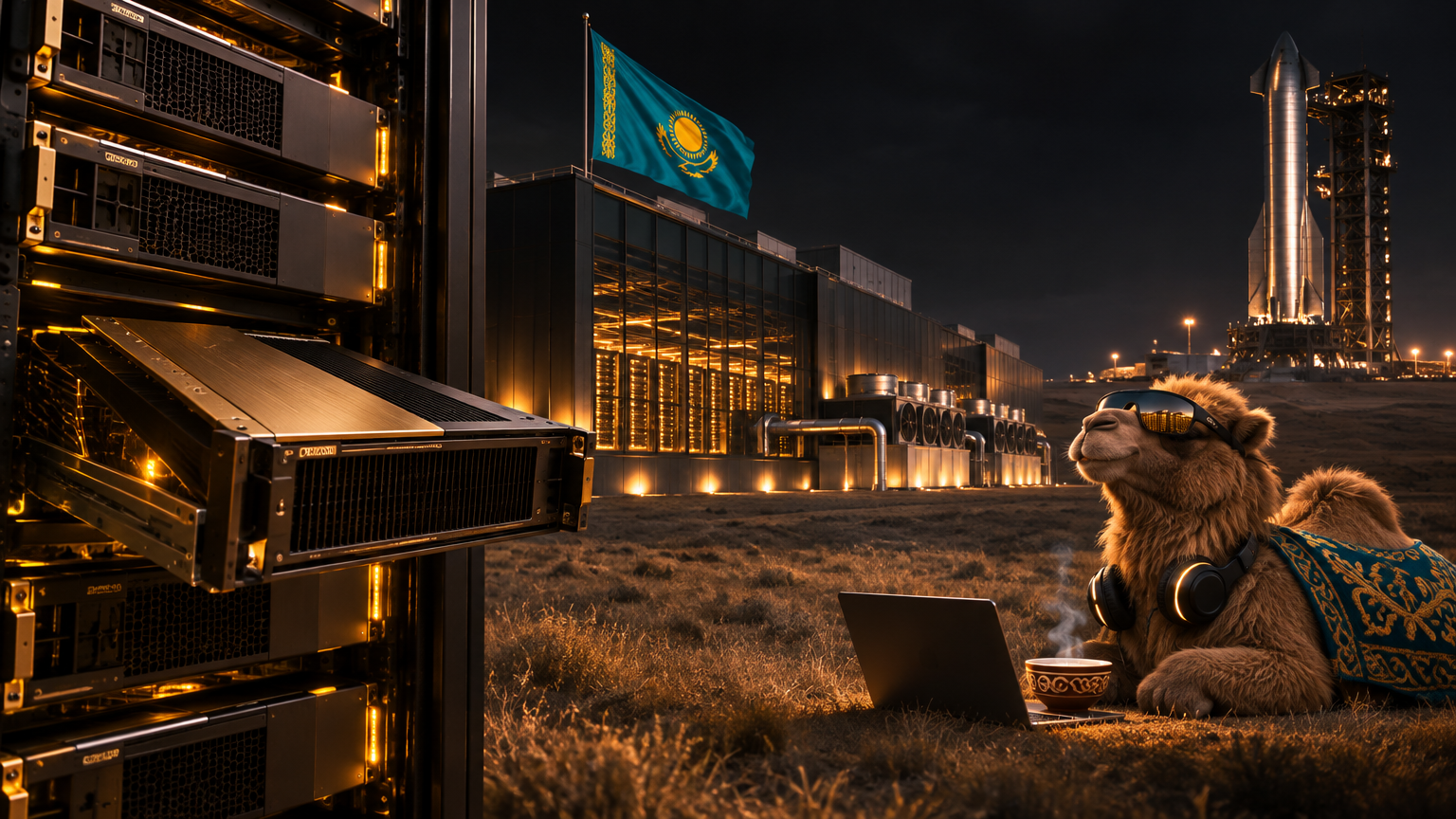 Kazakhstan plans a $2 billion sovereign AI hub built around Nvidia B300 accelerators, with the project intended to establish a regional data-center powerhouse and strengthen domestic model development. The scale signals how national AI strategies increasingly hinge on securing frontier chips, power and local compute capacity, rather than funding software alone. For Nvidia, sovereign deployments widen demand beyond hyperscalers and turn infrastructure procurement into industrial policy. The steppe is getting its own CUDA biome 😉Texas officials are accelerating approval work for SpaceX’s $24 billion Starbase data center before a new governor could halt it. The unusually compressed timetable underscores how permitting and political transitions can shape infrastructure almost as much as chips or engineering. At $24 billion, the project would represent a huge strategic expansion tied to SpaceX’s satellite internet operations, while concentrating power, land and network demands in Texas. Even launch windows now include zoning paperwork 😉
 A new quantum processor encoded information in atomic positions to create 123 entangled qubits, expanding the scale at which controlled entanglement can be demonstrated. Qubit count alone does not establish useful quantum advantage, because fidelity, connectivity and error rates determine whether computations survive. Even so, the result adds another hardware route to a field spanning superconducting, trapped-ion and photonic designs. Schrödinger’s roadmap now has 123 boxes to check 😉QuTech demonstrated weight-four stabilizer parity checks in a silicon spin-shuttling processor, an error-correction primitive needed to detect faults without directly reading and destroying quantum data. Weight-four checks compare four data qubits, while shuttling offers a way to move spin information through chip structures. The experiment matters because scalable machines need repeated correction, not merely larger raw qubit totals. Silicon is trying to make quantum debugging less like Dark Souls 😉Researchers developed a theory for scaling quantum states beyond 10,000 photons, potentially widening the design space for photonic computing and secure communications. This is a theoretical advance, not a finished processor, but handling such large states mathematically can guide experiments that would otherwise become intractable. Photons are attractive carriers because they move information efficiently, while controlling huge correlated ensembles remains the hard part. Ten thousand photons entered the chat; RAM left 😉