
Daily Podcast full article
Holy St! Ron Baron Puts Elon’s “99%” Prediction In Perspective
Ron Baron’s latest SpaceX comments turn Elon Musk’s “99%” idea from a futuristic sound bite into an investment framework: cheaper launches feed Starlink scale, Starlink feeds global connectivity, and AI agents may become the demand layer that makes SpaceX look less like a rocket company and more like an operating system for orbit.
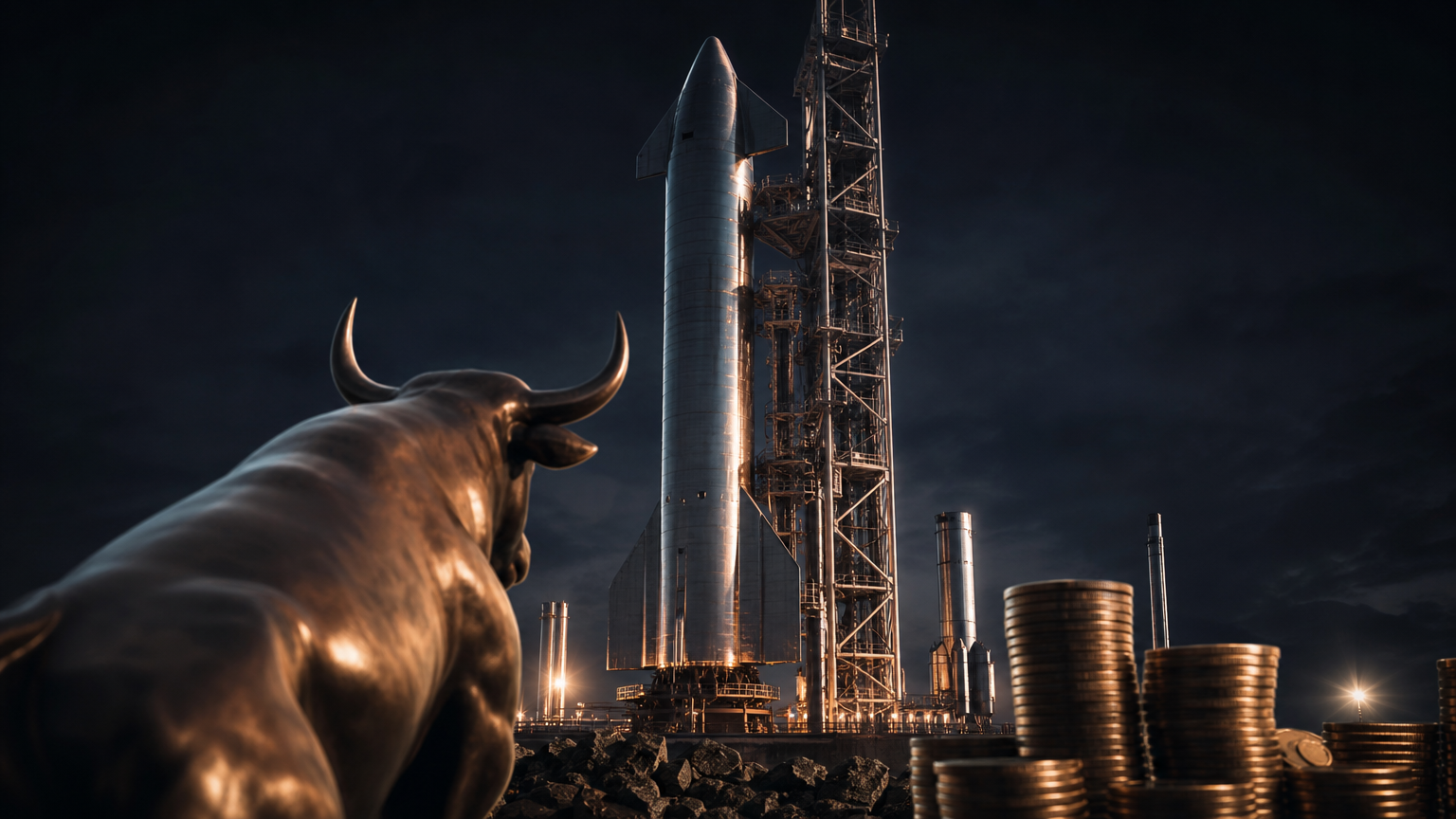
The headline is not the shock. The allocation is.
Ron Baron has spent years being identified with Tesla, but the newest SpaceX-focused discussion makes one thing unusually clear: in his own financial life, SpaceX now appears to be the center of gravity. The key figure is roughly 60% of his personal holdings in SpaceX, alongside a large Tesla position and money in Baron funds . That estimate comes from the disclosed numbers: about $5 billion personally in SpaceX, $1.5 billion in Tesla, and roughly $1.8 billion in Baron mutual funds .
That is why the reaction to Elon Musk’s “99%” prediction matters. Baron is not merely saying SpaceX is exciting. He is effectively saying that if the largest future value pool shifts toward AI-driven services, connectivity and compute, SpaceX already owns the infrastructure stack that could capture it . In that frame, rockets are not the final business. Rockets are the cost engine that makes the rest possible.
From launch company to launch economics
Baron’s argument starts with a brutal piece of industrial math: the cost of reaching orbit has collapsed. In the HelloBro summary of the latest video, Baron is described as citing a fall from about $18,700 per kilogram in 2010 to roughly $2,700 after Falcon 9 reusability began to matter, and then to around $1,500 per kilogram with current heavy-lift capability . He also suggested that Starship could eventually push SpaceX’s internal cost toward roughly $100 to $150 per kilogram .
That is the context behind the “holy s**t” reaction. A 99% reduction is not just a better margin on rocket launches. It changes what can be built. When the cost of deploying mass to orbit falls by orders of magnitude, satellite broadband, direct-to-phone service, military networks, orbital compute and AI infrastructure stop looking like isolated projects and start looking like one compounding platform .
The latest Baron Capital video framing supports that point. Its chapter list places “SpaceX and Declining Launch Costs” before “Starlink’s Global Growth Opportunity,” “AI Agents and Connectivity Demand,” and “Space-Based Data Centers,” which is exactly the sequence of Baron’s thesis: cheaper access first, then network scale, then AI demand .
Starlink is the bridge
Starlink is where the launch-cost thesis becomes a commercial thesis. Baron’s case, as summarized by HelloBro, is that Starlink already reaches places terrestrial networks struggle to serve: remote terrain, oceans, aircraft routes and other dead zones . The network’s scale has required the deployment of roughly 10,000 satellites over time, a buildout made possible by frequent and relatively low-cost launches .
The bigger claim is not just that Starlink can sell home internet. Baron’s model treats residential broadband as only part of the opportunity. In the latest summary, he argues that consumer internet may ultimately represent only about 30% to 35% of Starlink revenue, with the rest coming from government, enterprise and mobile connectivity . That distinction is crucial. A home-internet company is valued one way. A global connectivity layer for households, militaries, businesses, aircraft, ships, phones and autonomous systems is valued very differently.
The fresh coverage of Baron’s CNBC comments also notes that Baron Capital had about $25 billion in SpaceX and $5 billion in Tesla as of June, showing how concentrated the firm-level bet has become around Musk-led infrastructure . The same report says Baron told CNBC that early investments in Tesla and SpaceX have generated about $30 billion of Baron Capital’s $71 billion in lifetime client profits . That track record does not prove the next forecast. It explains why people listen when Baron makes one.
The 100,000-satellite leap
The most aggressive part of the argument is the move from tens of thousands of satellites to a possible 100,000-satellite constellation. Baron said earlier assumptions involved Starlink growing from 10,000 to 20,000 satellites, but the target shifted to 100,000 as the market opportunity widened beyond conventional broadband .
That is where AI agents enter the picture. In Baron’s view, always-on digital agents could create persistent demand for connectivity and computing capacity . The recent Baron Capital video description similarly says he discussed “future demand for AI agents” as part of the long-term SpaceX opportunity . A Korean-language digest of the same interview also frames the opportunity as a larger Musk ecosystem in which AI, robotics and space infrastructure reinforce each other rather than operate as separate themes .
This is the practical meaning of putting Elon’s “99%” idea in perspective. If AI becomes the overwhelming driver of demand, SpaceX’s value may not be dominated by selling launch services or even by selling individual internet subscriptions. It may be dominated by owning the physical layer that AI systems need to communicate, coordinate and eventually compute at planetary scale .
Starship is the hinge
Baron’s thesis still depends on execution. HelloBro’s summary says Starship could sharply expand Starlink capacity because the next generation of Starlink V3 satellites is expected to exploit Starship’s much larger lift capability . A full Starship payload of V3 satellites could reportedly deliver bandwidth roughly equivalent to about 20 Falcon 9 Starlink launches, which would accelerate deployment while reducing unit economics .
That is why Starship is not just a Mars vehicle in this investment story. It is the logistical hinge for the SpaceX business model. If it works at scale, it strengthens Starlink, improves direct-to-cell economics, supports government and enterprise use cases, and makes the more speculative orbital compute story less fantastical . If it slips, the timing of Baron’s valuation math slips with it.
The G.L.A. Invest newsletter, published during the same news cycle, captured this dependency directly: low-cost reuse underpins cheaper Starlink expansion, orbital computing and the broader idea that access to space can become more like airline operations than rare national missions . That is bullish commentary, not proof. But it describes the same causal chain Baron is laying out.
The investor signal
There is a difference between liking Elon Musk and sizing a portfolio around SpaceX. Baron is doing the latter. His personal SpaceX stake, by the disclosed numbers, is more than three times the size of his personal Tesla stake and roughly 60% of the three-position personal snapshot discussed in the video . His firm’s exposure is also massive, with about $25 billion in SpaceX and about $5 billion in Tesla reported in the latest Yahoo Finance coverage .
That does not make the bet safe. Concentration increases risk, and SpaceX’s most ambitious layers — Starship cadence, 100,000 satellites, direct-to-phone scale, orbital data centers and AI-agent demand — all require technical, regulatory and capital-market execution . But Baron’s point is that investors may be using the wrong category. If they see SpaceX as a launch contractor, the numbers sound absurd. If they see it as a vertically integrated space, connectivity and AI-infrastructure platform, the numbers become at least internally coherent.
The bottom line
Baron puts the “99%” prediction in perspective by translating it into a sequence: launch costs collapse, Starlink scales globally, Starship multiplies capacity, AI agents consume connectivity, and compute may eventually move into orbit . That chain is why he can describe SpaceX as early despite its already enormous valuation.
The shocking part is not that Baron is bullish. The shocking part is that his disclosed allocation suggests he is treating SpaceX as the strategic base layer of the next economy. Not a starship, in other words, but a starbase.
Sources from the last 72 hours
- [1]Ron Baron on Tesla FSD, SpaceX’s Starlink, and Data Centers in Space | CNBC Squawk BoxSep 18, 2026, 12:00 PM UTC
- [2]SpaceX-Tesla Merger: Ron Baron Told Elon Musk 'Whatever You Decide... Is What I'm Going to Support'Sep 19, 2026, 9:30 PM UTC
- [3]테슬라 FSD부터 우주 데이터 센터까지: 론 배런이 바라보는 머스크 제국의 파괴적 미래Sep 20, 2026, 12:00 AM UTC
- [4]G.L.A INVE$T RE$EARCH The Infinite Innovation Newsletter with Coach Kyle - Ron Barron on $TSLA & $SPCXSep 18, 2026, 12:00 PM UTC
- [5]Holy S**t! Ron Baron Puts Elon’s “99%” Prediction In PerspectiveSep 21, 2026, 5:15 AM UTC
AI-generated article based on recent web research, then preserved as a dated editorial snapshot.
Comments
Be the first to comment.